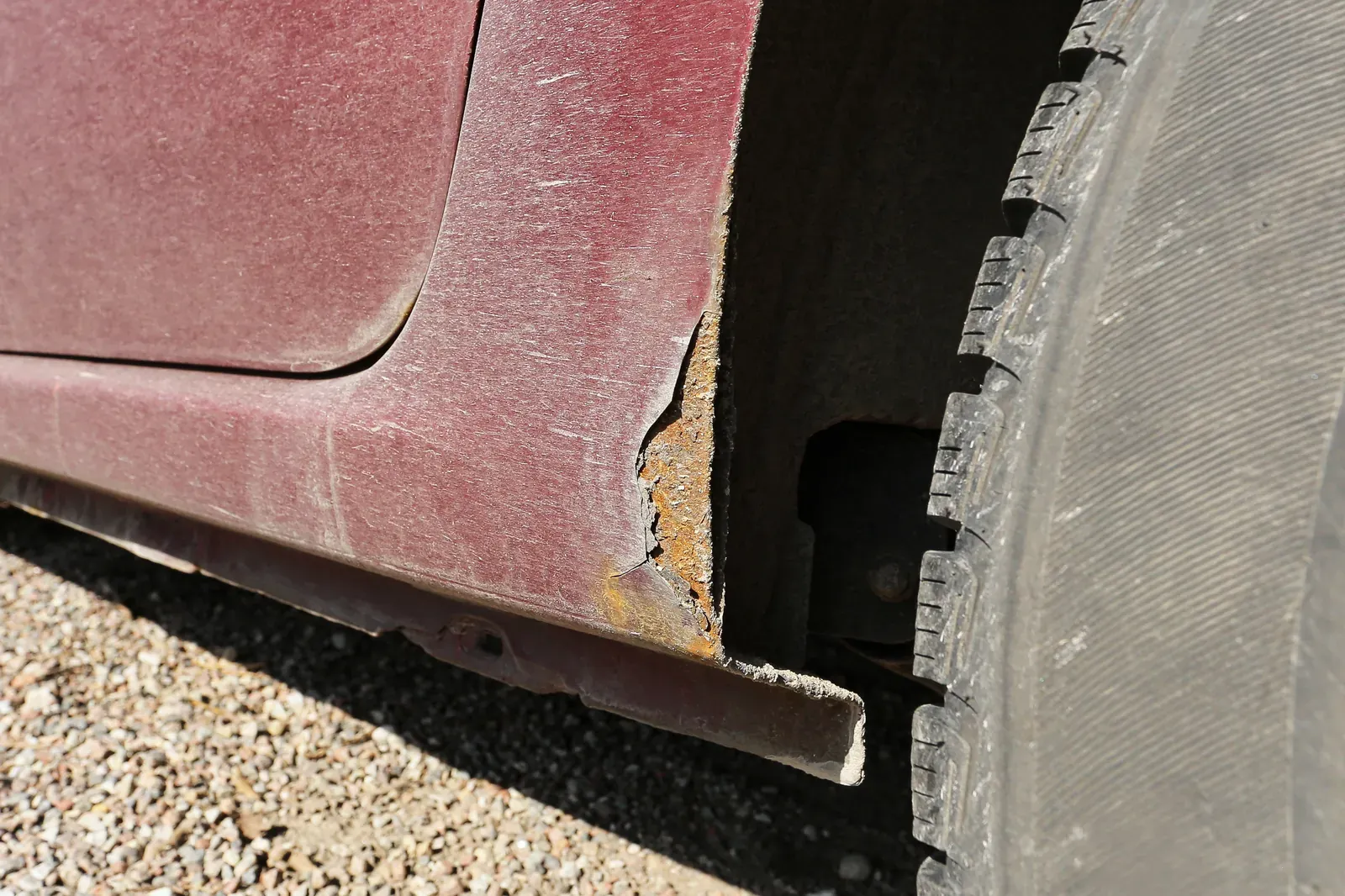
The question that comes before the repair
Oshawa keeps vehicles longer than most places in the region, so the rust conversation here is a genuine fork in the road rather than a formality. On one side: a work truck that is paid for, runs well, and has a bubble opening at the cab corner. Cutting that out and welding in new steel now is a small job that buys years on a vehicle costing far more to replace. On the other side: a small car with a rocker that flexes under a thumb and rot inside the arch when the liner comes out, which may be past the point where any honest repair pays for itself.
Photographs get you most of the way to knowing which you have: take them low and close, along the bottom edge of each door, into both rear arches, at the cab corners on a truck. Tap around each bubble and say where it sounds hollow. The answer comes back as one of three: cosmetic and worth fixing, structural and worth fixing, or a repair we would not take your money for. Better to hear the third one on the phone than after the drive.
Where the salt and the damp get in first
The 401 and Durham’s own roads are treated from November through April, and much of that treatment is brine rather than rock salt. Brine is a fine wet spray that climbs into rocker seams, sits behind arch liners and pools along the inside bottom lip of a door where nothing dries out for four months. Cars that sit outside all day — the harbour lots, the GO lot on Bloor, driveways without a garage — dry out slowly through the cold months, and steel that stays damp keeps corroding. Freeze and thaw from February opens the potholes, and the stone they throw chips the same low panels the brine is already working on.
The result is rust that grows from behind the panel outward, which is why it always looks smaller than it is. A blister at an arch lip has usually been working for two winters by the time it shows from standing height. Work trucks get it worst, salted once on the highway and once on the site. Cars that live at the curb in the older north end run a close second, with a plough windrow packed against the rocker melting and refreezing for weeks.
New steel, or it is not a repair
The only rust repair worth paying for removes the rust. A grinder takes the affected area back until there is bright, sound metal on every side of it. Where the panel has gone thin or perforated, that section is cut out and a new piece of steel is welded in and dressed flush. The cavity behind is treated with wax so the rot cannot restart from inside, the seams are sealed, and the panel is primed and sprayed in a colour tinted to the weathered paint, then faded upward so no edge exists. Filler skimmed over rust looks fine for a season and lifts the next spring, which is why it is not on offer here.
Scheduling is the easy part. No insurance policy in Ontario covers rust — it is wear, not damage — so there is no adjuster, no deductible and no rental on this job, and it gets planned around your calendar instead. Most Oshawa customers pick a week when a second vehicle can cover the commute. What people miss is the deadline: a perforated rocker fails a Safety Standards Certificate, which you need to licence a vehicle you are selling, and a bubble at a cab corner reaches the door pillar if it is left another two winters. Our estimator gives you the number of days from the photos so the week can be picked properly.
- Perforated rockers, arches and cab corners sectioned with welded steel, never filled over
- Cavity wax and seam sealer so it cannot come back from behind the panel
- Colour tinted to the aged paint and faded upward into the panel
- Booked around your calendar — no claim and no rental to wait on
Questions people ask
The rocker on my car is soft enough that a thumb dents it. Is the car finished?
Not necessarily, but that rocker is structural and it will fail a safety inspection. The rotten section has to come out and new steel has to go in, which is real work, so the question becomes what the vehicle is worth to you afterwards. If it is otherwise sound and you plan to keep it several more years, it is usually worth doing. If two or three other areas are at the same stage, we will say so.
Will my insurance company pay for any of this?
No. Rust is treated as wear and tear, and no Ontario auto policy covers it. The only exception is rust that formed because of a collision repair that was never sealed properly, which is a warranty matter with whoever did that work rather than a claim. The upside is that this job has no adjuster in it: there is nothing to approve and no deductible, so it moves at whatever speed suits you.
Is it worth spray-undercoating a truck that has already started to rust?
Not over active rust. Coating on top of rot seals moisture in and hides what is happening underneath, so the first surprise comes when a jack point folds. Get the rusted sections cut out and welded first, then treat the cavities and the underside, and an annual application on clean, sound metal genuinely does slow the next round down. Order matters more than product here.