The talk that belongs before the flatbed leaves
Structural work on a newer vehicle is a straightforward question — measure it, pull it, prove it. On a vehicle with a decade behind it, which describes a great many cars in this city, there is a question before that one: is it worth doing at all? Ontario sets no fixed percentage for a write-off. An insurance company compares what the vehicle was worth the day before the collision against what the repair costs plus what the salvage would return, and structural repair is not cheap. On an older car those two numbers land close together often enough that it should be discussed while the vehicle is still in Oshawa.
So we discuss it there. Send photos of the damage, of the wheel sitting in its arch from the front and the side, and of the panel gaps around the doors and hood, and our estimator will tell you plainly whether this is likely to be repaired or written off. If it is heading for a write-off, you have not paid for a tow to find that out and you can decide where you want the vehicle to sit while the claim runs. If it is repairable, the truck is booked and the rental is timed to your arrival. Either way the decision gets made with information rather than optimism.
What actually bends around here
Three things account for most of it. First, the 401 itself: a rear-end at highway speed near Courtice or Harmony folds the rear rails into the trunk floor and changes the shape of the trunk opening, which is why a lid that no longer latches is a structural symptom rather than a hinge problem. Second, winter on the roads north of the built-up city — black ice on Conlin, Winchester and the concessions past Raglan, where a wheel dropping off the edge at speed loads a whole corner sideways and pushes on the strut tower, the rail behind it and the subframe mount. The vehicle usually drives out of that. It does not always drive out square.
Third, the potholes. Freeze and thaw from February through April opens holes on Ritson, Simcoe and King that are deep enough to bend a control arm and nudge the mounting point it bolts to, and a hard strike against a downtown curb while reversing out of an angled stall does something similar to a rear corner. None of these look dramatic. All of them can move the structure by a few millimetres, and a few millimetres is the whole argument.
Bench, sheet, alignment, calibration
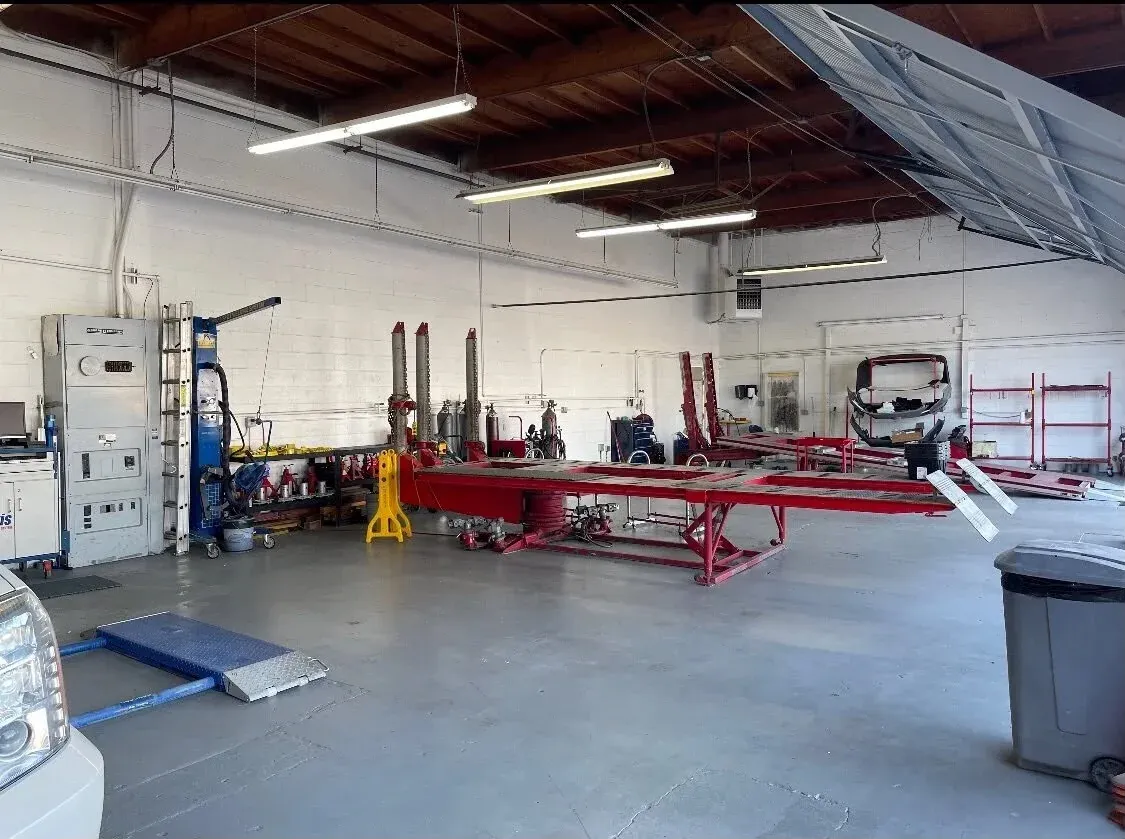
A vehicle with a shifted unibody rarely announces the fact. It drives. The steering wheel sits slightly off-centre after the alignment shop has done its best, a door needs a firmer push, the gap along one edge of the hood is wider than the other, an inner tire edge wears out in one season. Those are symptoms and not measurements. The only way to know is to put the vehicle on the bench and compare every factory reference point against the manufacturer’s figures, which produces a sheet listing each point and how far it has moved in millimetres.
That sheet drives everything after it. Clean sheet, and your problem is suspension and a cheaper week. Not clean, and the structure is pulled back in stages with a fresh measurement after each pull, finishing with a final sheet that matches the factory numbers point for point. Then the panels go on, the refinish is blended into the neighbouring panels, a four-wheel alignment is done, and any camera, radar or steering-angle sensor the procedure calls for is recalibrated — because a vehicle aimed straight before the collision has to be aimed straight after it. Both sheets stay in your claim file, which matters later if anyone asks what was done.
- Before-and-after measurements in millimetres, kept with the claim
- Structure pulled in stages on the bench, never eyeballed
- Alignment and driver-aid recalibration once the numbers are right, not before
- Total-loss conversation had at the start, while the vehicle is still in Durham
Questions people ask
How do I find out whether my car is a write-off before paying to tow it fifty kilometres?
Send photos before you book anything. Pictures of the damage, the wheel in its arch and the gaps around the doors and hood tell an experienced eye roughly how far the hit travelled into the structure, and that plus what the vehicle is worth today is usually enough for a straight answer. It will not be a guarantee, because only measurement is certain, but it is enough to keep you from spending on a tow for a vehicle heading to salvage.
Is a car with a repaired unibody as safe as it was before?
When it is measured, pulled back to the factory figures and re-measured, yes — modern structures are designed to be repaired to specification, and the sheets prove it was. What is not safe is a repair done by eye, or one where crumple-zone parts that should have been replaced were straightened instead. Ask for the measurement documentation from any shop, here or in Durham; a shop that cannot produce it did not do the work.
Do I have to tell a buyer about frame repair when I sell the car privately?
You have to be truthful about what you know, and a private sale requires a UVIP, which shows liens, registration history and any salvage or rebuilt brand — and most buyers pull a vehicle-history report on top of it, so hiding it rarely works anyway. Repaired structural damage does reduce resale value, which is a real cost of the collision rather than a repair failure. Keeping the measurement sheets and the repair invoice helps considerably — documented, measured work reassures a buyer far more than a vague answer.