The lots that supply the work
Oshawa Centre fills from the doors outward, so the far half of every row is where cars end up nose to tail with nothing between them, and Saturday afternoon in that half is a reliable source of door dings and cart dents. The downtown core is a different mechanism entirely. The angled stalls around King and Simcoe put you reversing blind into moving traffic, usually past something tall, and the contact when it comes is a bumper corner or a swinging door meeting your rear quarter at walking speed. That leaves a soft, shallow, hand-sized dent, very often with the paint completely intact — which is the best possible news for the repair.
The Tribute Communities Centre adds its own pattern: a few thousand people leaving surrounding lots inside the same ten minutes, all of them reversing at once. Down at Lakeview Park in summer the hazards are trailer tongues and gravel edges, and up at the plazas along Taunton the vehicles are simply bigger — tailgates, running boards and mirror housings all sit at exactly the height of somebody else’s door.
Campus cars and cars that sleep at the curb
Simcoe Street North is its own category. The student lots serving Ontario Tech and Durham College hold rows of older, closely parked cars for a full day at a time, and the dent that turns up there is usually anonymous — no note, no witness, discovered at four in the afternoon. Because those cars are older and often owned outright, the question is rarely whether the dent is perfect afterwards and almost always whether it can be dealt with cheaply and without paint.
In the older north-end neighbourhoods the driveways were poured one car wide, so the second and third vehicle in a household lives at the curb. A car parked on the street collects a different set of marks: mirror strikes from vehicles squeezing past on a narrow road, a crease along the driver’s door from someone opening theirs, and in winter the shoulder of a plough windrow packed hard against the rocker. None of that is a collision, none of it is going to a claim, and all of it accumulates until somebody decides to deal with the lot in one go.
Pushed out, filled, or honestly not worth the drive
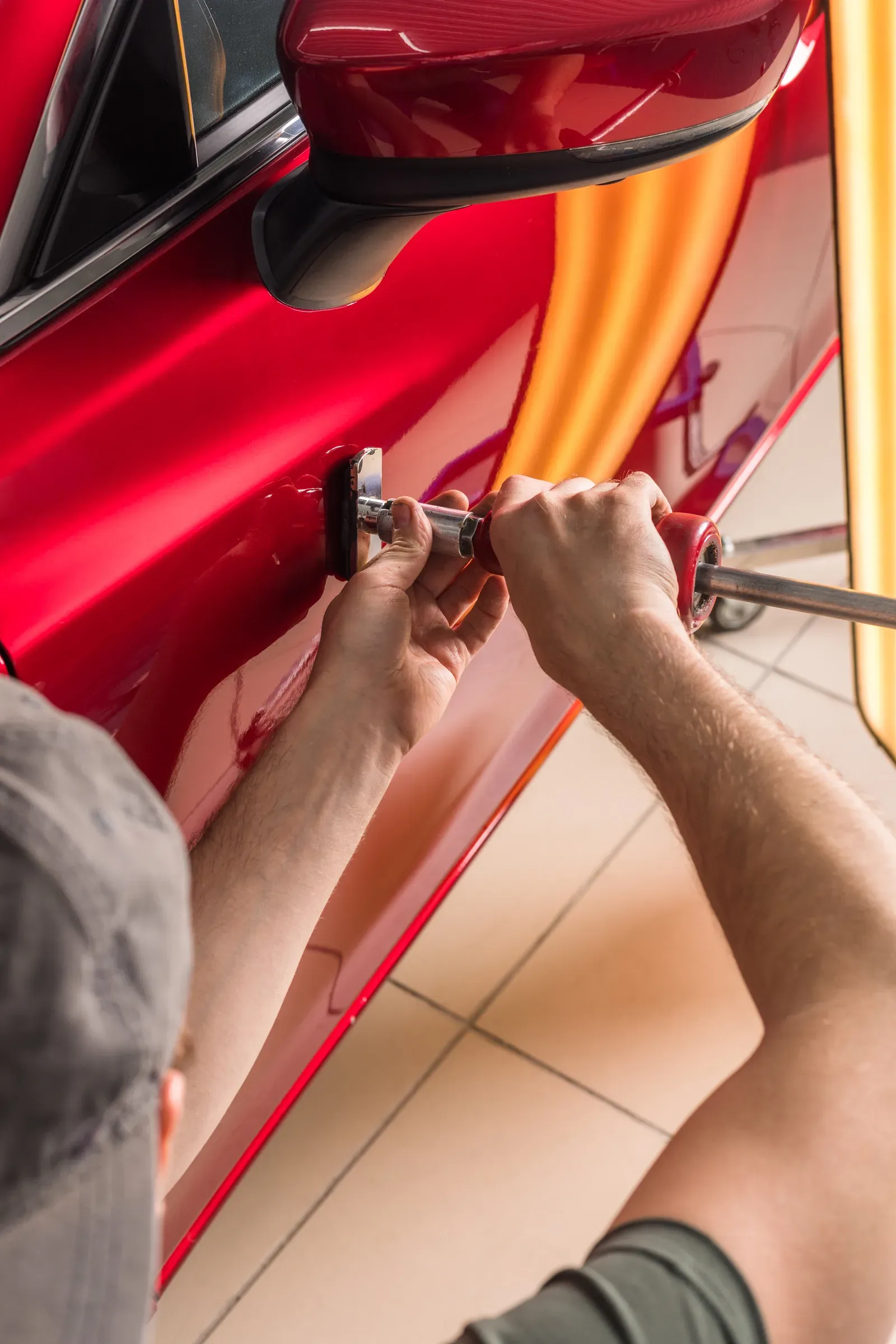
The method depends on one thing: whether the paint survived. Where it did, and where a tool can reach the back of the panel, a striped light board goes over the damage and the metal is pushed back in small increments until the stripes run straight again. Nothing is sprayed, the factory finish stays where it is, and the work is often finished the same day. Where the paint has cracked, where the dent sits on a body line, or where the metal has been stretched into a sharp crease, it becomes filler and refinish with a blend into the panel beside it. Photograph dents from a low angle so the light bends across them rather than head-on, and our estimator can usually call it from the pictures.
Then the part that decides the trip. One small dent is not worth a hundred kilometres of round trip, and we would rather tell you that than watch you spend a morning on the 401 for it. What makes the drive make sense is volume — the parking lot ding, the curb-side crease, the tailgate dent from the hitch, priced and done together in one visit. Send photos of every mark you would fix if you were fixing anything, and you get one list back with a number beside each line so you can choose where to stop.
- No paint and no blend when the finish is unbroken and the panel can be reached from behind
- Filler and refinish once the paint has cracked or the dent crosses a body line
- Replacement recommended when straightening a creased skin would cost more than a new one
- Several dents quoted as one job so the trip is made once
Questions people ask
A cart rolled into my door in the Oshawa Centre lot. Claim it or pay directly?
Pay directly, almost always. A single cart dent with the paint intact comes out for less than most deductibles, and putting a claim on your record for it helps nobody. Keep the claim for damage that genuinely needs one. If the cart cracked the paint or the dent sits on the crease line of the door, send a photo and our estimator will price it both ways before you decide.
My pickup has an aluminum tailgate with a dent in it. Can that be pushed out?
Sometimes, but it behaves differently from steel. Aluminum does not stretch and return the same way, it work-hardens faster, and it usually needs heat and a slower, more patient push, so the panel has to be a good candidate to start with. A shallow, round dent in a flat area is workable; a sharp crease at the edge often is not. Send one photo straight on and one from the side along the panel.
There are three or four dents on an eight-year-old car. Is it worth doing anything at all?
Depends what you want from the vehicle. If you are keeping it, deal with any dent where the paint has cracked, because that is where rust starts, and leave the rest if they do not bother you. If you are selling, a car with a straight side sells faster and for more than one that looks knocked about. Photos of each mark get you a line-by-line list and you pick.