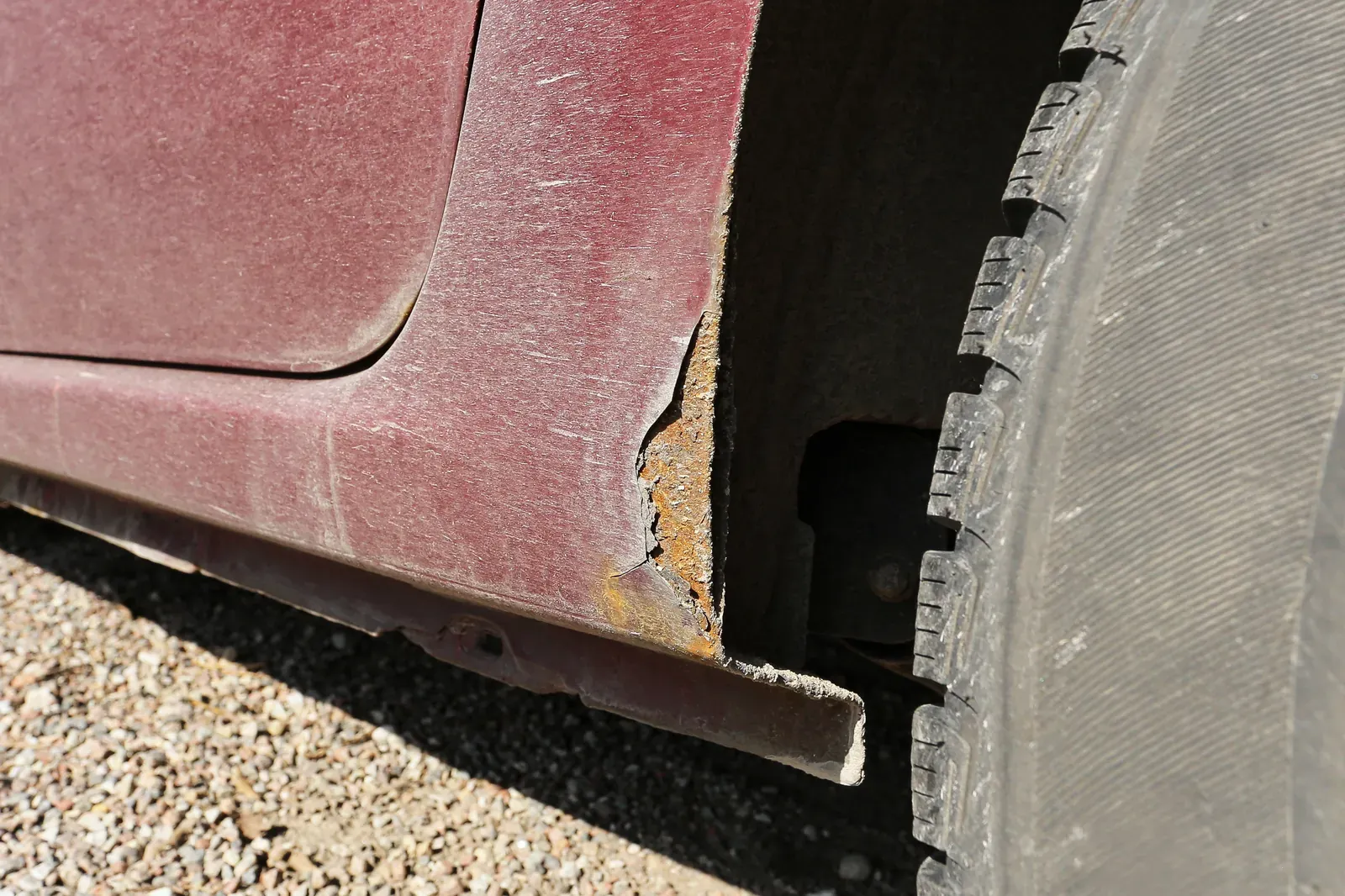
The repair nobody’s policy covers
Rust is the one job that arrives without a claim number. Corrosion is wear, not an event, and no collision or comprehensive policy in Ontario pays for it — which changes the conversation from the start. There is no adjuster, no deductible, and no fault. There is a car, a photo of a bubbling rocker, and a decision about whether the metal is worth the money. So the estimate we write for rust is the whole story, not a starting number: what is bubbled, what is perforated, what is hiding behind paint that still looks fine, and what each option costs relative to what the car is worth to you.
The honest answer is sometimes no. A rocker that has gone through on both sides of a car that also has a rotted subframe is not a body repair; it is a conversation about the car’s future, and we will have that one rather than sell you a cosmetic patch that fails by spring.
Brine outside, warmth inside
The core rusts cars faster than the suburbs for two reasons. The first is what goes on the road: downtown streets are treated with liquid brine ahead of snow and salt behind it, so the slush a car throws into its own wheel arches on Lake Shore is saltier than what a driveway in Scarborough sees. The second is where the car sleeps. A warm underground garage at CityPlace or beneath a Bay Street tower keeps that slush liquid all night, and salt water at a comfortable temperature corrodes steel far faster than frozen salt on a cold driveway. A car driven twice a week and parked wet underground is the worst case we see.
The damage shows in a fixed order. Bubbles along the bottom edge of a door where the drain holes clogged. The rocker behind the front wheel, where the arch throws slush straight at the seam. The rear wheel arch lip. The dogleg ahead of the rear wheel. By the time paint lifts, the metal beneath has been going for a year or more, and what looks like a coin-sized bubble is usually a hand-sized hole under the sander.
- Door bottoms: clogged drains, rust from the inside out
- Rockers behind the front wheels: the first seam to go
- Rear arch lips and doglegs: slush and salt trapped in the fold
- Warm underground garages speed all of it up
The hole you can see is smaller than the repair it needs
A rust repair that lasts starts with cutting. Surface rust that has not perforated is ground back to bright steel, treated, primed, and refinished. Rust that has gone through is cut out past the visible edge, because the corrosion always extends further than the hole, and new steel is welded in — a patch on an arch lip, a full rocker section where the seam is gone. Welds are dressed, seams are sealed, and the inside of the panel gets a cavity coating so the same slush cannot start the process again from behind.
Then the panel is refinished like any other: primed, blocked, colour matched to the weathered paint beside it, blended into the neighbouring panels, and covered by the lifetime warranty on the refinish. The right time to do this is before winter, when the car comes up the DVP dry. Send photos of every bubble, and one of the underside if you can, and our estimator will tell you what is cosmetic and what is structural before you decide.
Questions people ask
The rust bubbles on my rocker are still small. Is grinding and repainting enough at this stage?
Only if the metal underneath is still solid, which is rare once bubbles appear. A bubble is paint lifting over corrosion that started from inside the panel, and sanding usually opens a hole. The lasting fix is to cut past the rot and weld in new steel; a sand-and-paint patch tends to bubble again within a winter.
My car lives in a heated condo garage. Why is it rusting faster than my parents’ car in a driveway?
Because it never freezes. Salt slush that stays liquid at garage temperature keeps corroding steel all night, every night, while the same slush on a cold driveway freezes and stops. Rinsing the wheel arches and rockers after a salted drive, and letting the car dry before it goes underground, slows it noticeably.
Is rust-proofing still worth doing on a five-year-old car that parks under a CityPlace tower?
Yes, with one caveat: rust-proofing slows corrosion that has not started, and it does nothing for metal that is already bubbling — spraying over an active spot only hides it while it spreads. Repair what has started first, then treat the clean car, and rinse the arches and rockers after salted drives before the car goes back underground. In that order, the treatment earns its cost.