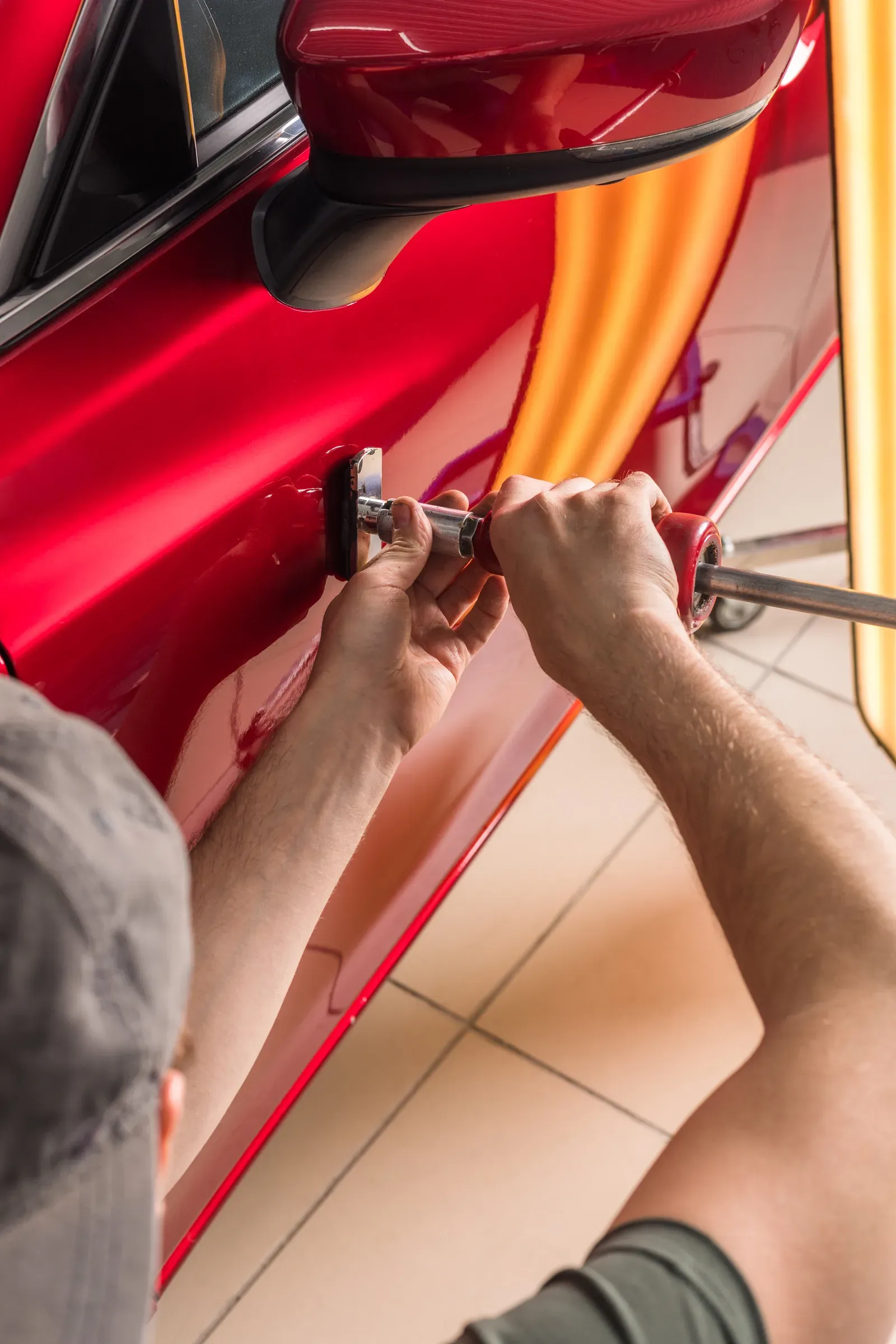
Working the metal back, not painting over it
A dent with unbroken paint is a shape problem, not a finish problem. The panel is reached from behind — through a window opening, a wheel well, a light socket — and the metal is pushed back in hundreds of small movements while a reflection board shows exactly where it still sits low. Done properly, the factory paint stays, the panel reads flat from every angle, and nothing about the car has changed except its shape. Where the paint has cracked, the dent sits on a sharp body line, or the metal has stretched too far, the honest repair is conventional: work the metal, fill, prime, refinish, and blend.
The photos decide which path you are on. Take one from straight on, one from a low angle so the reflection breaks across the dent, and one of the whole panel. Our estimator reads those and tells you whether it is a paintless job, a refinish job, or a case where a replacement door skin costs less than either.
- Paintless repair where the paint is intact — no colour work at all
- Conventional repair and refinish where the paint has broken
- Panel or skin replacement only when it is genuinely the better fix
- Photo estimate first, so you know the path before you drive
Where the core puts dents
The single biggest source is the underground garage. CityPlace, the Waterfront towers, the Bay Street office garages: pillars set for the cars of twenty years ago, ramps that turn tighter than a modern crossover wants to, and a neighbour’s door that opens into your rear quarter because the stall is a hand’s width narrower than the car. Next is the street. A Kensington Market delivery van that backs up Augusta by feel, a shopping cart on a slope at a Front Street grocery, a bike lock swung against a fender on College — each leaves a round dent in a door or a soft crease in a quarter.
And there is a downtown-only classic: the boot-shaped dent low on a door where someone kicked it, or a bag of road salt set down on a hood. These are almost always paint-intact dents in thin, accessible metal, which is exactly what paintless repair was designed for. The ones that hurt are the creases along a door’s swage line from a planter on the King Street corridor — the metal is stretched, the body line is gone, and that is a refinish.
Deductible first, then decide
A single dent is the repair most likely to sit right at the claim-or-cash line. A paintless job on one door often comes in under a typical deductible; a crease that needs refinishing across two panels usually does not. So we put a written number beside your deductible before anyone decides. If another driver dented the car and left a note, DCPD means your own insurance company covers it under the Fault Determination Rules. If nobody left a note in the garage, it is usually your collision coverage with your deductible — and worth asking whether the building’s cameras caught it.
Car-share members get one more step: the operator will want its own damage report, and our estimate should match what you told it. Rideshare drivers get the opposite problem — a door dent is not worth a day off the road, so we book paintless work in a single block and the car is often back the same day it arrives. Either way the trip is one highway, about 20 to 35 minutes up the DVP, and a rental through your coverage is timed to your drop-off if it turns into a longer job.
Questions people ask
The dent from a garage pillar is on my rear door and the paint is not cracked. Does it really need no paint?
If the paint has not broken and the dent is not on a sharp body line, usually no. The panel is worked from behind until it reads flat under a reflection board, and the factory paint stays. Send a photo from a low angle so the reflection crosses the dent and we can confirm it qualifies.
The car came back from a week on P2 near Union Station with a door ding and no explanation. Is there any point claiming it?
Rarely, for one ding. With no identified driver it runs under your own collision coverage with your deductible, and a single-ding repair usually costs less than that deductible. Photograph the dent and the stall, ask the garage about camera footage in case a driver can be identified, and send us the pictures — the written number settles it.
How quickly can a paintless dent be done on a rideshare car?
Often within the day it arrives, because there is no paint to cure. Tell us it is a working car when you send the photos and we book the job as one uninterrupted block, so you drop it off in the morning and are back downtown for the evening rush.