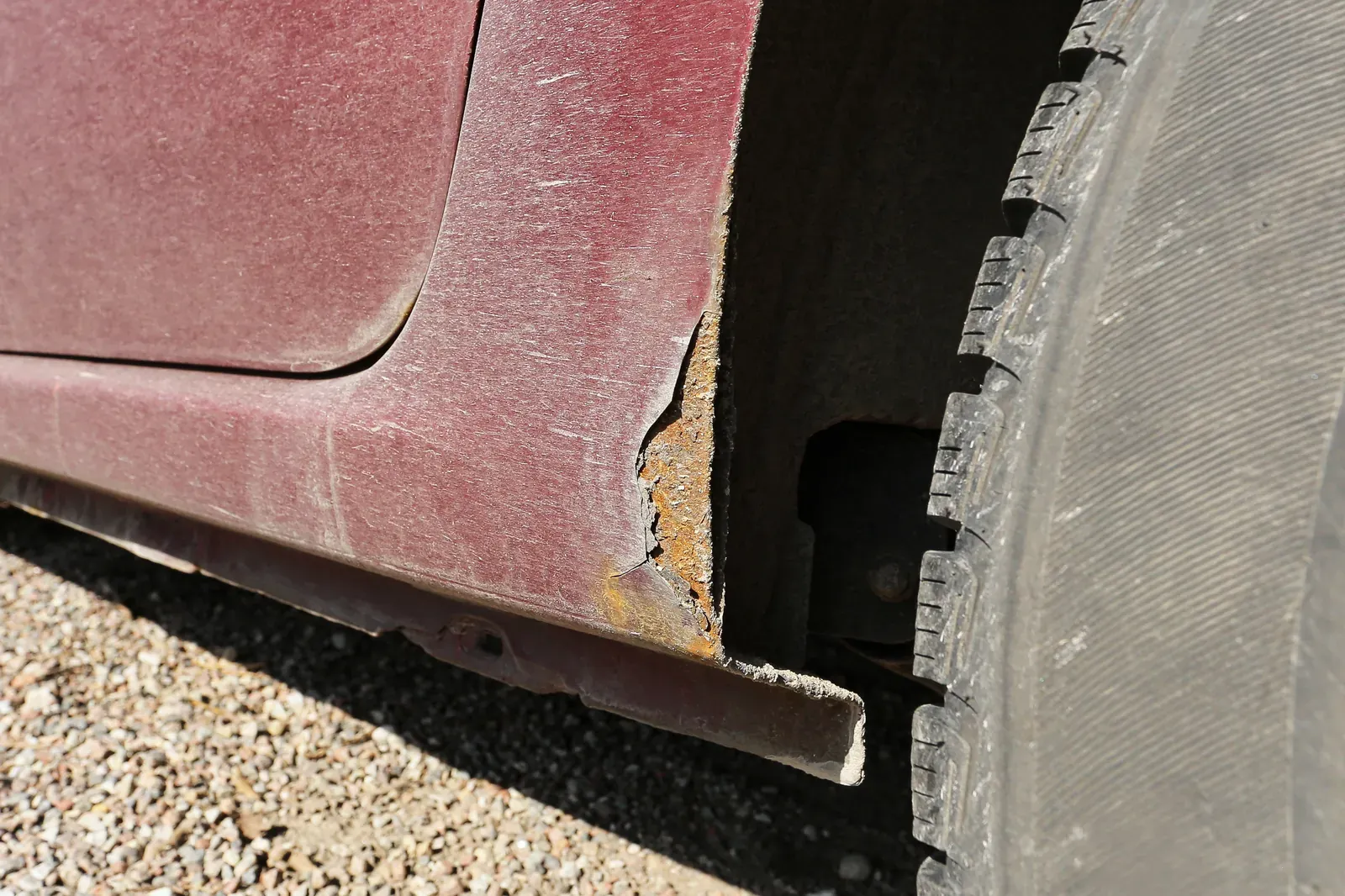
Two Stouffvilles, two kinds of rust
Drive Main Street from the tracks east and the cars change. The farm properties and the older streets around the core, Ballantrae and the lake still run pickups and sedans that have seen twelve winters, and those come with the rust everyone recognises: rockers rotted from the inside, cab corners gone soft, arches with a hole you can put a finger through. Cross Ninth Line into the subdivisions off Hoover Park and Millard and almost nothing is older than the houses — but the rust is there too, in an earlier form. Gravel on the concessions has scoured the clear coat off the lower doors and rockers, the first salted winter on the 404 got into the bare spots, and by the second spring there is a bubble at the rear arch on a car that still has years of payments on it.
The old kind is a sectioning job. The early kind is a stop-it-now job, and it is far cheaper to do at a bubble than at a hole.
Gravel first, then salt: why Stouffville rusts from the bottom up
Toronto cars rust because of salt. Stouffville cars rust because of gravel and then salt. The lanes around Musselman’s Lake, the concession roads north of Bloomington and the unpaved shoulders of Highway 48 throw stone at everything below the door handles, and every chip is a hole in the clear coat waiting for brine. Then the commute delivers the brine — the 404 south to Sheppard every morning from December to April, spraying the rockers, the lower doors and the seam where the fender bolts on, with the underside never drying in February. Construction traffic in the new subdivisions adds one more: the dust and stone from every dump truck on Main Street settles on the same lower panels.
We cut rust out; we do not cover it. Bubbled paint is ground back until clean metal shows, and where the metal is thin or perforated the section is cut out and new steel welded in. Seams are sealed, the inside of the panel is treated, and the outside is primed and refinished to your colour, blended into the panel above it. Filler skimmed over rust returns within a year, so we do not do it.
- Surface rust and bubbles taken back to bright metal before primer
- New steel welded into rockers, arches and cab corners that have gone through
- Inside of the panel treated and every seam sealed ahead of primer
- Colour blended upward into the door or quarter so the repair is invisible
No adjuster, but a deadline of your own
Rust never goes through insurance — it is wear, and no Ontario policy covers it — so a Stouffville rust job is planned around your calendar rather than an adjuster’s. That calendar has a few fixed dates. A lease on a subdivision SUV ends and the inspector charges for the bubbled arch. A private sale needs a UVIP and a Safety Standards Certificate, and a perforated rocker fails the safety. A farm truck you want to keep another five years costs less to fix at the first bubble than after the rocker lets go.
Send photos of every spot, including under the doors, behind the rear wheels and along the rocker seams, and our estimator will tell you which are cosmetic and which are structural. The car stays a few days for cutting, welding, sealing and cure. Because there is no claim and often no rental, this is the job Stouffville customers most often pair with the GO line from Agincourt, a short ride east along Sheppard — drop the car, ride home, ride back when we call.
Questions people ask
Gravel took the paint off the bottom of the doors and now there are brown spots. Is that rust repair yet?
Just barely, which is the good time. Brown spots on gravel-scored panels are surface rust in the chips, not perforation, so the panel is sanded back to clean metal, primed, and refinished with the colour blended upward. Wait a winter or two and the same panel needs steel welded in.
The pickup has twelve winters on it and the rockers are going. Is there any claim to make, or is this all on me?
It is on you — rust is wear and tear, and no Ontario policy covers it. The one exception is rust breaking out at an earlier collision repair that was done badly, which is a warranty conversation with whoever did that work. If the earlier work was ours, it falls under our lifetime paint warranty.
I am selling the farm truck privately. Does the hole in the rocker have to be dealt with first?
If the buyer wants it certified, yes. A perforated rocker usually fails the Safety Standards Certificate inspection because the rocker is structural, and selling without a certificate shrinks your market to project-truck buyers. The repair is to cut the rotten section out, weld in new steel, seal it and refinish. Send a photo of the hole and one of the whole side, and we will tell you how much of the rocker needs replacing.