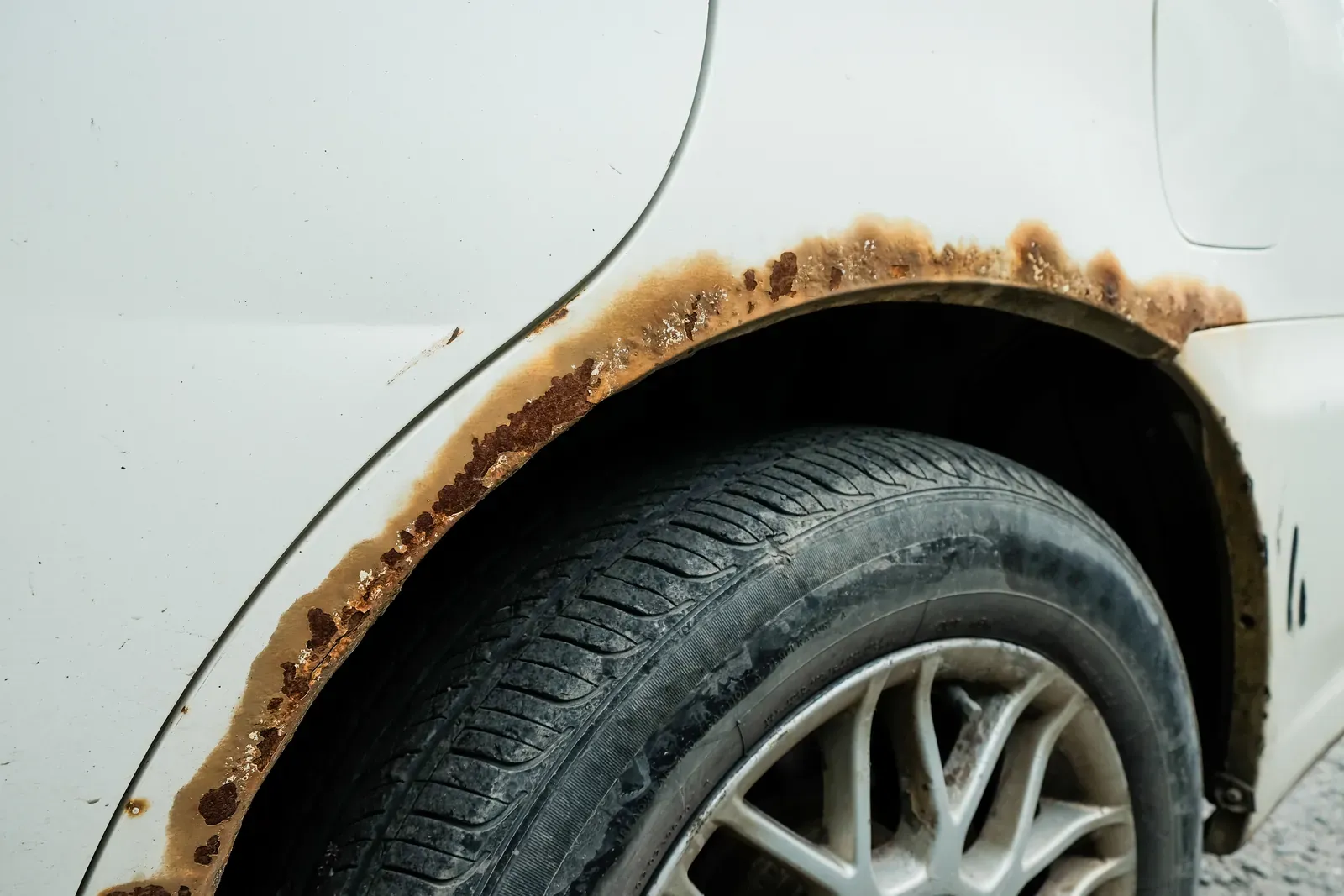
Salt season on the open roads north of Major Mackenzie
Maple gets more salt than most of the GTA because its roads need it. Teston, Dufferin and the concession roads between the subdivisions run open to the wind, drift over in every storm, and get brined before the snow and salted after it. That mixture packs into the lip of the arches and the seams of the rockers and stays wet for weeks after the road is dry. The freeze-and-thaw of February and March pulls it deeper. By the time the ploughs are parked, the rust that started in December has been working under the paint for four months.
It shows in April. The first warm wash lifts a line of bubbles along the rear arch, or a driver crouching to check a tire notices the rocker below the door has gone soft. On the older village streets around the GO station the cars are old enough that this is expected. On the newer streets off Rutherford it surprises people, because the car is only six or seven years old, but a vehicle that spends every winter night on the driveway rusts on the same schedule as the older one.
Where Maple cars rust first, and what is done about it
Rockers and rear wheel arches lead, because they take the spray and hold the slush. The dogleg ahead of the rear wheel and the bottom of the doors follow. The pickups from the Teston sites add the tailgate seams and the cab corners, and any hood chipped by gravel will rust from each chip outward if the chips are not sealed. Bubbles are the rust you can see; behind every one of them the metal is thinner than it looks, and paint sprayed over bubbles lifts again within a season.
So the repair starts by cutting. The rotten steel is cut back to clean metal, and a new section, either a manufacturer panel or a fabricated patch for a rocker, is welded in and ground flush. The seams are sealed, the inside of the panel is treated so the rust does not restart from behind, and the outside is primed, refinished and blended into the neighbouring panels so the arch matches the door and the door matches the quarter. On a rocker under a pickup the finish is a heavy protective coating rather than a mirror, because that is what the factory used.
- Rot cut back to clean metal, never ground and filled over
- New steel welded in at the arch, rocker, dogleg or cab corner
- Seams sealed and the cavity treated from inside
- Refinished and blended, or coated to match a factory rocker
When to bring it, and how long the car is away
Spring and summer are the season for this work, because the salt has stopped and the car will not go straight back into it. A single arch is usually a few days; both rockers and an arch can be a week or more, since welding, sealing and refinishing each need their own time. Rust is not an insurance claim, so there is no rental through a policy for it, and most Maple households solve that with the second or third car in the driveway. A second driver following you down the 407 or Major Mackenzie makes the drop-off one trip.
The honest conversation happens before any of that. Rust work is paid for directly, and our estimator will tell you from the photos whether the car justifies it: a well-kept ten-year-old SUV with one bubbling arch usually does, while a fifteen-year-old sedan with both rockers gone and the floor going soft usually does not. When it does, the repaired panel carries the same lifetime warranty on its refinish as any other paint we do, and the rest of the car gets a look underneath.
Questions people ask
My pickup works on Teston all winter. How do I slow the next arch down?
Keep the drain holes at the bottoms of the doors clear, rinse the arches and rockers whenever February gives you a mild day, and have stone chips sealed the same season they happen, because on a Teston truck every chip is where the next rust starts. A fall cavity spray buys more time. None of that shrinks a bubble that already exists — that still gets cut out.
Can the arch repair and the gravel-chipped hood be done in one visit?
Yes, and it is usually cheaper together, because the car is masked, primed and in the booth once instead of twice. The arch is cut and welded first, then both repairs are refinished in the same session. It also means one stretch without the car instead of two.
Is my older car from the village side of Maple worth rust work?
Sometimes. If the mechanicals are sound, the rockers and floor have not gone soft, and the rust is confined to an arch or a door bottom, it is usually worth doing and the car will pass a safety inspection more easily afterward. If the structure is rotting, the money is better spent elsewhere, and our estimator will say so from the photos.