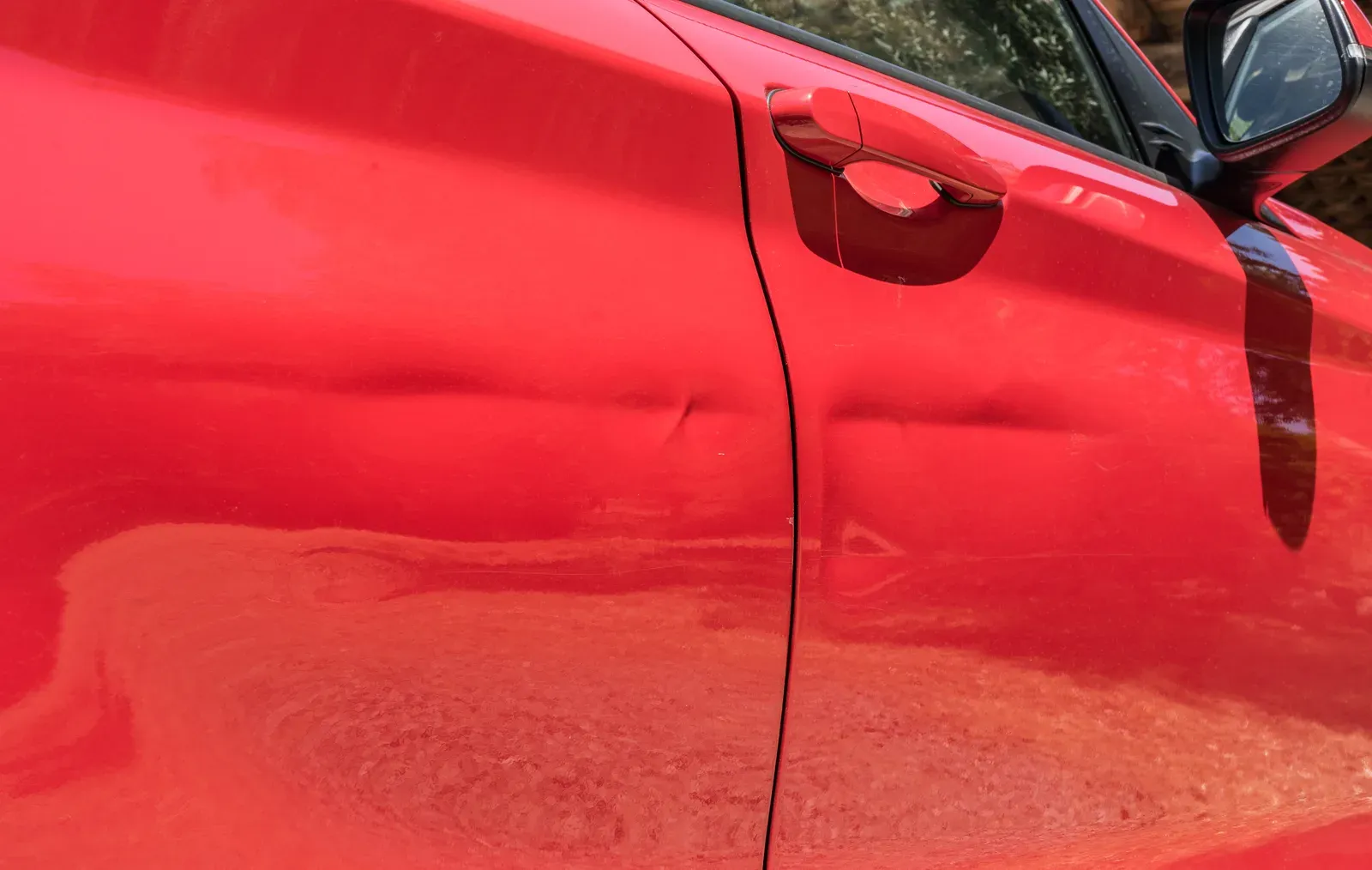
Three rollers, three tracks, and one door that has to agree with all of them
A sliding door is closer to a drawer than a hinged door, and a bend anywhere along its rails changes how it travels. The door hangs from an upper roller arm running in a channel along the roof edge, a lower arm running in a channel in the floor sill, and a centre or rear hinge arm running in a track built into the body side, usually hidden under a trim strip below the rear side window. As the door opens, all three pull it outward and then slide it back along the van.
Every track is a formed metal channel attached to the body. That means a dent in the quarter panel behind the door, a hit to the rocker below it, or a scrape along the roof edge can push its channel out of line even when the door skin itself is untouched. The door then rides up, drags, or pops out of the track at one point in its travel. A dent on the door skin, in contrast, can be a purely cosmetic job if it sits in the middle of the panel.
This is the difference between sliding-door damage and an ordinary door ding. A shallow ding in the flat of the door can be removed without touching the mechanism. A dent that lands on a track, a roller bracket, the latch or the rear edge of the opening is a functional repair first and a paint job second.
Why a small dent near the rear roller stops a power door working
Power sliding doors are watching for resistance, and a bent track feels exactly like a child’s arm in the way. A motor and cable drive pull the door along the centre track, and the control module compares how hard it is working with how hard it should be working at that point in the travel. When the effort spikes, the system assumes an obstruction and reverses the door. That is the anti-pinch feature doing its job.
So the typical complaint after a quarter-panel hit is not a stuck door. It is a door that opens fine, closes most of the way, then bounces back open near the end, or one that chimes and refuses to latch. The damage might be a crease no longer than a hand just behind the door opening, sitting right where the centre track runs inside the body.
Pushing the door shut by hand to get home is fine. Forcing it repeatedly can strip the drive cable or damage the motor, which turns a body repair into a parts order. If the power door misbehaves after a hit, switch it to manual mode where your van allows it, close it gently, and leave the diagnosis for the shop.
- Reverses near the end of travel — centre track bent or rear roller binding
- Rubs or squeals along the sill — lower track pushed up by a curb or windrow
- Door sits proud at the top rear corner — upper track or roller arm out of line
- Will not release from the latch — latch actuator or cable affected by the impact
School lots, plaza stalls and plow windrows bend minivan tracks
Most sliding-door damage we see comes from parking, not driving. Minivans in North York and the 905 live in school drop-off lines, daycare lots, hockey arena parking and condo garages, and each one leaves a recognizable mark. The tight angled stalls in a busy plaza lot are where the opened sliding door gets clipped by a passing car, or where a pillar catches the door at full travel and bends it outward beyond its stop.
Winter adds two more. A snow windrow left by the plow at the end of a Scarborough or Markham driveway can scrape the rocker and push up the lower track when the van is backed over it. And in a hard freeze, slush packed into the lower track turns to ice; a power door forced against that ice can jump a roller or overload the motor. Clearing the sill channel before opening the door on a cold morning prevents a surprising number of repairs.
The third pattern is the parked hit: another car backs into the side of the van at the quarter panel. On a sedan that would be a dent and refinish. On a minivan the same impact lands on the centre track, which is why the estimate looks bigger than the dent.
How the track, the door and the finish are put right
The order matters: structure, then fit, then paint, then electrics. We remove the trim that hides the centre track and inspect all three channels and the roller arms. A track that is only displaced can often be straightened through the panel repair. A track that is kinked or cracked is replaced, and on some vans that involves sectioning part of the quarter panel, which is why quarter damage behind a sliding door takes longer than the same dent on a fender.
With the body straight, the door is hung and adjusted at the roller brackets and striker until the gaps match front and rear, the door sits flush with the body, and it closes without a slam. The weatherstrip contact is checked, because a door that is a few millimetres out will whistle at highway speed on the 404 and may let water into the floor in a spring storm.
Then the panels are refinished, with the colour blended into the neighbouring door or quarter so the long side of the van reads as one surface. Finally the power door system is re-initialized, its travel limits relearned and the obstruction detection tested several times. A door that reverses correctly against a soft object at the closing edge is the last box ticked before the van goes home.
Model-specific track parts set the timeline, and who hit the van sets the claim
Track and roller parts are specific to the model, the year and sometimes the trim, so parts availability shapes the timeline more than labour does. Where the photos already show a kinked track or a broken roller arm, our estimator can flag the part at the first look so the order is not left until teardown; hidden damage behind the trim may still add a supplement once the panel is open.
If another identified driver hit the parked van and is insured in Ontario, the damage normally goes through DCPD with your own insurance company. If the van was hit and the driver left, there is no DCPD: it is claimed under your own collision coverage with your deductible, rated not-at-fault, and it needs a report made promptly at the nearest Collision Reporting Centre or with police.
Questions people ask
Is it safe to keep driving the van if the power sliding door won’t close by itself?
If the door closes and latches fully by hand and the dash shows it shut, short trips are generally fine. If it will not latch, do not drive with it held shut by a strap or the motor. Switch the door to manual mode where possible and have it checked.
Why does a dent behind my minivan’s sliding door cost more than the same dent on a car?
Because the centre track the door runs in is built into that panel. The repair has to restore the track as well as the shape, sometimes by replacing it, and then the door is re-aligned and the power system relearned. That is more work than a dent and refinish.
My sliding door squeals along the bottom since I backed over a snowbank. What happened?
The lower track or the rocker under it was probably pushed up, so the bottom roller is scraping its channel. It is usually repairable without replacing the door. Have it looked at before the roller wears through or the door jumps out of the track.