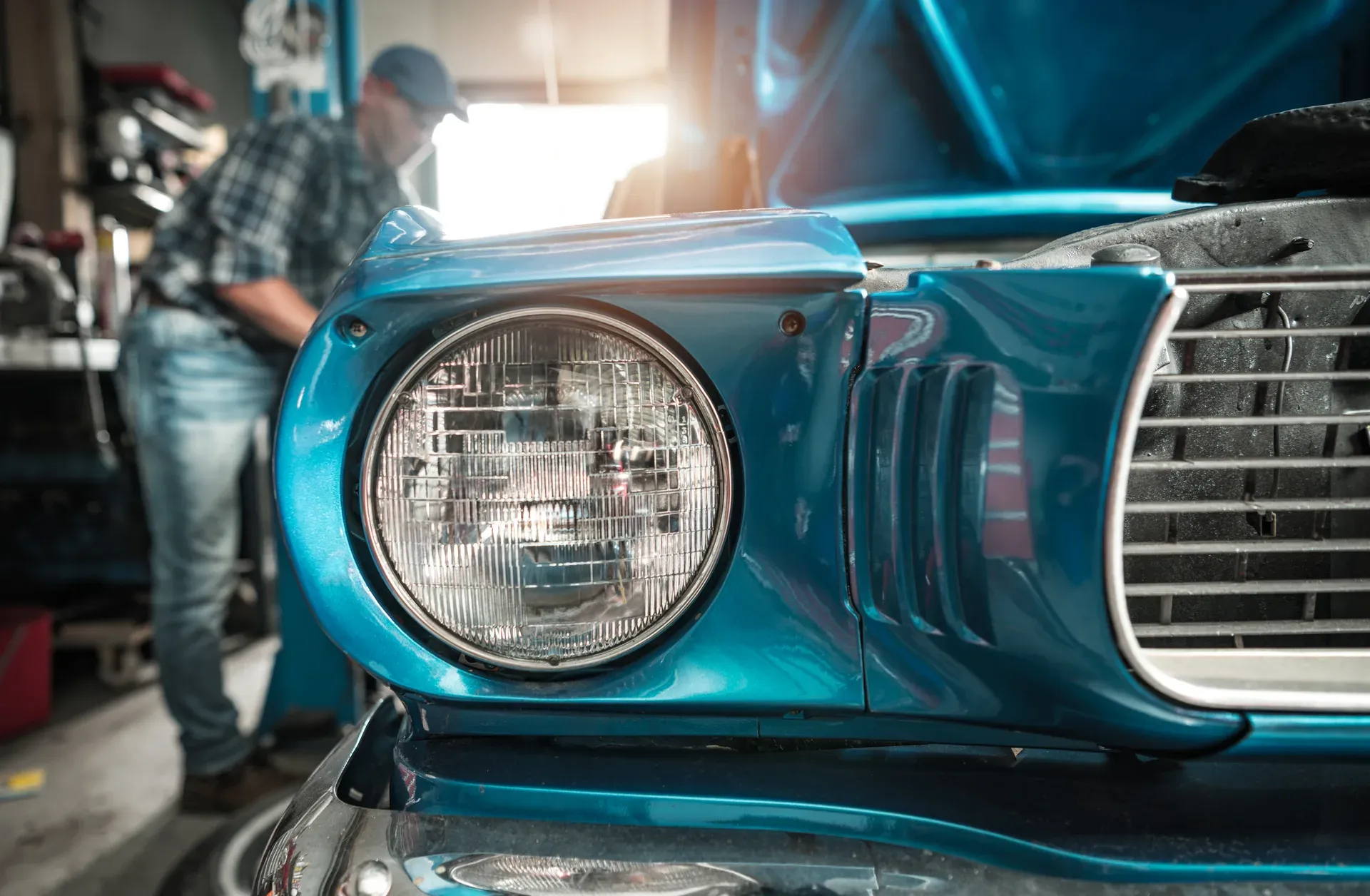
First find out which paint system is on the car
Before any quote, the painter needs to know whether the car wears single-stage colour or a basecoat with clear over it. Most cars built until roughly the late 1980s left the factory in single-stage paint: one layer where the pigment and the gloss are the same film. Modern cars use a thin colour coat protected by a separate clear, and most advice about blending a panel assumes that modern system.
A dab of polish on a hidden spot tells you without harming anything. Work it into an inside edge of the door jamb or under the trunk lip with a pale rag; colour transferring to the rag means the pigment is the top layer, so the paint is single-stage. No colour means a clear sits over it. The car may also have been repainted at some point, so the answer on the doors can differ from the answer on the hood.
It matters because single-stage paint ages differently. The pigment itself oxidizes and chalks, so the colour on an original panel has drifted, sometimes a long way. Metallic single-stage finishes are harder still, since there is no clear to even out the flake. Blending new single-stage colour into an aged original panel is possible but less forgiving than a basecoat blend, and a large repair often means refinishing to natural break lines such as a full fender or door instead of fading into the middle of a panel.
Lead, thick filler and old repairs hiding under the paint
On an older car you are often repairing a previous repair, and nobody knows its depth until the paint comes off. Factories once used body solder, a lead-based filler, to smooth seams around roof pillars and quarter panels, and older shops used it for repairs well into the era of plastic fillers. Later decades left their own layer: polyester filler applied far thicker than it should be, sometimes over rust or over a dent that was never pulled.
Lead is the one to respect. Grinding or sanding it creates hazardous dust, so a careful shop identifies it before power tools touch the panel and removes or works it with heat, extraction and protective equipment instead of a dry sander. If your car has original leaded seams in good condition, the best decision is often to leave them alone and work around them.
Thick plastic filler tells a different story. A magnet that barely grips, a panel that sounds dull when tapped, or cracking in a spiderweb pattern all suggest filler hiding a deeper problem. The honest way to quote this is in stages: strip the area, see what is underneath, then confirm the scope with you before committing to the rest.
- Pigment on the rag after a dab of polish in the jamb — no clear on top
- Fine cracking or a ring pattern on a flat panel — filler shrinking underneath
- A magnet that slides or barely holds — filler thicker than it should be
- Bubbles along the lower edges or behind trim — rust coming through from inside
When the part you need was discontinued decades ago
For a modern car, a damaged fender is a part number and a delivery. For a classic, sourcing is often the longest step in the job, and the options trade cost against originality. Popular collector models have a reproduction sheet-metal industry behind them: new fenders, quarter skins, floor pans and patch panels made to the original shapes. Fit varies by maker, so reproduction panels usually need trimming and adjustment before they sit properly.
For less common cars, the choices narrow to used original panels from a donor car, a section cut from a donor and welded in, or a patch fabricated by hand from flat steel. Chrome trim, badges, rubber seals and lenses are their own hunt. Many owners already belong to a marque club or know a parts dealer, and we are glad to work with parts you source yourself, as long as we can confirm before installation that they fit.
Parts hunting is where the timeline stretches. We would rather tell you that up front than promise a date that depends on a panel arriving from a seller in another province.
Refinishing so the repair fits the car instead of looking newer than it
The goal on an older car is usually consistency with the rest of the body, not a mirror finish that makes the original panels look tired. A brand-new single-stage door beside a forty-year-old hood with a soft, slightly faded gloss can look as wrong as a mismatched colour. Some owners want a full respray; others want to keep as much original paint as they can and accept a repair that is invisible from normal viewing distance.
Original nitrocellulose and acrylic lacquers are largely gone from the refinish market, and modern solvent rules shape what a shop can spray. Most period-looking finishes today are done with modern single-stage urethane, which gives the look of the original system with more durability. Colour is matched from the car itself, since original formula records for old codes may be incomplete or describe the colour as it was when new.
Talk through the goal before the work starts: preservation, a driver-quality repair, or part of a larger restoration. Each one leads to a different estimate.
How the policy values an older car matters more than the repair estimate
If the car is on a classic or collector policy, read how the vehicle is valued before you claim. Some collector policies are written on an agreed value set when the policy started; ordinary policies settle on actual cash value, which on an older car can be low. Photographs of the car before damage, receipts for past restoration work and appraisals all help the adjuster see what was there.
An older car with significant damage can reach total-loss territory quickly on actual cash value, so ask early how your insurance company values it. A collector policy may also have its own rules on how the repair is handled, so read it before work begins.
Questions people ask
Can you spot-repair original single-stage paint without repainting the whole panel?
Sometimes, on solid colours with modest fading and a small damaged area. Aged single-stage is less forgiving than modern basecoat, so on metallics or heavily oxidized paint we usually recommend refinishing to a natural break line such as the edge of the fender or door.
My older car has lead in the seams. Will you grind it out?
Only if the repair requires it. Sound original leaded seams are often best left alone. Where lead has to be removed, it is handled with heat, dust extraction and protective equipment, never dry-sanded in the open shop.
Can I supply my own reproduction fender for my classic?
Yes. Bring it in before the car is booked so we can check its fit and condition. Reproduction panels vary in quality, and confirming the fit first avoids a car sitting apart while a better panel is found.