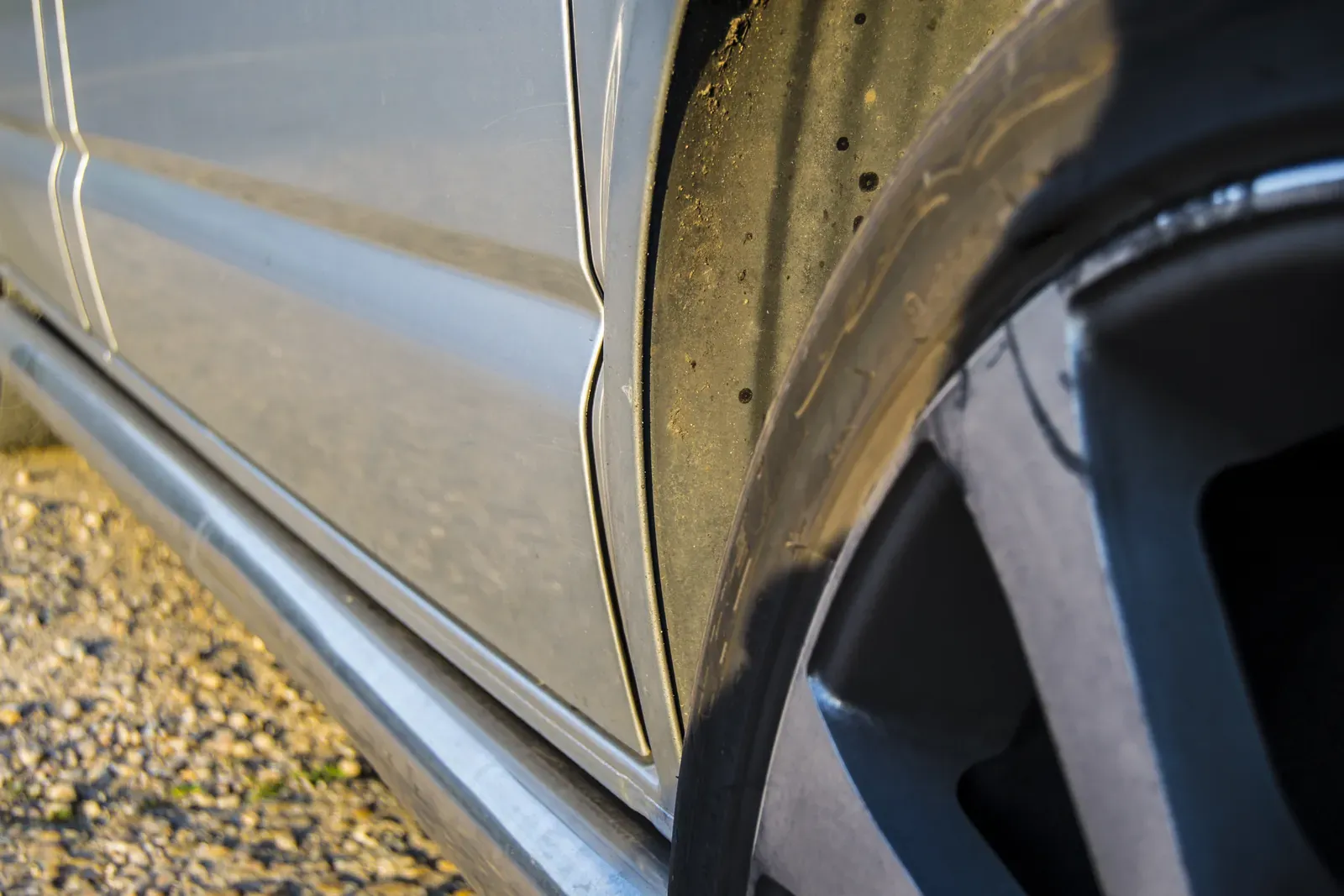
A wheel can be bent while the tire still looks fine and holds air
Most bends happen where you cannot see them. A pothole hit pinches the tire against the inner edge of the rim, the side facing the brakes, and folds a short section of the lip. From the curb the wheel looks untouched. The car tells you instead, usually within a day or two.
The first sign is often a vibration that was not there before, felt through the steering wheel or the seat once the car reaches highway speed on the 401 or the 404. A bend at the bead seat, where the tire seals against the rim, may let air seep out slowly, so the tire needs topping up every few days. In a GTA winter that leak often announces itself as a tire-pressure warning on a cold morning that clears once the tire warms up, because cold air already sits at a lower pressure and the bend pushes it below the warning point.
A tire shop can confirm it in minutes. On a balancing machine a bent wheel either refuses to balance or shows visible wobble as it spins, and the technician can measure how far out of round it runs. If the shop adds weight after weight and the vibration stays, the wheel is the problem rather than the balance.
Where the bend sits decides whether straightening is a safe repair
Wheel straightening is specialist work. The wheel is mounted on a machine that spins it while hydraulic rams press the deformed section back toward true, sometimes with gentle, controlled heat to help the metal move. The specialist measures runout as they go and stops when the barrel is round again.
A smooth bend in the inner barrel or lip, with no cracking, is the classic good candidate. A bend in the outer face or in a spoke is harder: the metal there is thicker and shaped for strength and appearance, and forcing it back can leave stress or a visible flaw. Several bends on one wheel, a flat spot along the bead seat that will not seal, or a wheel that has already been straightened once all push the decision toward replacement.
We do not straighten wheels ourselves; when one needs it as part of a repair, we coordinate with a wheel specialist and have the result checked before the tire goes back on.
Welding a cracked rim gambles with heat treatment the factory gave it
Most alloy wheels are cast or forged aluminum that is heat treated after forming to reach its strength. Welding pours intense, local heat into one spot. The bead of weld may look solid, but the metal around it, the heat-affected zone, has lost some of the treatment and is softer than the rest of the wheel. Cracks tend to return beside the weld, often under exactly the load that caused the first one.
That is why many wheel makers do not approve weld repairs on their products, and why a cracked alloy is a replacement in our book even when a welded repair looks tidy. A hairline crack on the inner lip may show itself only as a slow leak; brushing soapy water over the lip with the tire inflated reveals it as a line of bubbles.
Replacement does not have to mean a new wheel at dealer price. A recycled original wheel of the same design, inspected for runout and cracks, is often a sensible choice, and the tire-pressure sensor is moved over from the damaged one.
Steel winter rims, low-profile tires and the parts behind the wheel
Many GTA drivers run their winter tires on steel wheels from November to April. Steel bends more readily than alloy but rarely cracks, and a bent steel rim is normally swapped for a new one rather than sent out for straightening. The low-profile tires on the 19- and 20-inch alloys of many crossovers work the other way: there is so little rubber between the road and the rim that a pothole the winter set would shrug off can fold the summer wheel’s lip in April.
Not every slow leak is a bend. On older alloys, salt works under the tire bead and corrodes the seat, leaving a rough surface the tire cannot seal against. A tire shop can clean and reseal the bead, and that repair has nothing to do with straightening.
A hit hard enough to bend a wheel can also reach what holds it. The sidewall should be inspected for a bulge, the valve-stem sensor for cracks, and the steering and suspension for a bent tie rod or control arm. A pull to one side or a crooked steering wheel after new wheels go on means an alignment check, and sometimes more than an alignment.
A pothole or curb hit lands on your own collision coverage, deductible first
A pothole or curb strike is a single-vehicle collision on your own policy, so it comes under collision coverage with your deductible, and insurance companies usually rate it as an at-fault claim. For one bent wheel the repair often sits near the deductible, which is why many owners pay directly. When the same hit also bent suspension parts or cracked a bumper cover, the total changes and a written estimate is worth having first.
Two other routes are worth checking. A claim against the road authority is possible for damage from a road it failed to maintain, with short notice deadlines; the pothole-season guide explains how it works. And if your tires came with a road-hazard plan, read its terms, because some cover the tire and occasionally the wheel without touching your auto policy at all.
Questions people ask
Is it safe to drive on an alloy wheel that has been straightened?
Generally yes, when the bend was within a specialist’s limits, the wheel was checked for cracks afterward and the runout measured true. Ask whether the wheel was crack-checked, since a straightened wheel with an unseen crack is the case to avoid.
My all-wheel-drive car needs one new tire after the wheel was bent. Do the others need replacing?
Possibly. Some all-wheel-drive systems require all four tires to be close in tread depth, and a single new tire beside worn ones can strain the drivetrain. Check the owner’s manual; a tire shop can sometimes shave a new tire down to match.
The tire-pressure light only comes on during cold mornings. Could that be the wheel?
It could. A bent lip, a hairline crack or a corroded bead seat can let air leak just enough to cross the warning point when the air is cold. Have the tire dismounted and the rim inspected rather than simply adding air each week.