The flatbed from the Avondale ramp goes where you say, and the claim starts before it arrives
Structural damage is not something a Willowdale driver brings in on a Saturday morning. It arrives after a harder hit — a 401 merge at Bayview that became a spin, a left-turn collision at Sheppard and Yonge, a front corner into the end of the concrete barrier on the Avondale ramp — and the car comes on a flatbed. The first thing to know is that the flatbed goes where you say. Ontario’s towing rules put the destination in your hands, the operator is provincially certified and the invoice is itemized, and a tow to a yard you did not choose is a storage fee and a delay before the repair has started. Tell the driver Crash Consultant at Sheppard and Don Mills, or call us from the shoulder and we help arrange it.
The second thing to know is that the file moves before the car does. Send whatever photos you took at the scene and our estimator opens the claim with your insurance company, so the adjuster meets the car on our bench rather than in a compound. If anyone was hurt, 911 from the scene comes first; if nobody was and the car cannot be driven, the Collision Reporting Centre report can be made after the tow. When you were not at fault, in whole or in part, your own insurance company pays under DCPD, and where the car is leased the leasing company is named on the policy and hears about the claim too.
What a Bayview-merge spin does to a crossover’s strut tower, and what the measuring sheet shows
Take the spin. A crossover merging onto the 401 at Bayview is clipped on the rear quarter, rotates, and stops with its front corner against the barrier. The visible damage is a bumper, a headlamp and a fender. Behind them, the front rail has been pushed rearward and up, the apron that ties the rail to the strut tower has folded, and the strut tower itself — the pressed steel cup that holds the top of the suspension — has moved a few millimetres inward. Nothing about that shows from the outside. The wheel sits back in the arch, the hood gap has closed on one side, and the car may still drive straight at low speed.
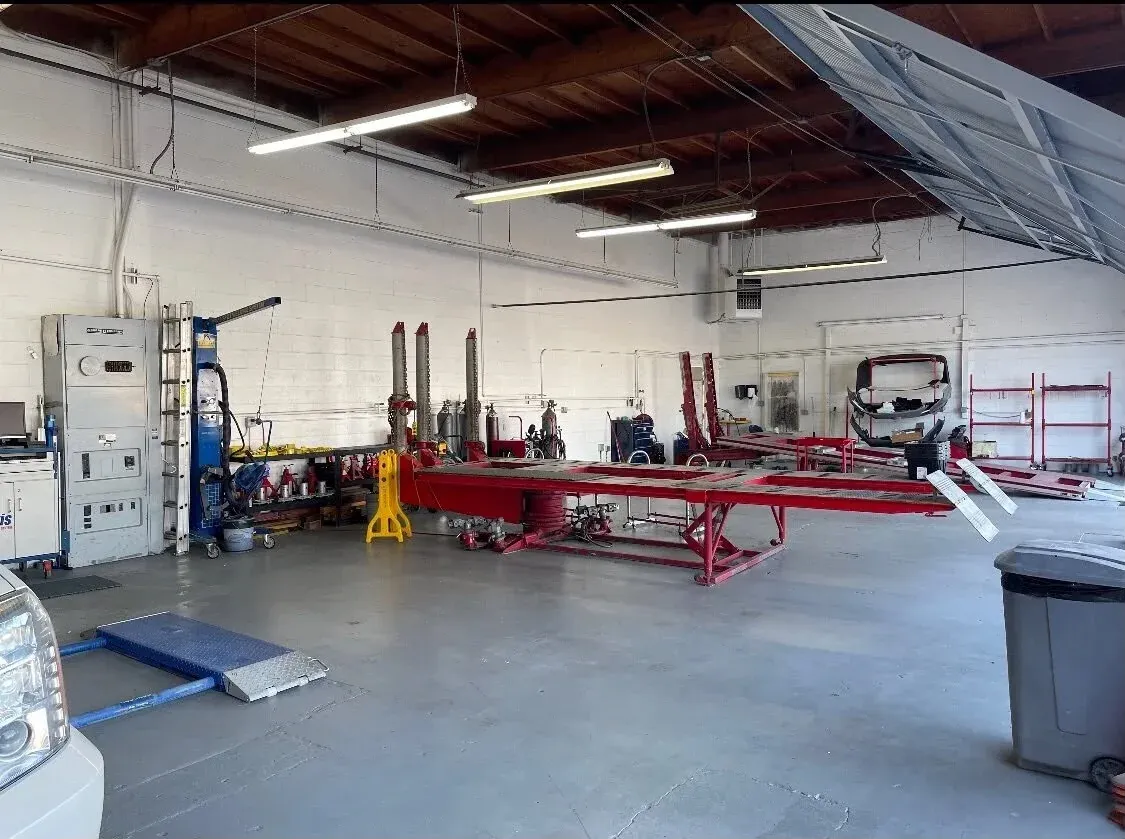
On the bench it stops being a guess. The car is anchored, the control points on the rails, towers and aprons are measured against the manufacturer’s data, and the sheet prints how far each point has moved in length, width and height. A strut tower five millimetres inboard is a number on that sheet, and the plan follows from it: chains and hydraulic towers bring the rail and apron back while the measuring system watches, in increments, until the sheet reads inside tolerance. Where the apron or a rail section has kinked high-strength steel, it is cut out along the manufacturer’s lines and replaced rather than pulled, because that steel does not straighten twice, and on those parts we ask your insurance company for OEM in writing. The after-pull sheet goes in your file beside the first one.
- Rail, apron and strut-tower control points measured before any decision
- Pulled in increments with the measuring system live, then measured again
- Kinked high-strength sections replaced along factory cut lines, OEM asked for
- Suspension aligned and the wheel back in the centre of the arch before paint
Newer cars in the Yonge towers carry sensors on the structure, and a three-year-old lease meets the total-loss test differently
The cars in the Yonge garages tend to be a few years old and full of driver aids, and two things follow. The forward radar sits on the bumper reinforcement or behind the badge, the front camera in the windshield, and the blind-spot units in the rear corners — all mounted to a structure that has just been moved and moved back. After a pull, those systems may require recalibration before the car is finished, and it is priced into the estimate rather than found on the road test. The other consequence is airbags: a hit that moves a strut tower has often fired one, and the modules and pretensioners add to the repair without by themselves making the car a write-off.
The total-loss test is the same for every car and lands differently on a lease. Ontario has no fixed percentage; the insurance company puts the actual cash value beside the repair cost plus what the damaged car would fetch as salvage. On a three-year-old crossover the value is usually high enough that a structural repair with airbags comes in under it, and the repair goes ahead. When it does not, the payout goes to the leasing company first as the registered owner, and any shortfall between the payout and the lease balance is where gap coverage — if it was part of the lease — matters. We give you the measuring sheet and the estimate early so that conversation happens before the pull, with numbers.
Questions people ask
The car drives but pulls hard to one side after a hit on the 401 at Bayview. Is that frame damage?
It could be a bent suspension component, a shifted subframe, or a moved rail — and the car cannot tell you which. Do not keep driving it on the highway. Have it towed to us, where it goes on the bench and gets measured; the numbers say whether the structure moved, and the estimate is written from that.
The car is leased through a dealer on Yonge. Does the leasing company get a say in whether it is straightened?
It is the registered owner, so it is named on the claim and it is paid first if the car is written off. It does not choose the shop — that is yours under Ontario law — and it does not normally weigh in on a repair that goes ahead. What it will care about at return is that the repair is documented, which is what the before-and-after measuring sheets in your file are for.
I hit the end of the barrier on the Avondale ramp and only the corner looks damaged. Why does the estimate mention the strut tower?
Because a barrier end is a point load. The energy goes into the corner of the rail and along the apron to the tower instead of spreading across the whole front, so a modest-looking corner can move the tower inward. The measuring sheet says whether it did; if the tower reads inside tolerance, the line comes off the estimate.