The visitor row beside the elevator core is where a rear door meets a column on P2
The underground garages along Yonge between Sheppard and Finch were laid out with a column every few stalls, and the visitor spots by the elevator core have the most columns of all. Open a rear door against one and you get a crisp, shallow dent in the door skin with the paint usually still intact. Back a tailgate into one and you get a broader, softer dent in a panel with a body line running through it. The two look similar from ten feet away and repair very differently.
Above ground, the pattern shifts. The wide driveways on the rebuilt streets — Kingsdale, Churchill, Hollywood — put two cars side by side in a garage built for one and a half, and the dents there come from bicycle handlebars, hockey bags, and a garage-door track. Then there is Empress Walk and the Yonge Sheppard Centre, where a cart on a sloped lot finds a door the same way carts do at every mall in the city. None of it is dramatic. All of it is the sort of thing people put off for a year and then want gone before a lease return or a sale.
A tailgate dent across a body line needs paint; a flat door skin usually does not
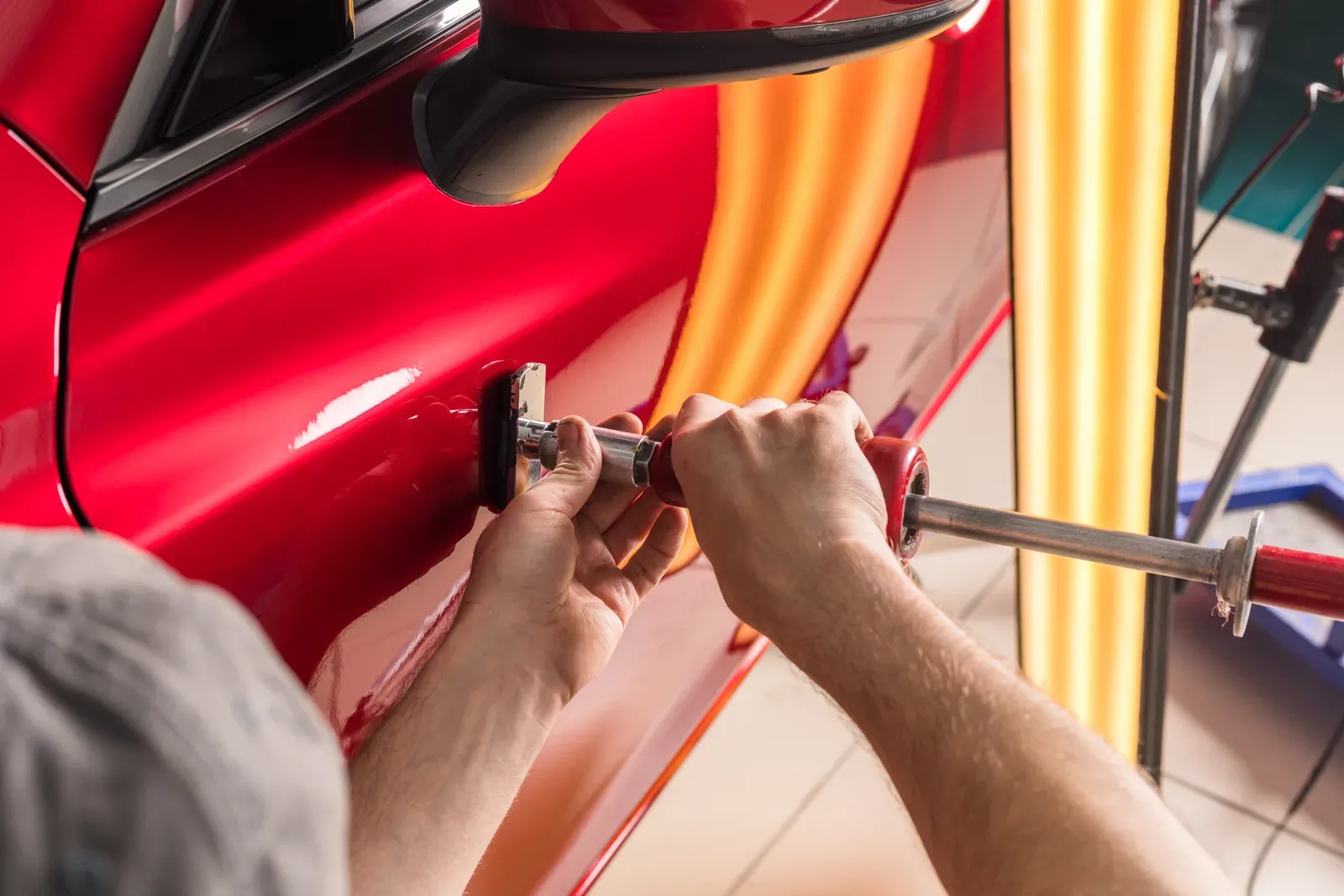
The difference between the two column dents is the line running through them. A door skin pushed in against a column in a flat area is a candidate for paintless repair: the tool goes in through the window opening or behind the inner panel, the metal is worked back in small pushes while a striped light board shows the reflection straightening, and the factory paint never comes off. A tailgate or a rear door caught on its body line is another matter. The crease has been folded over a stamped edge, the metal on that edge has stretched, and the paint along it has usually cracked even when it looks whole. That dent is worked back as far as the metal allows, skimmed thin, primed and refinished, with the colour blended into the quarter or the other door so the repair has no edge. On a body-line dent we say so from the photo rather than promising a push that will leave a ripple.
Reading that from a photo taken two levels underground is the hard part. Fluorescent light comes from every direction at once, so the reflection that would show the dent’s shape is washed out and a crease reads as a shadow. If the car can move, take the picture at street level with the reflection of a building edge or a light pole running across the dent and bending. If it cannot, hold a phone torch off to one side so the dent throws a shadow, and take one straight on and one close enough to show whether the paint has split. That is enough to say push or paint.
- Flat-skin column dents pushed out from behind with the factory paint intact
- Body-line and tailgate creases worked, skimmed and refinished with a blend
- Aluminum panels worked more slowly, because the metal has little memory and cracks if worked twice
- Several dents priced as one visit, because the masking and booth time are shared
Report the visitor-spot dent to the property manager first, then decide whether to claim
A dent you put in your own car against a column is either a collision claim with your deductible or a bill you pay directly, and a single flat-skin dent usually prices near enough to a typical deductible that paying directly is the plain choice. A dent someone else left in the visitor row is different in one way: a vehicle did it, so it is a collision claim on your own policy, rated not-at-fault, even when nobody left a note. That means a report to police or a Collision Reporting Centre and a call to building management the same day — ask whether the camera covers the row, ask for the footage to be kept, and fill in the building’s incident form. A plate on the footage turns it into an identified driver and a DCPD claim where your deductible normally does not apply.
Whether the claim is worth opening is arithmetic you can do from the estimate: one flat dent, usually no; a rear door creased on its body line with the paint cracked, often yes. Tell your insurance company about the incident either way, because the policy expects notice of a collision whether or not you claim, and notice is not a claim. We open the file when you decide to go ahead and deal with the adjuster from here; most paintless work is done within the day, and a refinished door keeps the car for a few days while the paint cures.
Questions people ask
The dent is on my tailgate from backing into a P2 column and it runs through the crease line. Is that a body-line dent?
Yes, if the dent crosses the stamped line rather than sitting in the flat above or below it. The metal on that edge has been folded and stretched, so a push from behind leaves a ripple along the line. Send a photo with the reflection of a straight edge running through the crease; if the reflection breaks at the line, plan on a refinish and a blend into the quarter.
Can a dent from a P2 column be photographed well enough down there, or do I have to bring the car up?
Try it underground first with a phone torch held off to the side so the dent throws a shadow, one close for the paint, one straight on. If the pictures come back flat, drive it up to Doris or Beecroft and take one with a building edge reflected across the panel. Underground light is the reason most garage-dent photos undersell the dent.
Will a properly refinished dent be charged at my lease-return inspection?
A paintless repair leaves the factory paint untouched, so there is nothing to find. A filled and refinished dent done properly matches in colour and texture; a paint-depth gauge may read the extra thickness, and inspection terms differ between leasing companies, but a proper repair is rarely charged as damage. If the return date is close, we can look over the whole car before the inspection.