First problem: getting it out of the neighbourhood
A car that needs frame work rarely drives well enough to go anywhere, and a Riverdale car is often somewhere a flatbed cannot reach. The laneways behind Withrow, Bain and Logan were laid out for horses; the turn from the street is tight, the lane is narrow and the garages sit right on it. A full-size flatbed does not make that turn. What works is a wheel-lift that drags the car to the street, or a smaller flatbed with a low deck, and we help arrange whichever the lane allows. Tell us the lane, whether the car rolls and steers, and which wheel has gone back into the arch.
If the car is on the DVP shoulder or at a Broadview curb after a track slide, the tow is simpler but the choice is the same: under Ontario’s towing rules the operator must be provincially certified, must give you an itemized invoice, and must take the car where you say. Say Crash Consultant, Sheppard and Don Mills. A car that goes first to a yard you did not choose pays storage every day it sits there and delays the measurement that decides everything else.
The bench finds where the damage went before anyone pulls
Almost nothing on Riverdale streets has a separate frame; a few pickups aside, it is unibody, where the floor, rails, aprons and pillars are one welded structure designed to crumple in a set order. When a Broadview curb or a DVP rear-end pushes a rail, the damage does not stop at the rail. It travels into the strut tower, the door gaps and the roof, in ways you can only see with a measuring system.
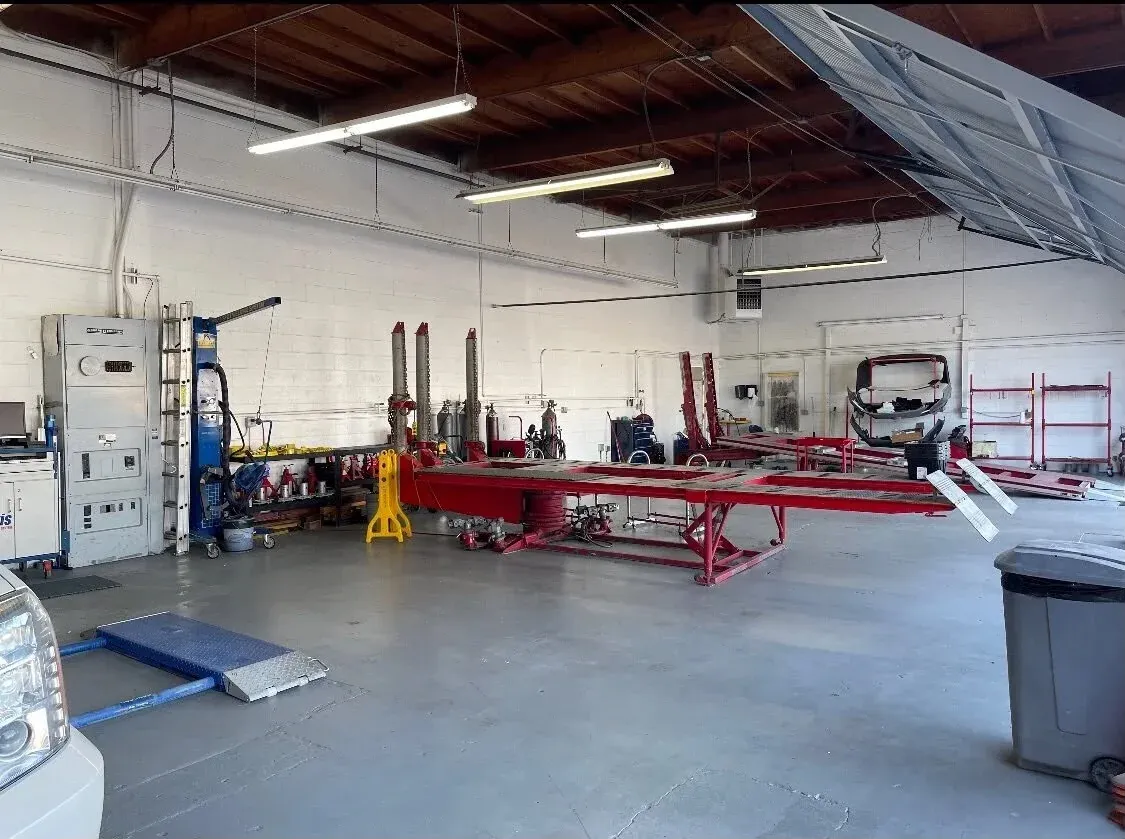
So the car goes on the bench first. Electronic measuring reads dozens of reference points against factory data and prints a sheet showing where the structure is and how far from where it should be. Then the pulls: the car is anchored, hydraulic towers pull in the direction the damage came from, and the measurement is repeated between pulls until the numbers sit inside tolerance. Where a rail is kinked past what can be pulled, the section is cut out and a new one welded in at the factory seam. High-strength steels in newer cars limit what can be heated or straightened, and we follow the manufacturer’s repair procedures on where to cut and where to replace. Then the panels go back on and the gaps are checked against the same sheet.
- Electronic measurement against factory data, before and after
- Sectioning at factory seams where a rail cannot be pulled
- Manufacturer repair procedures on high-strength steel
- Alignment and sensor check before the car is released
Where the total-loss line falls, and who decides
Structural work is where the claim gets serious. Your insurance company weighs the repair cost plus what the salvage is worth against the car’s actual cash value, and there is no fixed Ontario percentage that triggers a total loss; it is the numbers on your file. Our estimator writes the estimate against the measurement sheet, files supplements with photos as the teardown finds more, and asks for OEM structural parts, because a rail is a crash structure and not the place to economize. If the car is written off, you can usually ask to keep it and take the salvage deduction. If it is repaired, you get the before and after measurements to keep with the car.
Timelines are weeks, not days, and we say so up front. A rental through your coverage runs for the length of it when you are not at fault, or under OPCF 20 loss-of-use if you carry it.
Questions people ask
My car hit the curb on Broadview after the tracks and now pulls hard left. Is that frame damage?
Possibly. A sideways curb hit at speed bends suspension first — control arm, knuckle, tie rod — and can push the subframe or the rail mount behind it. An alignment that will not come into spec after the suspension is replaced is the classic sign. We measure the structure before anyone guesses.
Is a car straightened on a bench as safe as it was before?
When it is measured back to factory tolerance, sectioned at the factory seams and welded to the manufacturer’s procedure, yes; that is what the procedures exist for. What makes a repair unsafe is skipping the measurement, heating high-strength steel that should have been replaced, or reusing a rail that was kinked. You get the measurement sheets so you can see the numbers yourself.
The tow driver suggested a yard near the DVP. Can I still have it brought to you?
Yes. Ontario’s towing rules put the destination in your hands, and the operator has to give you an itemized invoice. Tell the driver Crash Consultant at Sheppard and Don Mills. If the car has already gone to a yard, call us and we help arrange the second tow before storage adds up.