Parking in Riverdale is how dents get made
The angled spots along Gerrard at the Bazaar end are the most productive dent factory in the neighbourhood. Cars back out blind into a lane shared with delivery trucks, and the trucks are unloading in the lane because there is nowhere else to be; the result is a soft crease on a rear quarter or a door, usually with no note. A few blocks north the mutual driveways do the same job more slowly — two households, one strip of concrete, and door edges that eventually find the neighbour’s fender. Behind the houses the laneway garages finish the set, with a jamb that catches a bumper corner and a door that swings into a rear quarter.
Add the visitors. Riverdale Park East fills on any clear evening, and on winter weekends the toboggan hill fills the surrounding streets with drivers who are not used to how close the cars sit. A door flung open against yours is the commonest dent we see from this side of the valley; the shopping cart rolling across a grocery lot on Gerrard is the runner-up.
Fixing the dent without touching the paint
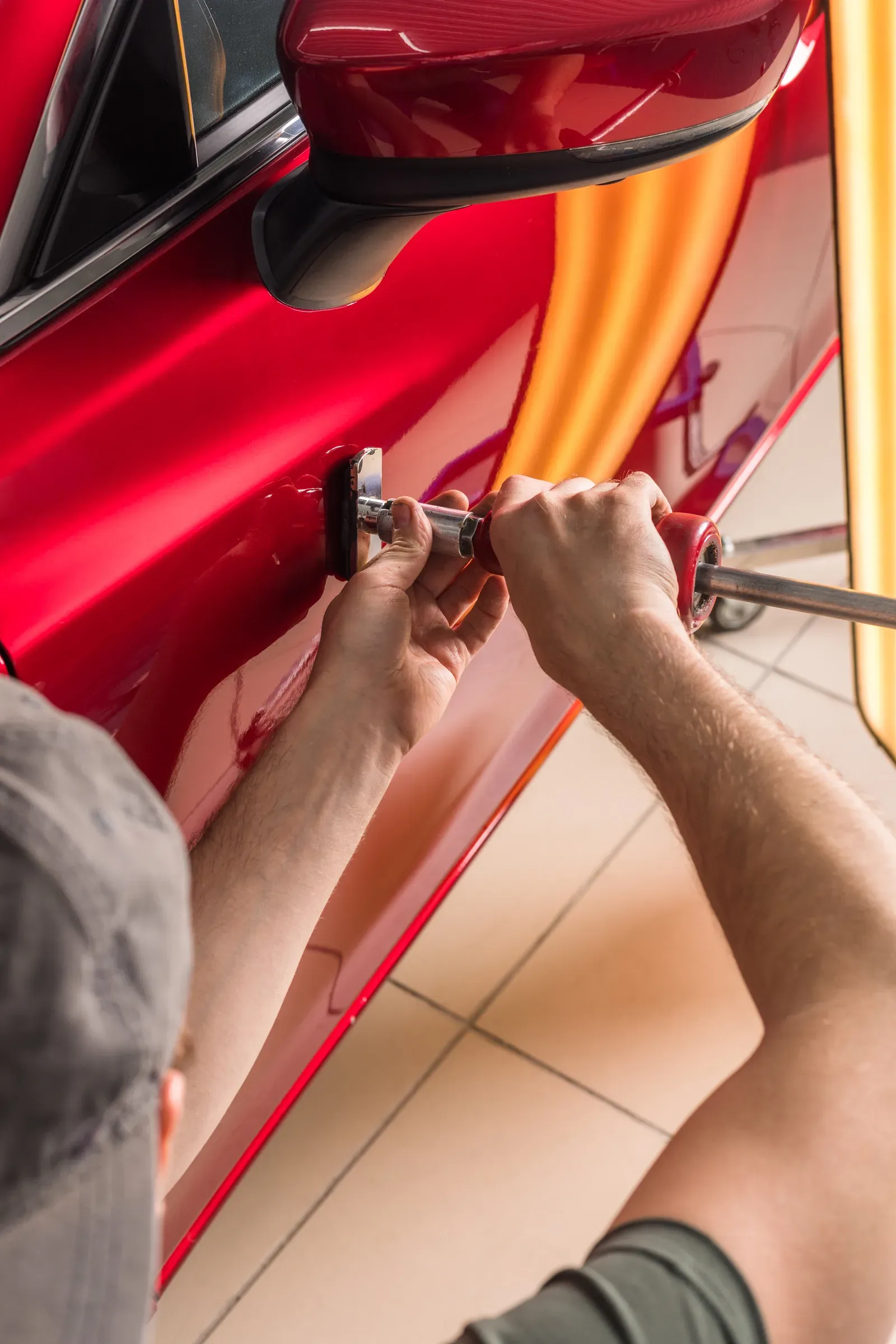
If the paint is intact — no crack, no chip, no white stress line in the clear — the dent can usually be worked back to flat without repainting. Take the classic Riverdale case: a rear-door ding collected in the mutual drive beside a Victorian semi. Getting behind it means the inner door panel comes off, and that happens in our bay rather than in a drive barely wider than the car; with room to work, the tech reads the panel off a reflection board and eases the metal back until every low spot is gone. No filler, no colour to match, no new paint to blend — the factory finish stays exactly as it was, which matters on a lease and on a car you plan to sell.
When the paint has cracked, or the dent sits on a body line where the metal has stretched, paintless work is the wrong tool. Then it is a conventional repair: the dent pulled or filled thin, primed, painted in the booth and blended into the next panel. Aluminum hoods and tailgates, common on newer SUVs, take a different set of tools and a lighter hand, because aluminum does not want to move back the way steel does. The estimate names which path your dent needs before the car leaves Riverdale.
- Paintless removal where the paint is unbroken
- Conventional repair and refinish where it is not
- Aluminum panels handled with aluminum-specific tools
- Reflection-board check before the car leaves the bay
A no-note hit in the angled row is a different claim from a door ding
A single door ding is often below your deductible, and a claim that pays nothing still sits on your file, so our estimator reads the photos and hands you the number before anyone calls an insurance company. A dent from a driver who left the angled row without stopping is another matter: that is a collision claim under your own Collision or All Perils coverage, with your policy deductible, rated not-at-fault — and it needs a police report or a Collision Reporting Centre report behind it. If the neighbour admits to the driveway crease and their car is insured in Ontario, it is a DCPD claim through your own company: no deductible on the share they caused, and your record stays clean. Even then, a mirror shell and a scuff can be simpler to sort out over the fence than through two files, and the estimate tells you what that favour is worth.
Most paintless jobs are in and out in a day. A repair that needs the booth runs longer, and the date is only set once the parts are already on the shelf, so the car waits in Riverdale rather than in our lot.
Questions people ask
A truck backed into my rear door in the angled row on Gerrard and left no note. What now?
Photograph the dent, the spot and anything you saw of the truck, then report it to police or the nearest Collision Reporting Centre so the hit-and-run is documented. Damage from a driver who cannot be identified runs under your own Collision or All Perils coverage, with your deductible, and it is rated not-at-fault. Send the photos before you decide: if the paint held, a paintless repair may come in near the deductible and make the claim not worth opening.
I cross the Broadview tracks four times a day. Will a repaired ding work itself loose over the rail ruts?
No. Paintless repair does not brace or patch the panel; it returns the steel to the shape and tension it was pressed with, so there is nothing to shake loose. A conventional repair holds too — filler bonded to keyed metal under baked primer and colour — and rail ruts and potholes do not undo it. What vibration exposes is bad work from elsewhere: thick filler bridging a flexing panel can crack at its edges, which is why ours is kept thin over metal that has already been straightened.
The car is leased and goes back next spring. Is paintless repair safe for the return?
It is the best option for a lease. Nothing is repainted, so there is no colour difference for the inspector to flag and no refinish for a paint-thickness gauge to find. Dents that need paint are repaired to factory appearance and documented, which is usually what the leasing company wants to see.