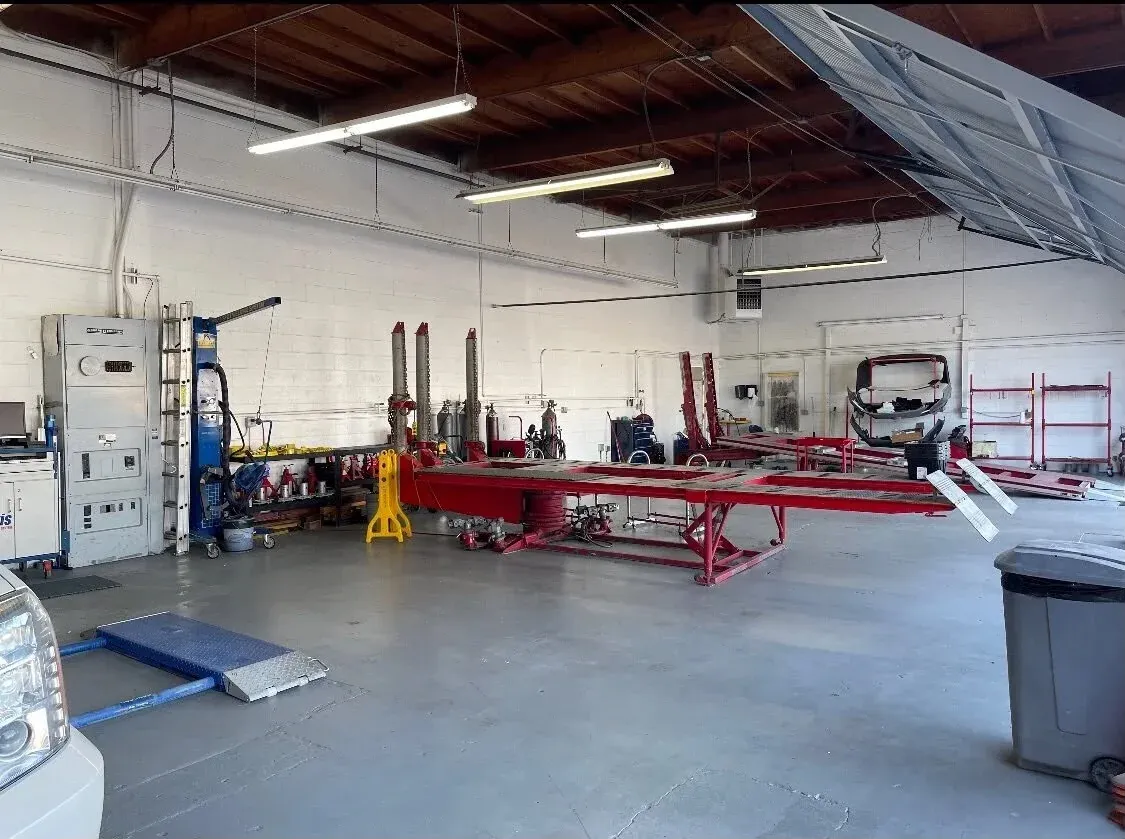
What straightening a frame actually means today
Nearly every car on Etobicoke roads is a unibody: there is no separate frame, just a shell of stamped steel and aluminum designed to crumple in specific places and stay rigid everywhere else. Straightening it is measurement first, force second. The car goes on a bench, target points are compared against the manufacturer’s dimensions to the millimetre, and the print-out shows exactly which rail, apron or pillar moved and by how much. Then chains and hydraulic towers pull the structure back while the measuring system watches. Metal that has been kinked beyond what it can return to, or high-strength steel that must not be heated or pulled at all, is cut out and replaced with a new section welded at the manufacturer’s seams. Where that section is a rail or a crumple zone it is specified as OEM on the estimate, with the reason beside it.
The test at the end is not a straight edge. It is the same measurement as the start, plus a road test that confirms the car tracks straight and the doors, hood and trunk close on their factory gaps.
The hits that bend a car in Etobicoke
Speed is the difference between a bumper and a bench. The 401 between the 427 and the 400 runs fast when it runs, and a car that stops short in the express lanes near the Basketweave gets hit at a speed that pushes the rear rails forward and lifts the roof skin. The 427 south to the Gardiner adds front-corner impacts at the Queensway split, and Dixon Road delivers the offset hits of a limo turning across traffic. Then there is the damage that does not involve another car: a spring pothole on Kipling or Islington that bends a subframe and a control-arm mount, a black-ice slide on Lake Shore into a curb that shoves a wheel back into the rocker. The tell-tale signs are the same whatever the cause: a door that no longer closes without a lift, a hood gap wide on one side, tires wearing on one edge, a steering wheel off-centre on the drive home.
Tow, claim and the total-loss question
A car with structural damage should not attempt the 401. Under Ontario’s towing rules you decide where the flatbed goes, so it comes from the shoulder at the 427, a Rexdale driveway or the yard where the police had it taken, straight to Sheppard and Don Mills; we coordinate the leg and fold the invoice into the claim. From the photos and the first measurement our estimator writes an estimate that tells your insurance company what the structure needs. If the repair cost approaches the car’s actual cash value once salvage is counted, the insurance company may declare a total loss; there is no fixed percentage in Ontario, and we walk you through the numbers before that call so you are not hearing them for the first time from the adjuster. If the car is repaired, the rental through your coverage runs for the duration, and the measurement print-outs go in your file for the day you sell it.
- Tow coordinated from wherever the car stopped to Sheppard and Don Mills
- Before-and-after measurement print-outs kept on your file
- OEM sections requested for rails and crumple zones
- Total-loss math explained before the adjuster calls
Questions people ask
How do I know if the hit on the 401 bent the frame, or just the bumper?
You often cannot from the outside. Signs are a hood or trunk gap wider on one side, a door that needs lifting to close, a steering wheel that sits off-centre, or a tire rubbing. The certain answer comes from a measurement on the bench, which is why our estimate on a hard hit says the structure will be checked before any parts are ordered.
Will the car drive the same afterwards?
If the structure has been measured back to the manufacturer’s dimensions and the suspension mounting points confirmed, yes. The road test checks tracking, and the alignment is done after the pull, not before. What we will not do is straighten a rail that should have been replaced; that is how a car ends up wandering on the 427 a year later.
My car is older and the rear rails are bent. Is it going to be written off?
Possibly, and it depends on value rather than age. The insurance company weighs the repair cost against the car’s actual cash value with salvage considered; an older car with modest value reaches that line sooner. We give you the honest estimate first so you can decide whether to argue for the repair, accept the settlement, or ask about keeping the car.