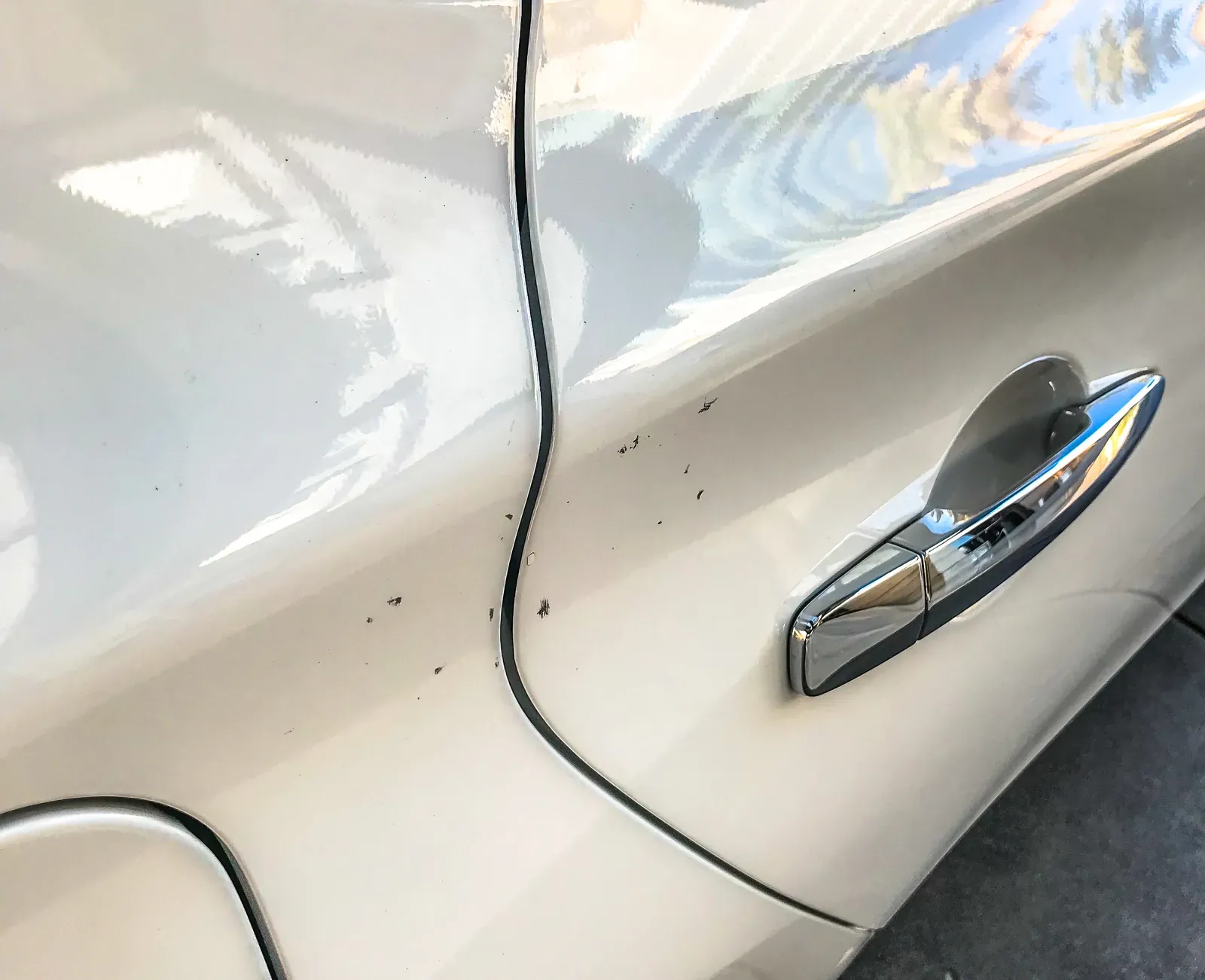
Backing out of an angled stall on Brock Street
The Four Corners has the parking downtown Whitby has always had: angled stalls along Brock Street near Dundas, each one a blind reverse into a live lane. The pickup beside you hides the traffic, you ease out, and the corner of a bumper or the swing of a door finds your rear quarter at walking speed. It leaves a soft, round dent the size of a hand, usually without a mark on the paint. The Whitby Mall corridor on Dundas East produces the classic door ding on a rushed Saturday, and the big-box lots along Taunton Road produce the cart dent, the trailer-hitch dent in a rear door, and the SUV-door-into-your-fender dent, because everything in those lots is tall and parks tight.
South of the 401 the GO lot at Whitby station is full by six and empties at once at six in the evening, and the ding on the driver’s door is the price of the last space in the row. Iroquois Park on a tournament weekend does the same to minivans. And at home, in the three-car driveway, someone eventually backs the compact into the pickup.
Is one dent worth the 401?
Straight answer: often not, on its own. A single paintless ding takes less time than the drive, and we would rather tell you that than see you spend an afternoon on the highway for it. What makes the trip sensible is doing everything at once — the Brock Street quarter, the Whitby Mall door, the driveway crease — as one visit, which for paintless work is often the same day. Send photos of every dent you can find and our estimator prices them as one job.
On the claim side, a dent below your deductible is not a claim. A hit-and-run in the GO lot that creased the quarter and cracked the bumper corner is one, and it goes through your own collision coverage when the other driver cannot be found. A two-car scrape in a Taunton Road lot where both were moving is usually shared fault under the Fault Determination Rules; report it to your insurance company promptly either way, and let the numbers decide whether to claim.
Reflection first, paint second
Where the paint is unbroken and the back of the panel can be reached, a striped light board goes over the dent and the technician pushes the metal from behind in small moves until the stripes run straight across the reflection. You keep the paint the factory sprayed, which matters on a leased minivan headed back to the dealer. Our estimator reads the reflection in your photos to decide whether the dent qualifies, so shoot them at a low angle with the light bending across the damage rather than head-on.
Where the paint has cracked, the dent sits on a body line, or the metal has been stretched into a sharp crease, it becomes a refinish: the panel worked back to shape, filled where the metal allows, primed and painted with the colour carried into the next panel. A door skin creased into its beam or a quarter folded at the arch is sometimes cheaper to replace than to straighten, and we say which before the work starts.
- No paint, no blend when the finish survived and a tool can get behind the panel
- Refinish and blend once the paint has cracked or the dent lies on a body line
- Replacement suggested when a creased skin or quarter would cost more to straighten
- Photos taken at a low angle tell our estimator most of this before you drive
Questions people ask
A door ding in the Whitby Mall lot — is it worth claiming?
Almost never. A single ding repaired without paint costs less than most deductibles, and a claim on your record for it makes no sense. Pay directly and keep the claim for something that needs it. If it came with a scrape through the paint and a cracked bumper corner, send photos and we run the number both ways before you decide.
Two of us backed into each other in a Taunton Road plaza. Who is at fault?
When both cars were reversing, the Fault Determination Rules usually split it evenly. Your own insurance company then pays the not-at-fault half of your damage under DCPD, and the at-fault half is a collision-coverage matter with your deductible. If one car was stopped and the other hit it, the moving driver carries it. Photograph both cars where they stopped, exchange details, and tell your insurance company within the week.
The pickup’s tailgate has a dent from the trailer hitch. Paintless or paint?
Tailgates are usually good candidates when the paint is intact, because the inner panel can be reached through the access holes and the metal is flat. A hitch strike is a small, deep dent, though, and if the paint has cracked at the bottom of it — look for a white ring — it needs filler and a refinish. Send a photo straight on and one from the side.