What sits in a Richmond Hill driveway
Richmond Hill’s paint work has a particular look because its cars do. The subdivisions that filled in around Bayview, Leslie, and the north end of Yonge are full of newer vehicles, and newer vehicles mean pearl whites, tri-coat reds, and fine metallic greys — the finishes that are hardest to match and most obvious when someone gets them wrong. A white that reads as plain white on a spec sheet has a pearl layer over the base, and a repaired fender that skips the pearl looks fine at pickup and wrong under the first sunset on 19th Avenue.
The older streets around Mill Pond and the village core, and the Oak Ridges side, bring the opposite problem: ten- and fifteen-year-old finishes with real sun fade on the roof and hood, clear coat starting to lift on the top of the rear bumper, and a paint code that describes a car which no longer exists. Matching that means tinting the mix against the panel next to the repair and sneaking the new colour into the old.
The gravel hauler ahead of you between Major Mackenzie and Sheppard
The 404 carries the gravel haulers coming down from the pits north of town, and the car behind one between Major Mackenzie and Sheppard collects the fallout across the front of the hood and the base of the windshield pillars. After two or three winters the hood’s leading edge is freckled with chips gone brown at the centre, because the 404 brine gets into every one. A hood refinish is the front third of the panel blended back into the rest; a whole-hood respray on a pearl or a tri-coat means a blend into both fenders, and the estimate says which.
Summer writes a quieter version. The older streets around Mill Pond and off Bayview south of Major Mackenzie have mature maples over the driveways, and sap and bird droppings left through an August week etch through the clear on a roof in a pattern that looks like water spots. Caught early, the roof is compounded and the clear is still thick enough to save. Left for a season, the etching is through the clear and the roof is refinished as a panel.
What a tri-coat red asks of a fender
A lot of the newest cars on Yonge north of Elgin Mills wear a tri-coat red: a base colour, a translucent tinted layer that gives the depth, and clear on top. The translucent layer changes with every pass of the gun, so the same mix can come out a shade darker on a fender than the factory managed on the door, which is why a tri-coat is never sprayed to the panel edge. The fender is refinished and the translucent coat is walked into the door and the front bumper so the eye sees one colour across three parts; the bumper, whose plastic takes the coat differently from steel, is painted complete as a part and blended into the fender so the texture does not read as a colour step.
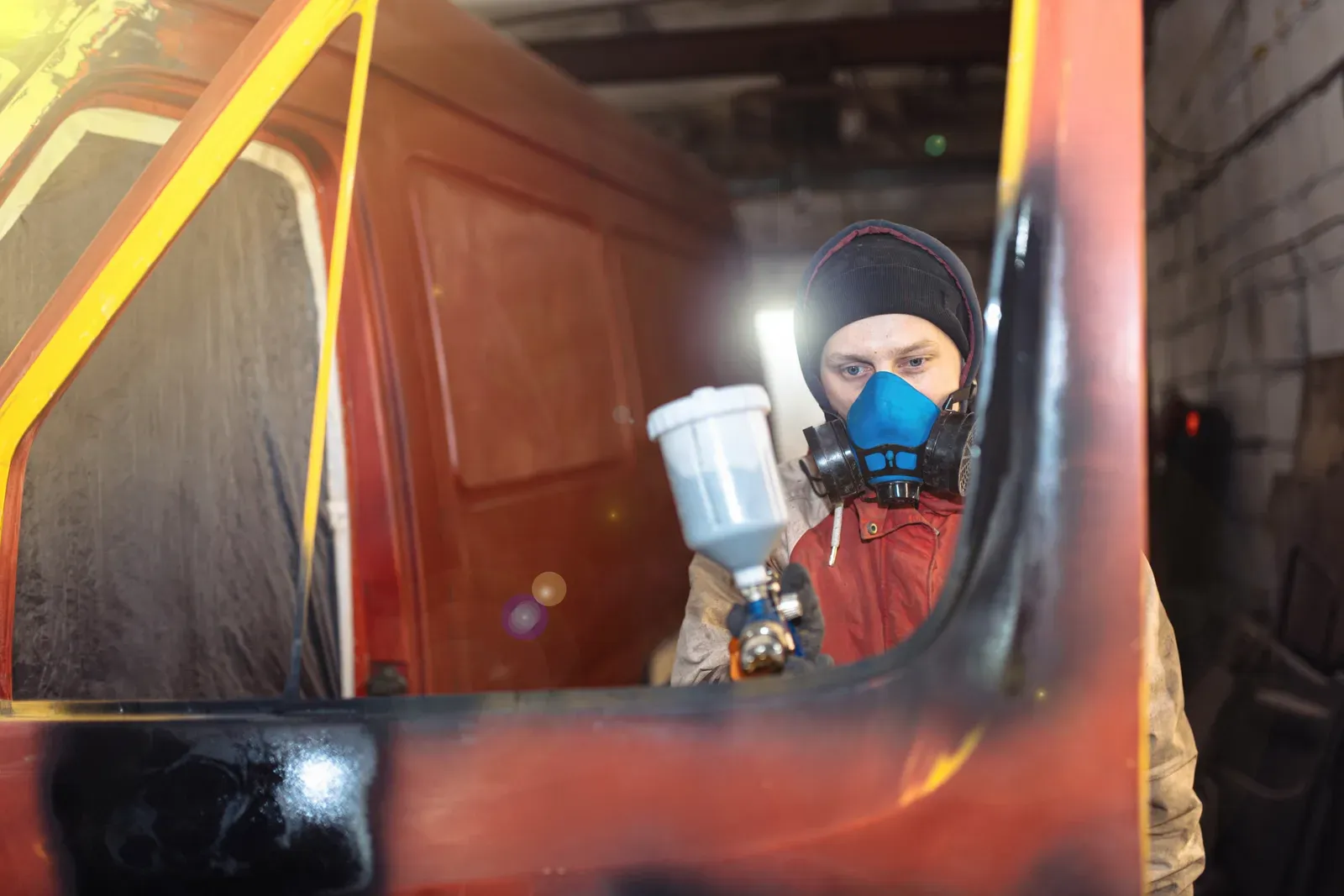
Preparation is still most of the job. Chips and etching are sanded back to a sound layer, primed and blocked flat so nothing telegraphs through a finish that is, by design, transparent. Cure is under controlled heat in the booth, and the car stays out of the brush wash on Yonge for the first few weeks. Paint work books to a known number of days — there is no teardown on a refinish to change the plan — so the drive down the 404 happens once, on the booth date.
- Let-down card sprayed at several coat counts and checked under corrected light
- Tri-coats and pearls walked into the neighbouring panels, never stopped at an edge
- Hood chips and roof etching taken back to sound material before primer
- Refinish warranted for as long as the car is yours, in writing
Questions people ask
My car is a tri-coat red and only the fender needs paint. Why does the estimate include the door and the bumper?
Because a tri-coat’s colour sits in a translucent layer that varies with the number of coats, and a fender sprayed to its edge would read a shade off from the door in daylight even with the right code. The door and the bumper are not being repainted; the translucent coat is faded into them so the transition disappears, and the cover is blended into the fender so its plastic does not show as a colour step. It is more masking and more booth time than a solid colour, and it is the difference between a repair you can find and one you cannot.
The hood on my older car has faded and the clear coat is peeling. Is that a repaint or a replacement?
A repaint. Peeling clear is a surface failure, not a metal failure — the hood is sanded back to sound material, primed, refinished in a colour tinted to the fade on the fenders, and cleared. Replacing a hood for a paint problem only makes sense if it is also dented or rusted through.
My grey car has faded after ten summers on a Lake Wilcox driveway. Will a freshly painted door stand out?
Not if the colour is tinted to the car rather than to the code. The code gives the formula the factory used; the mix is then adjusted against your fender and rear door as they are today — a touch lighter, a little less flake — sprayed on a card and compared in daylight before the door is painted. The refinish is blended into the fender and the rear door, so any difference that remains is spread across three panels instead of sitting at one edge. What we cannot do is un-fade the roof; if the clear there has gone chalky, that is a separate roof refinish.
How long will my car be at your shop for a two-panel refinish?
Usually two to four working days once it is here: preparation, booth time, cure, reassembly and a final check under daylight. A tri-coat or a pearl sits at the long end because of the extra blend panels. The count we give you when you book from Richmond Hill is one you can plan around, because a refinish has no teardown to change it.