The roads north of Stouffville Road
Most of Richmond Hill’s damage is slow. The exceptions come from the top end of town, where the subdivisions stop and the moraine starts. Bayview and Leslie north of Stouffville Road run fast between fields, 19th Avenue and Bethesda Sideroad have soft shoulders and no lighting, and the Oak Ridges deer cross at dusk from October on. A deer strike at 80 km/h is a structural event: hood, grille, and headlamp are the obvious losses, and the radiator support and the upper rails behind them are the hidden ones.
The 404 provides the other kind. North of Major Mackenzie the highway opens up, speeds climb, and the rear-end at the back of a sudden queue at Elgin Mills is not the Yonge Street kind. Winter adds the slide on black ice at a sideroad stop sign into the ditch, or the pothole on Bayview in March hit hard enough to bend the control arm and nudge the rail it bolts to.
Getting the car out of Richmond Hill
A car with suspected structural damage should ride a flatbed, not the 404. Ontario’s towing rules are on your side: operators are provincially certified, invoices are itemized, and you choose the destination — tell the tow driver Sheppard and Don Mills, beside Fairview Mall, or tell us and we coordinate the tow from wherever the car stopped, whether that is a ditch on 19th Avenue or the Collision Reporting Centre lot. We coordinate; we are not a tow company.
Once it is here, the distance stops mattering. The claim opens from our counter with your insurance company, the adjuster deals with us, photos of the measurements go to your phone, and the rental through your coverage is booked so you are not stranded.
- Flatbed tow arranged from the roadside or the reporting centre lot
- You choose where the car goes — Ontario puts that in your hands
- Rental through your coverage timed to the tow-in
- One person, the owner, on the file from tow-in to road test
Deer at the front rails, queue at the rear rails, ditch at the strut tower
Three Richmond Hill hits, three structural jobs. The deer strike on Bayview or 19th Avenue lands low and wide: the bumper bar and the radiator support take the animal, the support folds back into the condenser, and the front rails behind it are pushed rearward a few millimetres. The usual repair is a new radiator support, with the rails measured and pulled forward to specification first, because a new support on short rails will never let the hood and fenders gap properly. The deer itself is a comprehensive claim with no fault assigned.
The 404 rear-end at Elgin Mills is the same problem at the other end of the car: the rear rails and the trunk floor take the hit, the floor ripples, and the quarter panels move inward at the tail lamps. That is a rear rail pull on the bench, with the rear body panel replaced where it crumpled. On the moraine, a car that leaves a sideroad stop sign on black ice and drops a front wheel into the ditch loads that wheel up through the strut, and the strut tower — the pressed steel cone the suspension bolts to — moves inward or up. The car may steer nearly straight; a tower a few millimetres out means an alignment that will not hold.
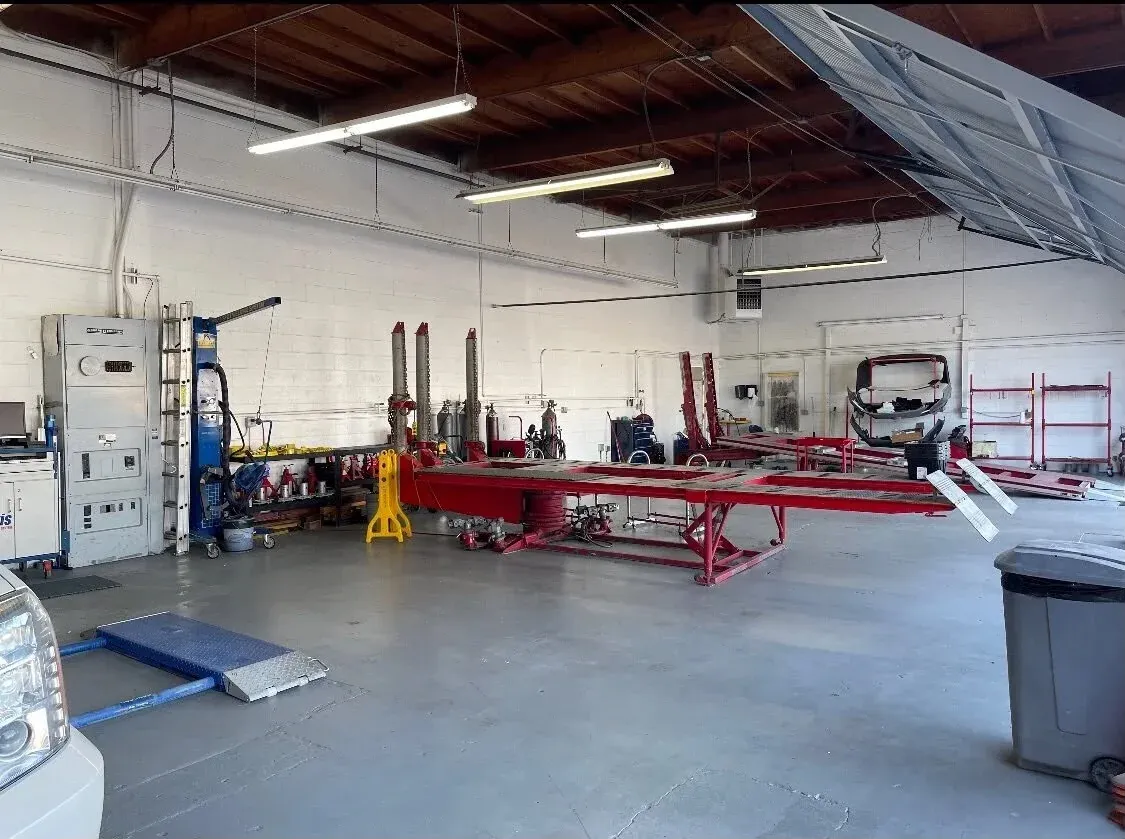
Whatever moved, the order is short to say: measured on the bench against the manufacturer’s data, brought back to those numbers in small pulls, measured again, with both printouts going to you and your insurance company. Panels and paint follow the geometry. If the rails have crumpled past what can be restored, or the repair is climbing toward what the car is worth, we say so before parts are ordered; there is no fixed line in Ontario for a write-off, and you are entitled to see the arithmetic.
Questions people ask
I hit a deer on Bayview near Lake Wilcox and the car still runs. Can I drive it down?
Not without checking. If the hood latches, the lights work, nothing is leaking, and the steering is straight, a slow drive may be possible, but a deer strike often pushes the radiator support back far enough to damage the cooling system. Photograph it, call your insurance company — an animal strike is a comprehensive claim with no fault — and ask us about a tow before you commit to the 404.
Almost every car on my street is a unibody. What does frame damage mean on one of those?
On a unibody the body shell is the structure: rails, pillars, the floor and the strut towers carry the loads a separate frame once did. Frame damage means one of those elements has moved out of specification, sometimes by a few millimetres you cannot see. It is repairable when the metal can be brought back to the factory numbers on the bench and the before-and-after readings prove it.
The car is a lease. Will the dealer take it back after a structural repair?
Yes, provided the repair is documented. A lease return inspection looks at fit, finish and function, and a unibody pulled back to specification with the before-and-after measurements in hand passes on all three. What the lease company also cares about is that the claim was reported and the repair done with parts it can accept, which is why we ask your insurance company for OEM structural parts and keep the measurement reports and the parts invoice with the file for you to hand over.
I slid on black ice on Bethesda Sideroad and went into the ditch, but nothing looks bent. Do you still need to measure it?
Yes, if a wheel dropped hard. A ditch loads the wheel up through the strut and into the tower, and a tower that moved shows up as an alignment that drifts back within a week, uneven tire wear, and a steering wheel slightly off-centre — not as a dent. Measuring takes far less time than guessing, and if the numbers are within specification you drive home knowing it rather than hoping.