First minute: people, then position
Look at yourself and your passengers before you look at the car. If anyone is hurt, or you are not sure, call 911 and stay put. Injuries turn a fender-bender into a police matter, and the officers will come to you. If nobody is hurt and both cars can be driven, Ontario expects you to move them out of the live lane. On the 401 or the DVP that means the shoulder or the next off-ramp, not the middle lane with your hazards on.
Turn the hazards on, and if it is dark or the weather is bad, stay in the car with your seatbelt on unless it is unsafe to do so. A stopped car on a highway shoulder is a dangerous place to stand beside. On a residential street or in a mall lot this matters less, but get the cars out of the flow of traffic wherever you can.
Next ten minutes: exchange details and photograph everything
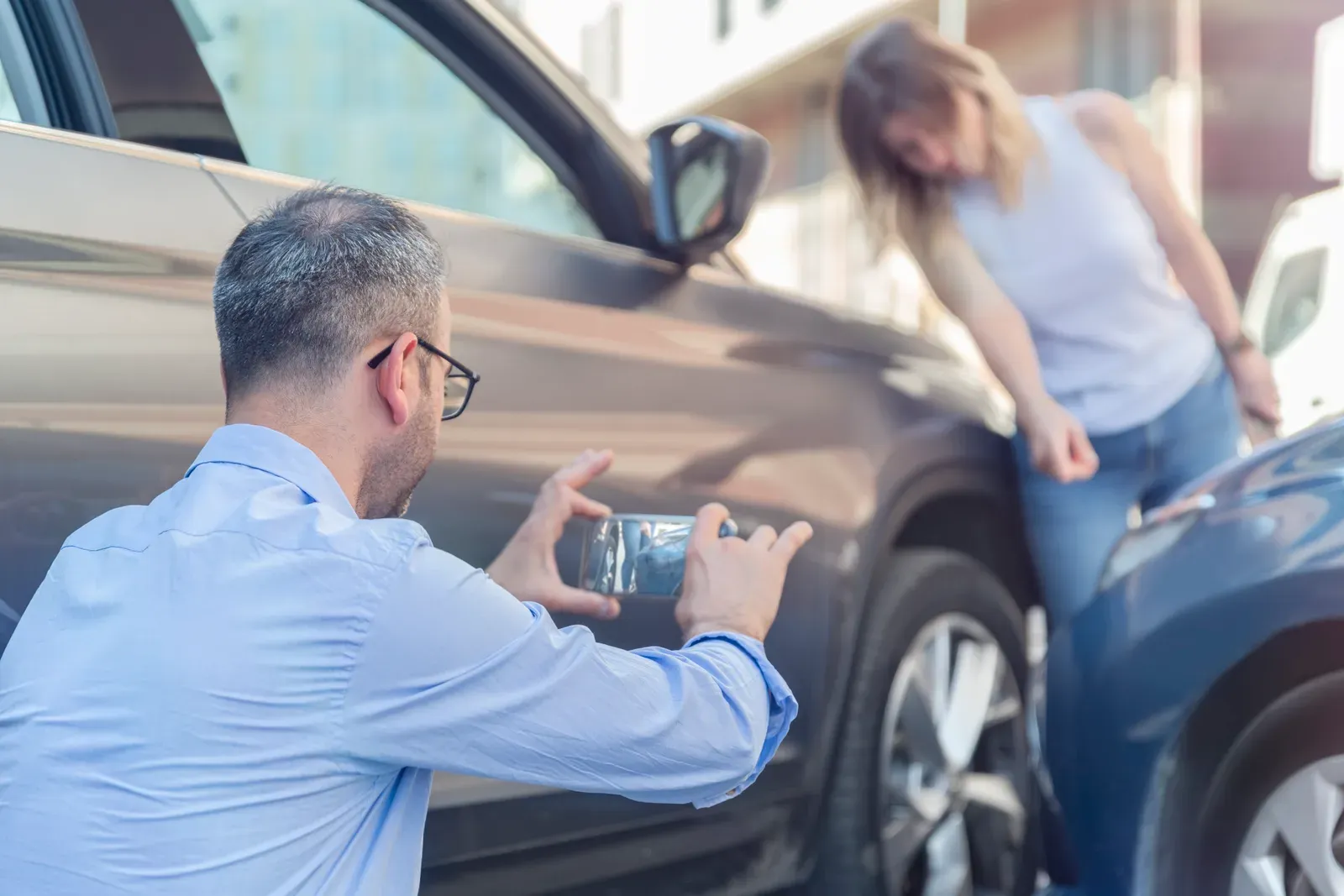
Every driver involved needs the same set of things from every other driver. Do not rely on memory or on a promise to text later. Photograph documents rather than copying them by hand.
Do not discuss fault. Not because you are hiding anything, but because fault in Ontario is decided by rules applied to the facts, and “sorry, I didn’t see you” gets repeated back later as an admission. Be polite, exchange information, and let the facts do the talking.
- Driver’s name, address and licence number — photograph the licence.
- Insurance company and policy number — photograph the pink slip.
- Plate number, plus the make, model and colour of each vehicle.
- Names and numbers of any witnesses, before they drive off.
- Photos of both cars from all four corners, close-ups of the damage, and wide shots that show the lane, the signals and the road markings.
- The time, the location by intersection or highway marker, and the weather.
Within the day: report it if you have to
If anyone is injured, the police attend and the report is done at the scene. If nobody is hurt, you report at a Collision Reporting Centre when the combined damage appears to exceed the provincial reporting threshold, which has applied since the start of 2024, or when the other driver has left the scene. In Toronto that means driving to the nearest centre yourself, generally within 24 hours. There are separate pages on when you must report and on what a Collision Reporting Centre actually is, so the mechanics are not repeated here.
If you are unsure whether the damage crosses the threshold, go. Modern bumpers hide sensors, brackets and headlight assemblies, and a bump that looks cosmetic often is not. A report you did not strictly need costs you an errand. A missing report you did need complicates the claim.
Within seven days: call your insurance company and name your shop
Your policy expects notice of a collision promptly, and seven days is the figure the standard Ontario policy uses. Reporting is not the same as claiming; you can tell them what happened and decide about the claim once you have an estimate. When you do call, you will be asked where the car is going. That answer is yours to give. Ontario drivers pick their own repair shop, whatever list the adjuster mentions.
If the car needs a tow, tell the tow operator the shop address directly. You choose where the vehicle is towed, and a car that goes straight to the shop skips storage fees and gets its estimate written a day sooner. We help coordinate the tow to 1800 Sheppard Ave E if you call us first.
Keep everything in one place: the photos, the other driver’s details, the Collision Reporting Centre report number and the claim number. You will be asked for each of them more than once, and the adjuster, the rental company and the shop all need the claim number.
What happens once you contact us
Send three photos of the damage and our estimator writes a written estimate the same business day. If you have a claim number, we send the estimate to the adjuster and handle the back-and-forth from there. If you do not, the estimate is yours to use when you decide. A rental is arranged through your coverage and timed to the drop-off so you are not paying for a car sitting in a lot. If English is not the language you would rather do this in, we handle claims in Mandarin as well.
The one thing we ask is that you not drive a car with a damaged bumper, a hanging fender liner or a cracked headlight for weeks while you decide. The damage does not get cheaper, and on a Toronto winter road salt gets into every exposed edge.
Questions people ask
Should I say sorry at the scene?
Check on the other driver and be decent, but do not admit fault. Fault is assigned under Ontario’s Fault Determination Rules from the facts, and an apology offered out of politeness can be quoted back as an admission.
The other driver wants to settle in cash and skip insurance. Should I?
Be careful. A cash offer at the roadside is based on a guess at the damage, and hidden damage behind a bumper is common. Get the driver’s details anyway, get a written estimate, and decide with the number in front of you. You still have to report the collision if it crosses the reporting threshold.
What if my car cannot be driven from the scene?
Have it towed to the shop of your choice, not to a storage yard. Give the tow operator the address, keep the itemized invoice, and tell your insurance company where the car is. There is a separate page on a car that will not drive after an accident.
Do I have to call my insurance company if I am not going to claim?
Your policy expects you to report a collision regardless. Reporting does not open a claim, and it protects you if the other driver claims later or if damage turns out to be worse than it looked.