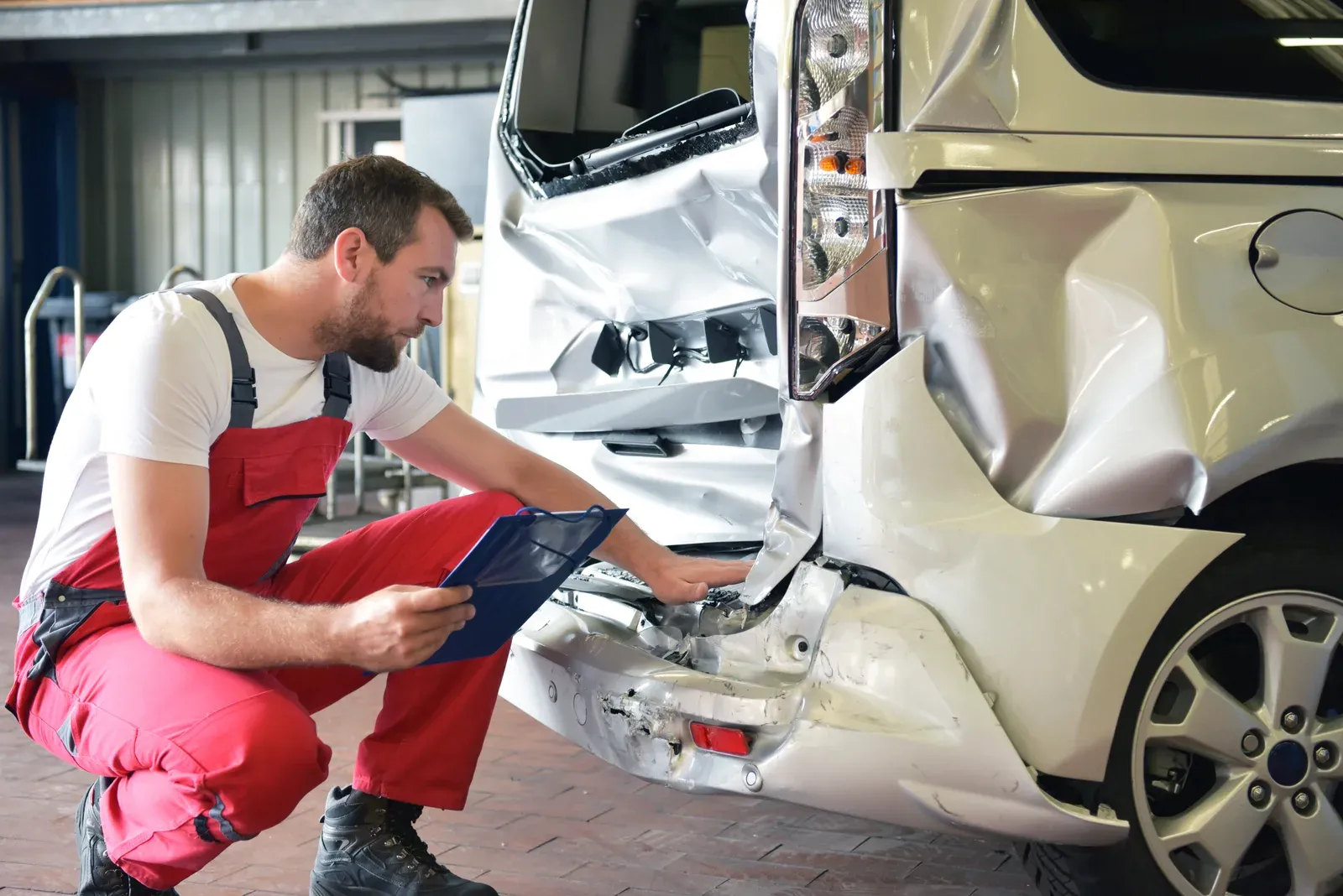
Before you drive off, check the post as well as the bumper
Most of these happen at walking speed: backing out of a plaza space onto a light standard, reversing in a tight drive-thru lane, or swinging the back of the car into a yellow bollard by a gas pump. Ease forward until the car is clear, put it in Park, and walk around to the back. Look at the bumper cover, the gap under the liftgate or trunk lid, the tail lights and the exhaust tips.
Then look at what you hit. A concrete-filled steel bollard rarely moves. A plaza light pole, a parking-sign post or a hydro pole can lean, crack its base or lose a cover. If you damaged someone else’s property, you have to tell the owner, which in a plaza usually means the management office or the business whose post it is. Leave your name and contact details, and photograph the post from the side so its lean shows. Damage to a pole on a public road should be reported to the municipality or the utility. If a hydro pole is leaning or a line is down on or near the car, stay inside unless there is fire, call 911 and keep everyone else back.
Because a pole or post is someone else’s property, a damage total that could exceed the provincial reporting threshold means a trip to the nearest Collision Reporting Centre, generally within 24 hours. A modern rear bumper with sensors can pass that figure on its own. If nobody is hurt and nothing else is involved, police do not need to come out.
A narrow post bends the bar behind the cover into a V
A bumper is designed to spread a hit across its whole width, like another car’s bumper hitting it. A pole puts the whole force into a strip a few centimetres wide. The plastic cover may pop back with only a crease, but behind it the foam absorber can be crushed in one spot and the reinforcement bar can bend inward in the middle while its ends stay in place. That bent bar is invisible until the cover comes off, and a reinforcement bent that way is normally replaced rather than straightened.
Above the bumper, look at the liftgate. On an SUV the lower edge of the liftgate sits just above the cover, and a tall post often catches it. A small dent there can throw off the latch, so the gate needs an extra push to close, or the gap along one side is wider than the other. A power liftgate that reverses on its own after the hit may have a bent bracket or a damaged sensor strip. On a sedan the same thing shows up as a trunk lid that does not line up.
Then the electronics. Parking sensors sit in the cover, and a backup camera often sits in the trim just above it. Ultrasonic sensors can miss a thin post, which is how many of these happen in the first place. Radar units for blind-spot and cross-traffic alerts sit in the rear corners. After the repair, those systems may need calibration and a scan before the car goes home. If you have a trailer hitch, check the receiver too; it can transfer the hit straight into the frame rails.
A post strike lands on your collision coverage with 100% of the fault
When the only things involved are your car and a fixed object, the claim runs under collision, or all perils where the policy uses that wording. There is no other driver to share the blame, so the Fault Determination Rules put it on you. Your collision deductible applies and the claim can affect your premiums at renewal. If you have no collision coverage, the repair to your own car is out of pocket.
Damage to the post is different. If the plaza or the city sends a bill to replace a light pole, that comes under the liability part of your policy, which pays for damage you cause to other people’s property. Send any letter or invoice like that to your insurance company rather than paying it yourself without telling them.
For a cracked cover and nothing behind it, paying directly is often cheaper than going through insurance. A bent bar, a damaged liftgate and sensors that need calibration can quickly add up to more than most deductibles. Even if you decide to pay yourself, your policy expects you to tell your insurance company about the collision, so make the call.
The cover comes off before a single part is ordered
Our estimator starts with the photos: one square to the back of the car, one close to the impact point, and one from the side so the cover’s shape shows. A post strike has a very clear shape on a photo, a narrow vertical dent with the paint pushed in around it, and that usually tells us whether we will find a bent bar underneath.
Once the car is in, the cover comes off before anything is ordered. We measure the gaps around the liftgate or trunk, check that the latch and any power-gate motors work properly, and scan the car for sensor faults. If the cover can be repaired, it is repaired and painted complete, with the neighbouring quarter panels blended on a metallic or pearl so the plastic does not look a shade off next to the metal.
Most of these cars are still drivable, which makes scheduling easier. If the gate will not latch, though, close it with a strap or bungee before you drive anywhere, because a gate that opens on the 404 is far more dangerous than the dent.
Questions people ask
The bumper only has a dent. Do I really need the bar checked?
If the dent is a narrow vertical crease, yes. That shape is what a post leaves, and it usually means the bar behind it took the force in one spot. The bar is what protects the back of the car in a real crash, so a hidden bend there matters even if the cover can be repaired.
The drive-thru wants me to pay for a scuffed bollard. Should I?
A paint transfer on a steel bollard is usually a cleanup rather than real damage. If they do send a bill, pass it to your insurance company, which handles damage you cause to property. Paying it yourself is fine for something small, but tell your insurance company about the collision either way.
My backup camera was on and I still hit the pole. Is the camera broken?
Not necessarily. Cameras distort distance at the edges of the image, and thin posts can fall between parking-sensor beams. After the hit, though, check that the picture is still lined up and the guide lines look right, since the camera or its mount can shift. That gets checked during the repair.
Will the hitch I use for my bike rack need replacing?
Only if it took part of the hit. A receiver that hit the post can bend, or push the crossmember it bolts to. We check whether it sits straight and whether its mounting points moved. If it is fine, it goes back on as it was. If it is bent, it is listed on the estimate.