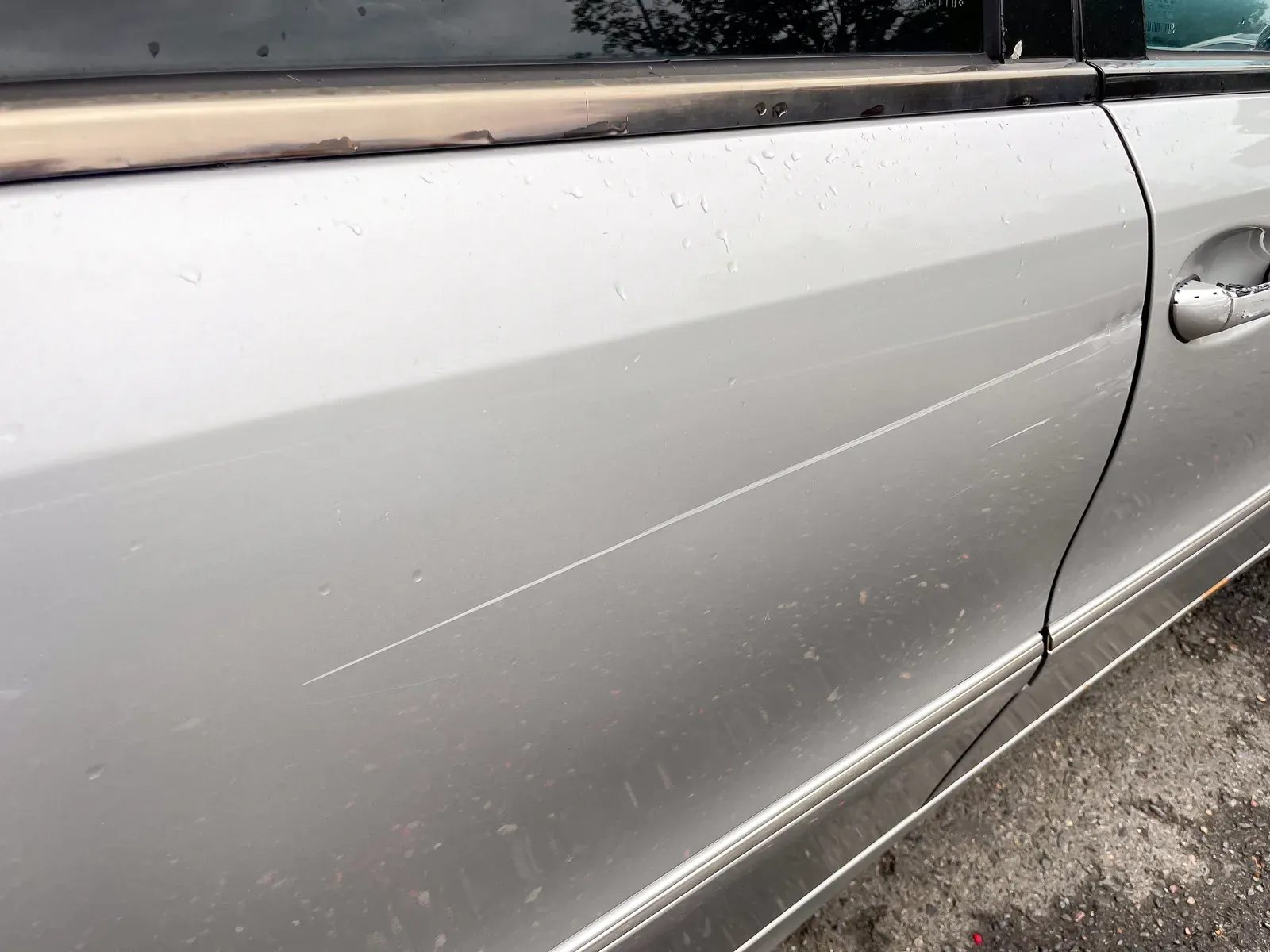
Scratches from the Rouge side of the neighbourhood
Malvern has a wild edge. East of Sewells Road the streets end at the Rouge, and Old Finch Avenue and Sewells run narrow through the trees with gravel shoulders and no curb. Pull over for an oncoming truck and the branches lay a set of fine parallel lines down the passenger side. The trail lots along the valley are gravel, and the Zoo lot on a summer weekend is thousands of cars parked tight; both hand out bumper-corner scuffs and the odd stone chip in a door. In spring the grit that washes onto Meadowvale and Old Finch sandblasts the lower doors and rockers.
On the built side of Malvern the scratches are more deliberate. Keys down a door on a crescent where the car had to park on the street. A brick garage-court corner that takes the paint off a rear quarter in a single arc. Cart edges at Malvern Town Centre. And the stone chips the 401 at Neilson throws at every hood in the collectors behind the trucks from Milner.
Brush lines polish out; keys and brick corners need paint
Wet the panel and watch the line. One that fades while the water sits on it is in the clear coat, and it comes out with compound and a polisher without any paint at all. One that stays sharp when wet has gone into the colour or down to primer or bare metal, and the fix is to refinish: sand the area, prime any bare spots, apply colour matched to the panel around it, and blend so there is no edge to find. Brush scratches are almost always the first kind. Key marks and brick corners are almost always the second.
We will not sell paint for a scratch that polishes out, and we will not polish one that needs paint; compound only hides a deep scratch until the next few washes. A scratch that crosses from a door to a quarter is refinished on both panels so the colour reads the same across the gap. Solid white or black can sometimes be spot-repaired inside a panel; the silvers and pearls that fill Malvern’s courts need a blend to disappear. Refinished panels carry a lifetime warranty.
- Clear-coat scratches polished, no paint involved
- Colour and primer scratches refinished and blended
- Runs of stone chips on a hood treated as one repair
- Depth read from your photos before the car comes in
Paying for it, and fitting it in
A keyed door on a crescent is vandalism, and it is usually claimed under comprehensive coverage rather than collision, which means it does not count as an at-fault claim; the deductible still applies, and we tell you whether the repair cost clears it before you decide. A brush scratch or a cart mark is nearly always a pay-directly repair. A scuff on a Tapscott work van is a business expense, and the estimate is itemized so it can go straight into the books.
A polish takes an hour or so and pairs well with a Fairview Mall errand next door. A painted scratch keeps the car for a couple of days, and for a one-car household we book it to the start of days off. For the photos, shoot straight on and then from a low angle in daylight so the depth shows, and add one of the whole panel so the blend can be planned. Our estimator reads them and tells you which kind of scratch you have.
Questions people ask
Branches scratched the side of my car on Old Finch. Is that a paint job?
Usually not. Brush leaves fine lines in the clear coat that polish out without paint. If a branch was thick enough to catch a fingernail, that section gets refinished and the rest polished; we can tell from a photo taken in daylight at a low angle.
Spring grit on Old Finch has dulled my lower doors and rockers. Is that fixable, or just what happens here?
It is fixable, and it is judged by depth like any other mark. Grit blasting usually frosts the clear coat, and a machine polish brings the gloss back; years of it can wear through to colour along the rocker, and that section needs paint. Photos taken in low sun show the frosting clearly — send one of each lower door and the estimate separates the polish panels from the paint ones.
Will the repaired scratch show under the parking-lot lights?
Not if the panel has been blended rather than spot-painted with a hard edge. Metallic and pearl colours are checked under both daylight and artificial light before the car goes back, because the visitor-lot lights at night are where a bad blend shows first.