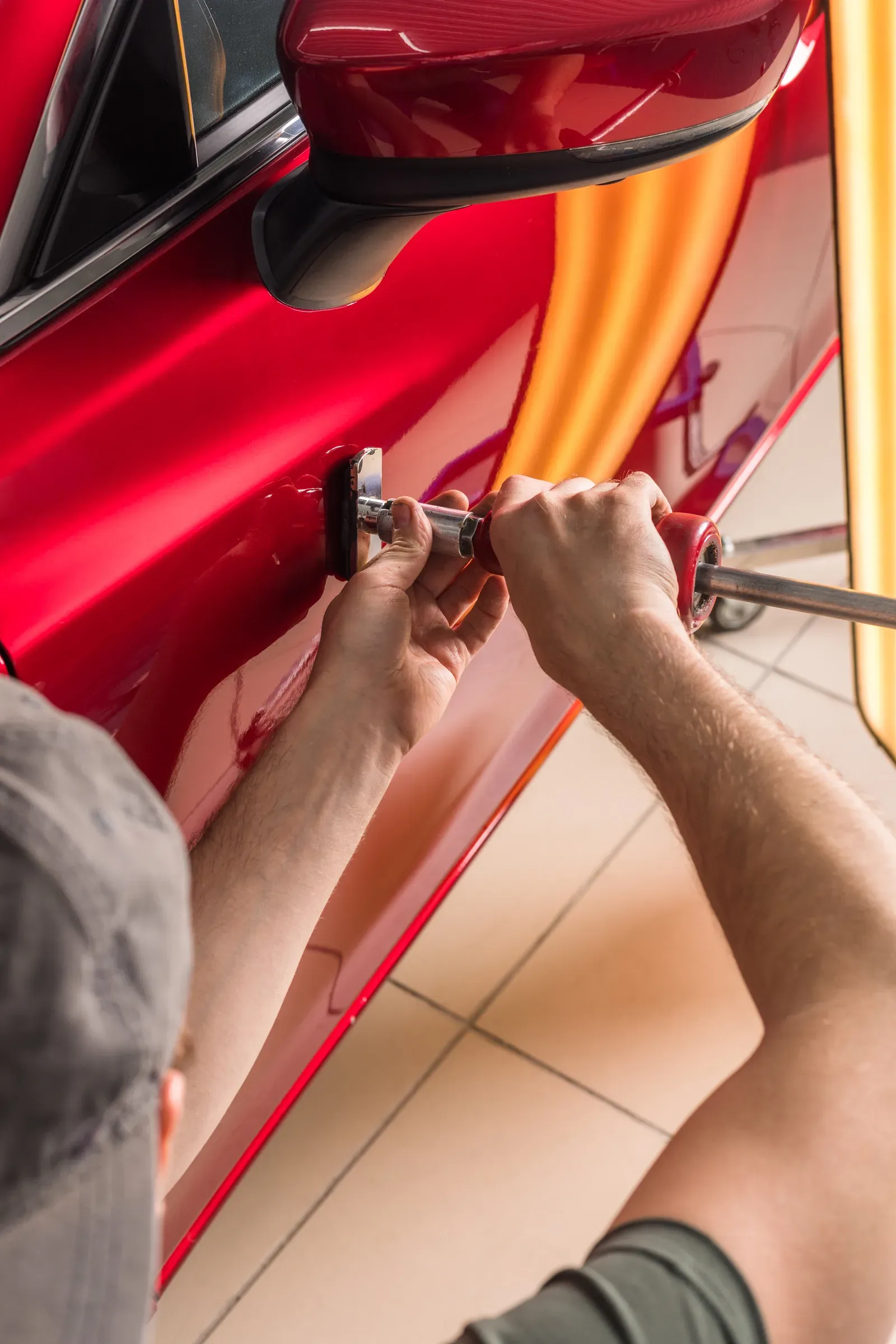
Paintless dent work travels well because nothing has to cure
A technician pushing a door ding out from behind needs rods, a light board and a way to reach the back of the panel. None of that depends on a clean room, and no product has to dry, so a skilled tech can do the same quality of paintless work in an office lot as in a bay. Plenty of good dent technicians run mobile for exactly that reason.
The limits are physical rather than about the address. Paint turns brittle in the cold, so a GTA January driveway well below freezing is a riskier place to push a panel without cracking the finish, and the tech may ask for a heated garage or a milder day. Wind and low winter sun make the reflection board harder to read. A tight underground spot in a condo near Yonge and Sheppard may leave no room to get at the far side of the door.
What paintless work cannot do anywhere is fix broken paint, a sharp crease that has stretched the metal, or a dent with no route behind it that glue tabs cannot reach either. Those push the job into refinishing, and that is where location starts to matter a great deal.
Sprayed paint needs controlled air, and a driveway offers none
Dust comes first. A booth filters incoming air and moves it in one direction so particles leave the panel instead of landing on it. Outdoors, wind carries grit, pollen and the occasional insect into wet clear, and each one becomes a speck that has to be sanded and polished out or left in place.
Temperature and humidity come next. Paint and clear makers print an application temperature range on their technical data sheets, and a Toronto driveway sits below it for a large part of the year. Cold slows solvent release and cure, and muggy summer air can cloud some clears. Spring and fall mornings that start near freezing catch people out even when the afternoon feels mild.
Then curing. A booth can bake the panel so the clear reaches handling hardness on a predictable schedule. Air-dried clear on a driveway stays soft longer, and a car that heads onto salted roads or through a wash too soon can mark or dull a finish that looked fine the evening it was sprayed.
Overspray is the neighbour problem. Fine mist drifts, and in a shared garage or a tight townhouse lane it can settle on someone else’s car. Check your building’s rules before booking a technician into an underground garage.
Spot repairs disappear on some colours and show on others
A spot repair, sometimes sold as a smart repair, keeps new paint to a small area on a bumper corner or door edge and melts the edge of the new clear into the original with a blending solvent. On a solid colour, on a plastic bumper corner, a well-done spot can be hard to find.
Metallic silvers, greys and pearls are harder, because flake in a small sprayed patch rarely lies the way the factory finish around it does, and the patch reads as a slightly lighter or darker circle at an angle. The melted clear edge is the weak point too: on a panel that gets sun and regular washing, it can show as a faint ring within a season or two.
- Good candidate: a scuff on a bumper corner in a solid colour, low on the car and out of direct view
- Poor candidate: anything on a hood, roof or trunk lid, where sunlight lands flat on the surface
- Poor candidate: damage that crosses a body line or wraps around a panel edge
- Poor candidate: a three-stage pearl white, where depth of colour depends on a counted number of mid-coats
- Not a candidate: a scratch through to primer or metal along most of a door
Polishing out light scuffs is the mobile job that most often earns its fee
Marks that sit only in the clear coat, such as transfer from another bumper in the Fairview Mall lot or light swirls from a brush wash, can often be machine-polished away anywhere with power and some shade. The result tells you the depth: if the mark is gone after a careful polish, it was in the clear; if it fades but still catches light when wet, it reaches the colour, and polishing harder only thins what protection is left.
A mobile detailer who stops at that point is doing the job properly. One who keeps cutting into factory clear to chase the last trace is setting up a clear-coat failure for next year. Touch-up paint dabbed into stone chips from the 404 is another worthwhile mobile job, for protection, as long as nobody expects the chips to vanish.
Warranty and paperwork are where mobile and shop repairs differ most
A mobile spot repair is usually backed by whatever the technician chooses to offer, which may be a short period or a promise to come back. Refinish work at our shop carries a lifetime warranty on paint and refinish, written down and tied to the invoice.
The paperwork matters beyond the paint. Insurance claims are written and paid through a shop estimate, and few mobile operators handle the claim side. A leased car going back is inspected under bright light, and a halo around a spot repair can be charged at turn-in. Where the hit landed near parking sensors or a radar module tucked inside the bumper, those parts may need recalibrating afterward, and that calls for shop equipment.
None of that makes mobile work a bad choice. It makes it the right choice for paint-free dent removal, polishing and a narrow set of small solid-colour spots, on a car you plan to keep and are comfortable inspecting yourself.
Three questions settle where the repair should happen
Run the damage through these before booking anyone. Then send daylight photos, one straight on and one along the panel, to a mobile tech and a shop and compare what each proposes; the answers often decide it for you.
- Does any colour or clear have to be sprayed? If not, mobile is a fair option.
- Is the damage on a metallic or pearl, or on a flat surface facing the sky? If so, lean toward a booth.
- Does the job need an insurance estimate, a lease-return standard or a sensor check? Then it belongs in a shop.
Questions people ask
Can a mobile technician repaint a whole bumper cover in my driveway?
Some will, but it is the job most affected by outdoor conditions. A full cover needs colour and clear across a large curved surface, and dust, cold and an air-dried cure all show more across that area than in a small spot.
Is mobile dent removal safe on an aluminum hood?
It can be, in skilled hands. Aluminum is softer than steel, has less memory and work-hardens as it is pushed, so it needs slower, more careful work. Ask whether the technician regularly repairs aluminum panels before booking.
Why does my mobile touch-up look fine in the garage but not in the sun?
Garage lighting is soft and comes from overhead. Low, direct sun shows texture, edges and flake orientation that diffused light hides, which is why any paint repair should be judged outdoors before you pay.
Will a body shop fix a mobile spot repair that did not hold?
Yes. Usually the patch is sanded back and the panel refinished in a booth, which means the spot repair is redone at the full scale the damage needed in the first place.