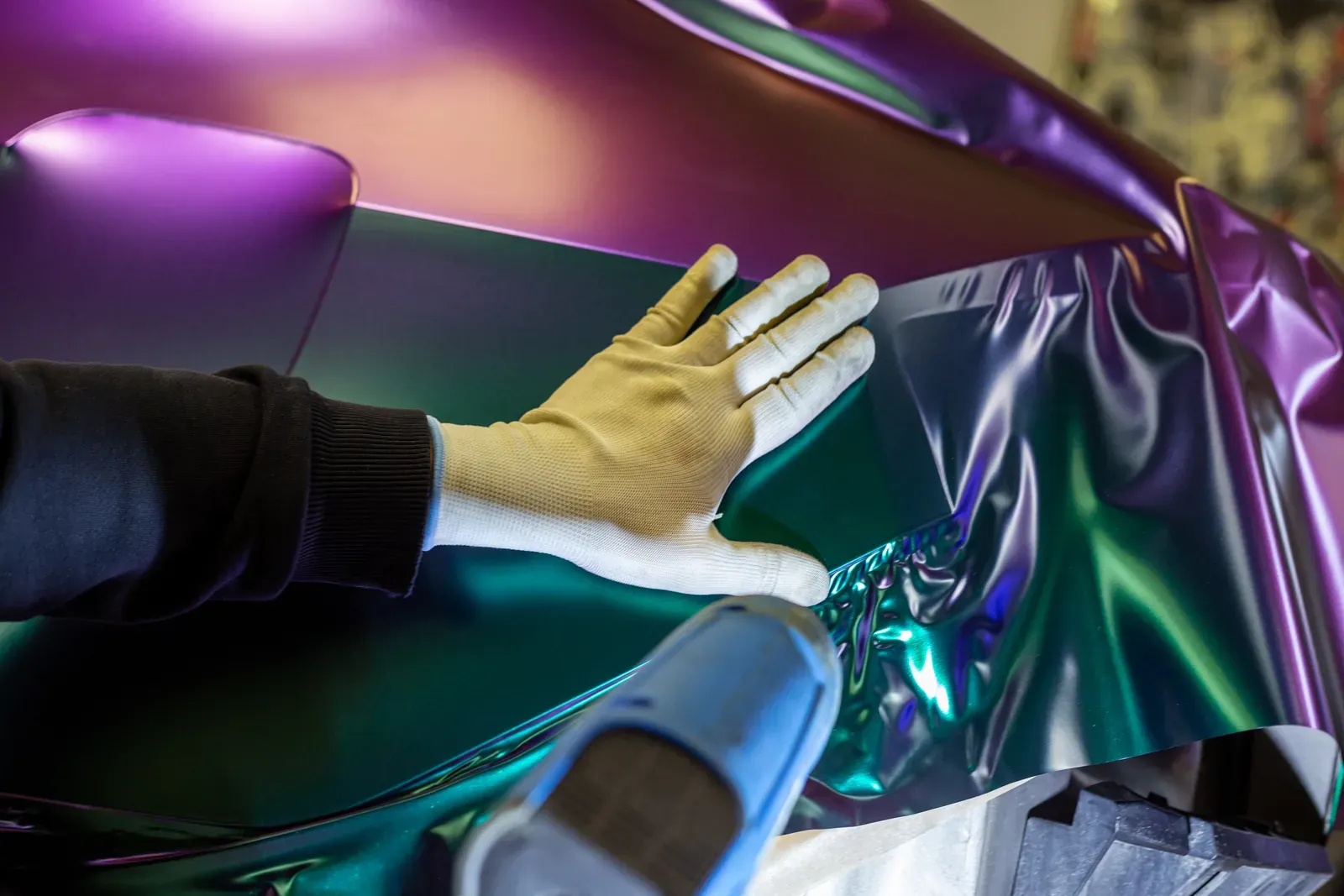
The film comes off before anyone can see how far the damage goes
Vinyl stretches over dents, creases and cracked bumper covers and hides their real extent. Before an estimate can be final, the film on the damaged panel, and usually on the panels touching it, has to come off.
Film is released with gentle heat and a slow pull at a low angle, so the adhesive lets go of the paint instead of taking paint with it. Wrap installers do this every day; we repair and refinish, and the vinyl itself is a wrap shop’s trade. On most jobs the owner’s installer strips the affected panels before drop-off, and we line up the dates so the car does not sit bare longer than it must.
Cold makes removal harder. Vinyl that has been through several Toronto winters and summers turns brittle and comes off in chips rather than sheets, so in January the job belongs in a heated bay, not on a driveway. Cast film generally releases more cleanly than cheaper calendered film, which tends to shrink and leave more adhesive behind. Residue is cleaned off before any sanding starts.
A first estimate can still be written from photos of the wrapped car, on the understanding that the damage under the film may be larger. If it is, our estimator sends the added work to your insurance company as a supplementary estimate once the film is off.
Paint that lifts with the vinyl was usually weak before the wrap went on
Sound factory paint normally survives a careful removal. Paint that comes away on the back of the film is almost always paint that was already compromised: an earlier respray with poor adhesion, clear coat that had started to fail, or a panel painted shortly before it was wrapped.
That is why a car whose roof was peeling before it was wrapped can shock its owner at removal, with sheets of clear stuck to the vinyl. It is also where an older, hidden body repair tends to reveal itself, because a poorly prepared refinish releases where factory paint holds. Any paint that lifts on a panel near the repair is photographed and noted before work begins, so it is clear what is collision damage and what was already there.
Paint under a wrap is also a different shade from paint that stayed exposed. Door jambs, the underside of the hood edge and the area under mirror bases were often never covered, and they aged in daylight while the paint under the vinyl did not. That affects which colour the refinish is matched to.
Decide early whether the new paint has to stand on its own
Before work starts, settle whether the repaired panel is being painted to be seen or only to be wrapped again. The structural repair is identical either way; what changes is how far the colour work goes.
If the car may be unwrapped later, for a lease return, a sale or a change of mind, the panel should be refinished and blended to the factory colour as if no wrap existed. Leasing companies generally expect the car back in its original colour, and a repaired panel that does not match under the film becomes a problem the day the vinyl comes off.
If the car will stay wrapped and you accept that, the panel still has to be straightened, primed, sealed and painted close to the original colour, with a smooth, level clear. Vinyl shows every ridge, sanding mark and dust nib underneath it, so surface quality matters even where colour does not. Our estimator writes the chosen approach into the estimate, so your insurance company, you and the installer all work from the same plan.
- Jambs and tucked edges: paint visible in door openings still has to match
- Body lines: filler work must be crisp, because film follows every contour
- Clear: level and fully glossy, since nibs telegraph through vinyl
- Panel gaps: set to factory so the installer can tuck film evenly
Vinyl that has spent summers in the sun rarely matches a fresh roll
A new roll of the same film seldom looks identical to film that has been on the car for a few years. Vinyl fades and shifts with ultraviolet exposure, and separate production batches of one colour can differ slightly even when new.
Installers handle this in a few ways. On a recent wrap, a new panel from the same film line usually disappears, especially when it ends at a natural break such as a door gap. On film that has spent four or five summers on a Markham driveway, a single new door can read as a brighter patch from the sidewalk, and rewrapping the whole side, or the whole car, is sometimes the only way to lose it. Colour-shift, chrome and printed films are the hardest to match, and a discontinued film may not be available at all.
Keep the film brand, colour name and any lot number from the original install invoice. Your installer can check whether that line is still made and order from a close run. Whether your insurance company pays for one panel of vinyl or more depends on the policy and the adjuster, so mention the wrap when you open the claim and send them that invoice.
New film goes on only after the paint underneath has cured
Vinyl laid over fresh refinish traps solvent under the adhesive, and the result is bubbling, edge lift and adhesive that bonds unevenly to soft clear. The wrap has to wait.
Film manufacturers publish a minimum age for painted surfaces before application, and we give a cure date for your panels at pickup; the installer should work to the later of the two. That leaves the repaired panel bare for a few weeks. On a car wrapped in a colour far from its paint, or a contractor’s van that runs Steeles every day with its company graphics on the side, it will look odd in the meantime, so plan for it.
Driver-assist hardware needs the usual attention. Bumper and mirror work may require radar or camera recalibration, and that should be done before film goes back on. Vinyl over a radar zone or a parking sensor should follow the vehicle maker’s guidance on what may cover it.
Questions people ask
Can a small dent be fixed through the wrap without removing it?
Sometimes. A minor door ding can occasionally be pushed out from behind without disturbing film, if the vinyl is not creased or overstretched at the dent. Anything needing filler, paint or a new panel means the film comes off that panel first.
Do you remove and reinstall the wrap yourselves?
No. We repair and refinish the panel and coordinate timing with your wrap installer. If you no longer use one, start with the company that did the original install; they have the film details and know how it was laid on your car.
The wrap was put on partly to hide old damage. What happens now?
It comes to light when the film is removed, and it is not part of the new claim. Our estimator separates the fresh damage from what was there before, in writing, so you can decide whether to fix the older work at your own cost while the car is already apart.