Black ice on Bayview through the ravine
The stretch of Bayview that drops into the Don Valley below Leaside is shaded, damp and the first road in the area to glaze over on a cold morning. A car coming down toward the valley with the wheel turned a little finds the curb, the guardrail or the far bank, and the hit goes through the wheel into the suspension mount and the front rail behind it. Millwood on the bridge is the same story with wind added. These are the collisions that leave a car looking almost fine and driving wrong: pulling to one side, a steering wheel off-centre, a tire wearing on one edge.
The other Leaside frame hit is the side impact at a signal, most often Laird at Eglinton or Bayview at Eglinton, where a car turns across the through lane and takes a hit on the B-pillar or the rocker. On a modern unibody the door, the rocker and the floor are all structure, and a hit that pushes the pillar in a couple of centimetres has moved the roof rail and the floor with it. That is not a door job.
The printout from the measuring bench decides what gets pulled and what gets replaced
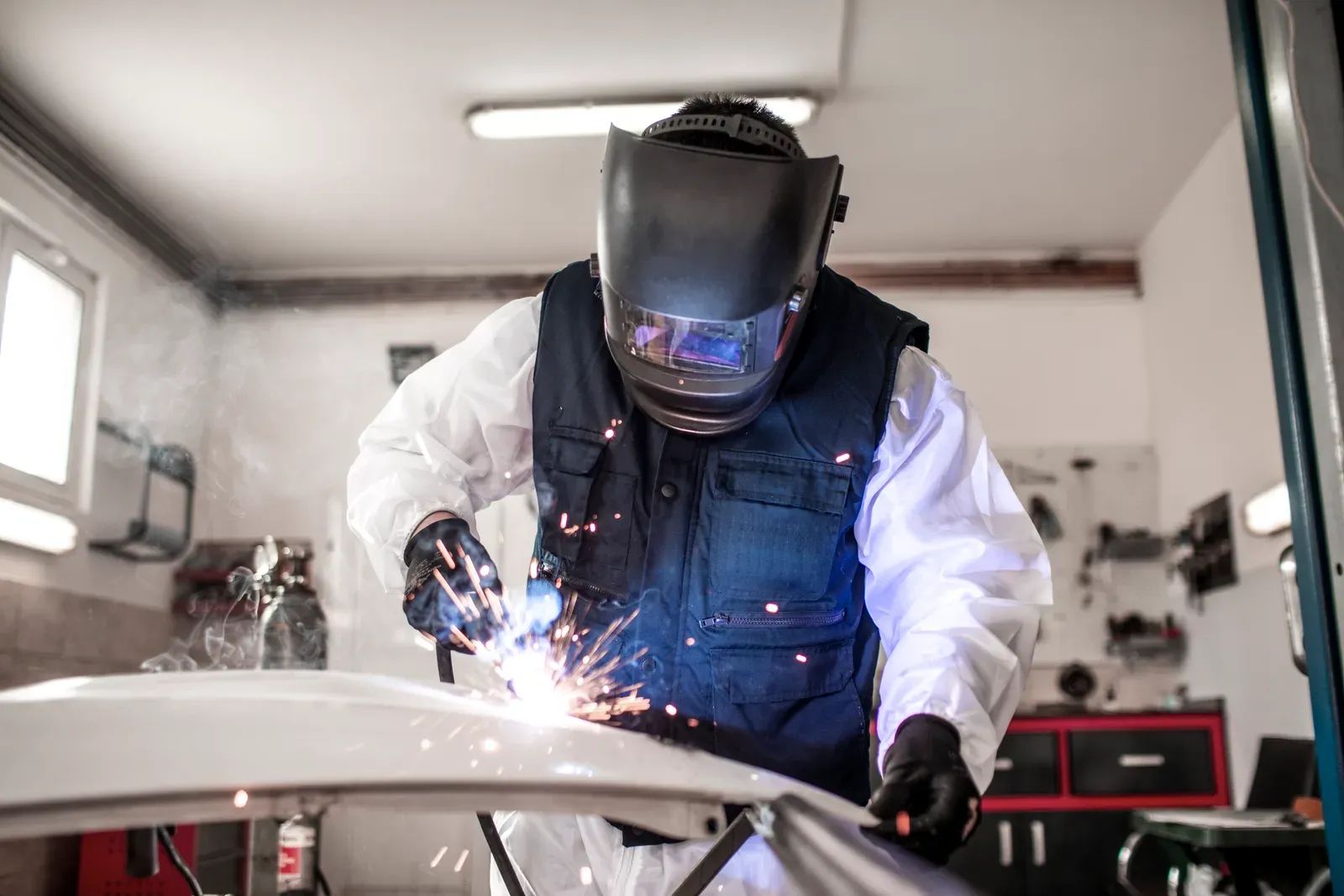
Almost nothing in a Leaside driveway has a frame in the old sense. The body is the structure, made of steels of very different strengths welded into one shell, and that changes what repair means. The car is mounted on a bench, dozens of reference points are measured electronically against the manufacturer’s dimensions, and the printout shows exactly what has moved and by how much. Mild steel rails can be pulled back to specification with controlled force. Ultra-high-strength pillars and rails cannot be pulled without weakening them, so they are sectioned out at the points the manufacturer allows and new steel is welded in.
Then it is measured again, because a pull that brings one point home can move another. Only after the structure reads within tolerance does the repair move on to panels, suspension alignment and paint. On cars with driver-assistance systems, the cameras and radar depend on the body being where the manufacturer expects it, so the repair may require recalibration once the structure is right. The paint and refinish are warranted for life; the structure is documented with before-and-after measurements you can keep.
When the numbers decide: repair, total loss and the claim
Structural repairs are where the insurance conversation gets serious. The adjuster compares the repair cost against the car’s actual cash value less its salvage value; Ontario sets no fixed percentage, so the decision is arithmetic on your specific car. A newer SUV with a bent front rail is usually repaired. An older sedan with a pushed pillar may not be, and if the car is written off you can generally ask to keep it and buy back the salvage. Our estimator walks you through the numbers either way rather than letting the file go quiet.
For a repair, we ask the insurance company for OEM structural parts, because a rail or pillar is where like-kind-and-quality is not good enough. Under DCPD a not-at-fault hit is paid by your own company, fault is set under the Fault Determination Rules, and a collision that passed the provincial reporting threshold with nobody injured has to be reported at the nearest Collision Reporting Centre. A car with a bent rail is not driven to Sheppard; you tell the tow operator the destination, and the rental through your coverage is arranged for the length of the repair — usually weeks, and we give an honest range once the bench has spoken.
Questions people ask
The car pulls to the right since I hit the curb on Bayview. Is that frame damage or just alignment?
It could be either, and the only way to know is to measure. A bent control arm or knuckle alone shows up as alignment that will not hold; a rail or a suspension mount that has moved shows up as reference points out of tolerance on the bench. Send photos of the wheel, the fender gap and the tire, and do not drive it far — a wheel that is pointing somewhere new is also a wheel that can fail.
Is a car with a straightened unibody as safe as it was before?
When it is measured to the manufacturer’s dimensions, repaired using the manufacturer’s procedures and the right steel, and measured again afterward, yes. The parts of the shell designed to crush in a collision are replaced rather than straightened, so they can do their job a second time. Ask for the measurement printouts; a shop that has done the work properly will have them.
Who decides whether my car is a write-off — the adjuster or the shop?
Your insurance company makes the decision, using the repair estimate we write and their valuation of the car. Our job is to make the estimate complete, with the structural measurements and the OEM parts the repair needs, so the decision is made on real numbers. If you think the valuation is low, you can challenge it with comparable listings, and we help with the evidence.