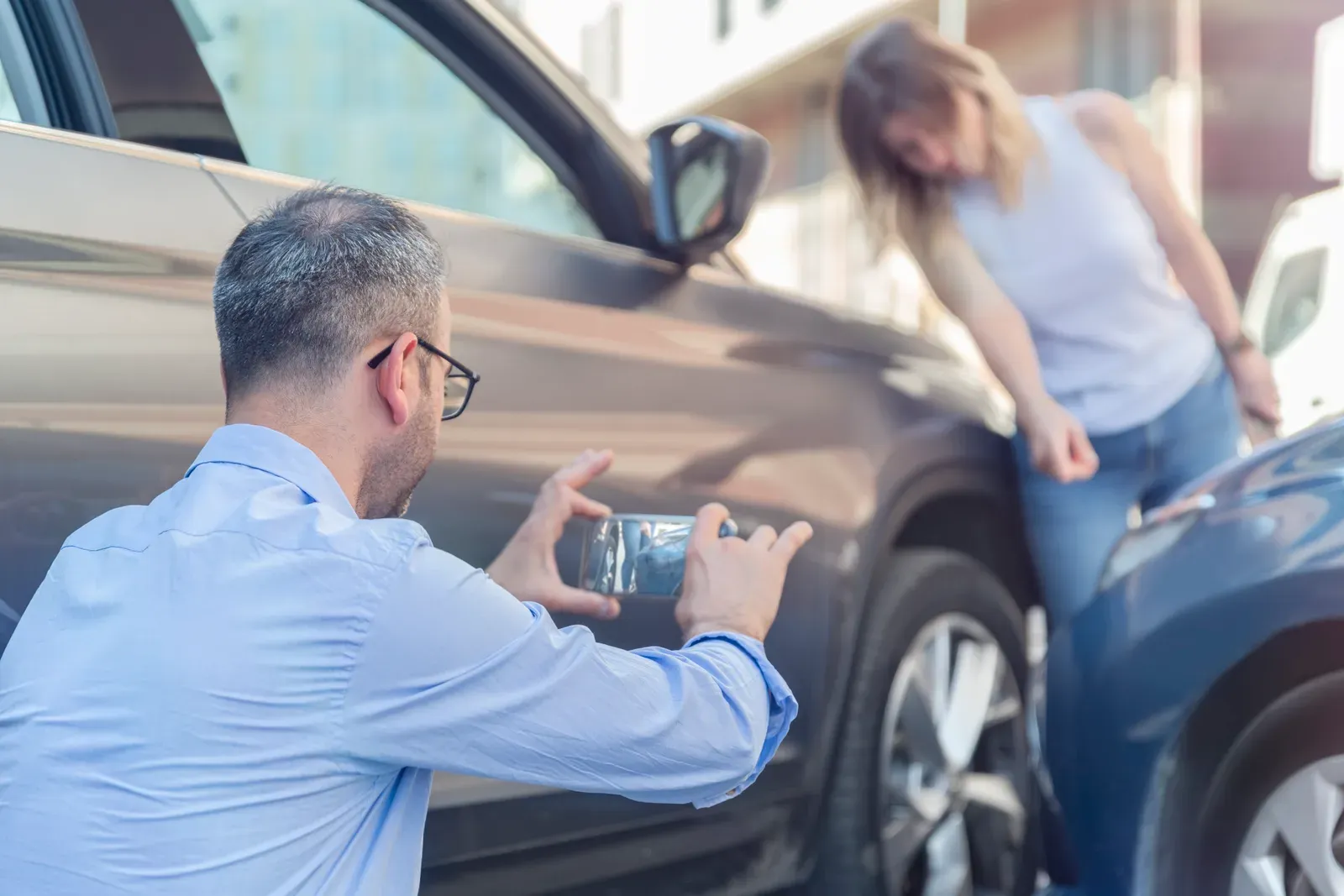
Start with people, then use four checks to decide about the car
An electric drivetrain does not change the usual order at a crash. Injuries mean a 911 call on the spot and staying put until police arrive. With no injuries, get the cars out of live lanes if they can move safely, swap details with the other driver and photograph both vehicles. Whether you then go to a Collision Reporting Centre depends on the damage and the other driver, not on whether your car is electric.
Once that is handled, an EV needs four quick checks before you decide to drive it. None of them needs tools, and together they take a couple of minutes at the curb.
- The dashboard: any message mentioning the high-voltage system, the battery, the drive system, or an instruction to stop safely.
- The underside: did anything hit the floor of the car, such as a curb, a median, debris or the other vehicle riding up?
- Your senses: a sweet or chemical smell, smoke or vapour, popping or hissing from under the car, or heat from the floor.
- The drive: does the car power up, select drive and creep forward normally?
Battery warnings and underbody strikes are the two that rule out driving
In most EVs the battery sits under the cabin as a large flat case running between the axles. A bumper tap in a Fairview Mall lot or a slow nudge in DVP traffic usually never reaches it. A hit that does reach it is one from below or a hard side impact: sliding over a curb on black ice, bottoming out on a median, striking debris on the 401 that passes under the car, or a crash where the other vehicle rides up.
If any part of the impact touched the underside, or the dashboard shows a high-voltage or battery message, treat the car as not drivable even if it seems to run. A damaged pack can be fine for a while and then deteriorate, and the car’s own message is the manufacturer telling you its systems have detected something. A reduced-power or turtle symbol after a collision belongs in the same category.
If there is smoke, a strong chemical smell, hissing, popping or noticeable heat from the floor, everyone leaves the car, puts real distance between themselves and it, and then dials 911. Tell the dispatcher it is an electric vehicle so the fire service knows what it is dealing with. Do not try to push it, tow it with a strap or retrieve belongings from it.
A light hit with no warnings is usually drivable, but drive it gently and get it checked
If the hit was clearly to a bumper cover, a door or a corner light, no messages appeared, nothing touched the underside and the car drives normally, it is usually fine to drive home or to a shop. Keep it to local roads if you can, watch the dashboard on the way, and stop if anything changes.
Two cautions make sense for the first day. Avoid DC fast charging until the car has been looked at, because fast charging pushes the most current through the pack and its cooling system. And if you live in a condo, think about where you park it overnight. Battery problems after a collision can show up hours or even days later, and a car parked outdoors away from buildings is easier for everyone to deal with than one in a crowded underground garage. If you notice a smell or warning later at home, call 911 rather than moving it yourself.
Even a minor-looking EV hit is worth a proper inspection. The radar, cameras and parking sensors in the bumper may need attention, the cooling lines at the front are closer to the surface on some models, and a scan can show stored faults that never lit a warning.
When you call for a tow, say it is an EV and ask for a flatbed
If the car should not be driven, tell the tow operator at the first call that it is an electric vehicle, with the make and model. Most manufacturers say an EV should travel on a flatbed with all wheels off the ground, because the drive motors turn whenever the wheels do. Many cars also have a tow or transport mode that releases the parking lock, which the operator may need you to select from the screen.
The destination is your call in Ontario, not the operator’s, so a yard suggested at the roadside is only a suggestion. If you want it brought to us, we help arrange the tow and ask that the EV be parked outdoors and apart from other vehicles until it has been inspected. Our estimator can walk you through it on the phone in English or Mandarin.
What happens once the car reaches the shop
The first step is a scan and a visual check of the underside and the pack case before any panel comes off. If there is any sign the battery or high-voltage system was affected, that part of the work follows the manufacturer’s procedure and may involve a dealer or a battery specialist. The answer on what is different about EV collision repair explains the shop side in more detail, and the guide on EV body repair covers how panels and parts differ.
Questions people ask
The car drove fine for a day after the accident. Can a problem still appear?
Yes. If anything hit the underside, a fault can surface later. A clean drive does not rule out damage, which is why an underbody strike should be inspected even when the car seems normal.
Can I charge my EV at home the night of a minor bump?
If there was no underbody contact, no warning and no smell, a normal home charge is usually fine. If you have any doubt, wait until the car has been scanned and inspected.
Does the tow cost more because my car is electric?
It can, since a flatbed is usually required. Ask for an itemized invoice. On a covered collision claim, towing is normally part of what your insurance company handles.