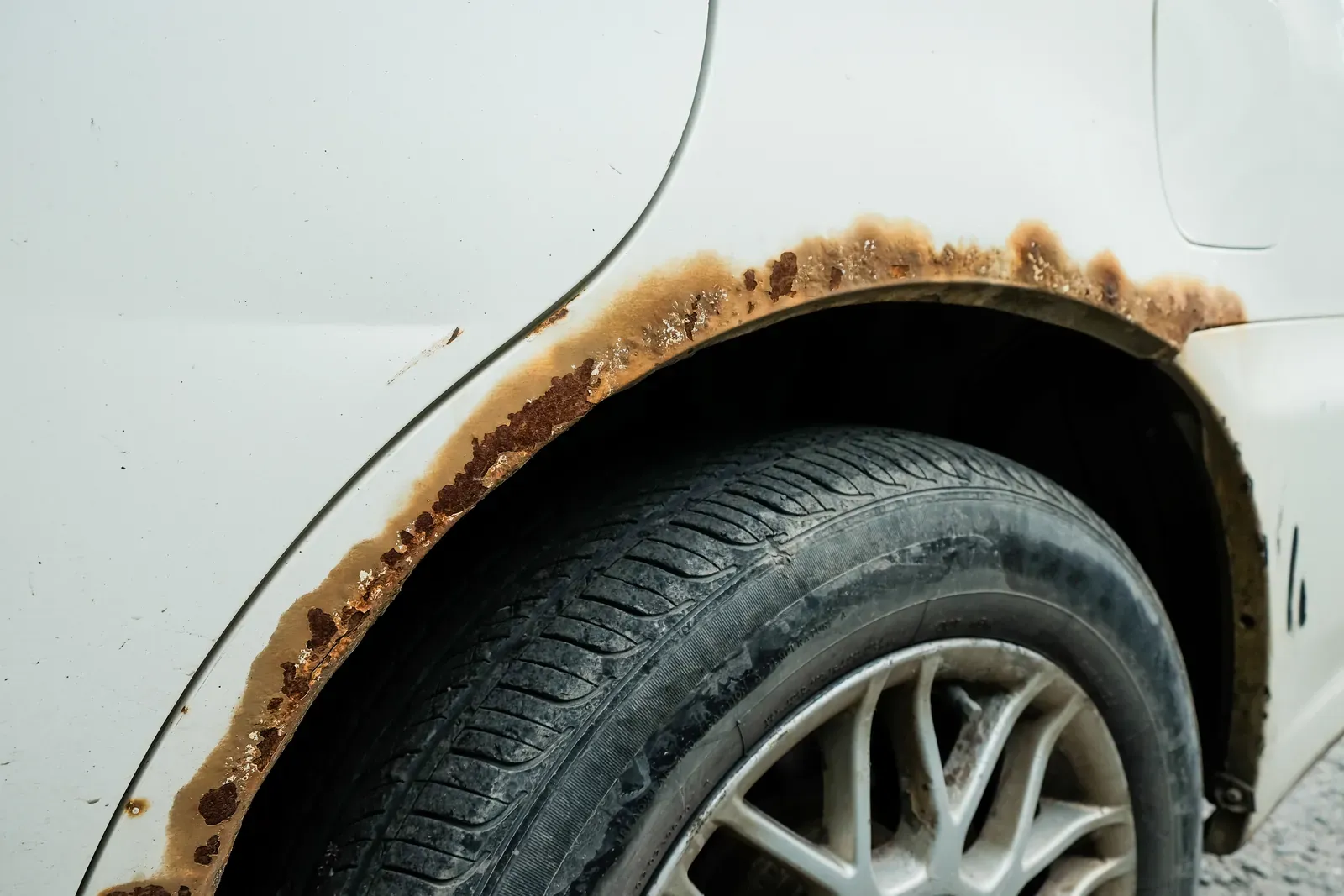
QEW brine, Speers Road potholes and a warm garage every night
Winter here does what winter does across the GTA — salt, slush and potholes — and Oakville adds a commuter’s dose of it. The QEW is salted heavily and early because of its traffic, and a car that runs it every day carries a film of brine into the garage each night. Freeze-thaw in February and March opens potholes on Speers Road and Kerr Street that chip the paint behind the front wheels and start an arch rusting from a stone chip outward. Heated garages, common on the estate streets, are the quiet accelerator: a warm garage melts the slush off the rockers every night and keeps the salt wet in the seams, where it works all winter. The result is the pattern we see across the region: bubbles on the rear wheel arches, a soft spot on the rocker behind the front door, and rust in the dogleg where the rear door meets the quarter panel.
Which Oakville cars come in for rust
It is rarely the leased SUV in the driveway. Those go back to the lease company before rust becomes visible, and most premium cars now use galvanized or aluminum panels where it matters. The Oakville rust job is the second car: the ten-year-old Japanese compact the teenager drives to Sheridan, the pickup that tows the boat to Bronte harbour, the wagon someone has kept because it is paid for. On those, the honest conversation is about scope. Surface rust and small bubbles on an arch can be ground back to clean metal, treated, primed, sealed and refinished, and that holds for years if the inside of the panel is coated too. A rocker that has gone soft has usually rusted from the inside, and the only real repair is to cut out the section, weld in new metal, seal the seams and refinish, then coat the cavity. Patching over soft metal with filler is a repair that fails by the following spring, and we do not do it. On a car worth little, our estimator will say the repair does not make sense; on a car worth keeping, it is one of the better investments the owner will make, and it usually needs a Safety Standards Certificate conversation if the car is about to be sold.
Is this the job to drive to North York for?
Rust is the service where we say the drive is not worth it most often, and we would rather say it from photos than after you have paid the 407 toll. A single arch bubble on a car with three winters left in it is a job for a shop near Kerr Village. What does bring Oakville rust jobs east is scale and referral: a rocker-and-arch job on all four corners of a car the family wants to keep another decade, a truck that needs its bed sides and cab corners done in the same visit, or an owner sent by a relative whose car we repaired. In those cases we plan it like any other job at this distance. Photos of each rusted area from a metre away and close up, with a screwdriver pressed gently on the rocker to show whether it is soft, go to our estimator for a written estimate. Rust is almost never insurance work, so the estimate is the budget, and it is itemized by area so you can decide what to do now and what can wait. Drop-off is one trip, the job usually runs a week or more depending on how many areas are being cut, and the rental is your own arrangement, since coverage rarely applies to rust.
Questions people ask
The rocker on my older Honda sounds hollow when I tap it. Is that already too far gone?
Hollow means the inner structure has thinned and the outer skin is holding its shape on its own. It is repairable by cutting out the section and welding in new metal, inner and outer, and it is worth doing if the rest of the car is sound. Send a photo and a short video of the tap; our estimator can usually judge the scope from that.
The pickup that launches our boat at Bronte backs into the lake every weekend all summer. Is that why the back half is rusting first?
Partly, but not the way people assume. Lake Ontario is fresh water, so the ramp adds no salt; what the launch does is keep the rear frame, bumper mounts and cavities wet all summer, which lets whatever road salt is still sitting in the seams from March keep working instead of drying out. Rinse the underside after the last launch of the season and have the cavities oiled in the fall, and the back half will age at the same pace as the rest of the truck.
We want to keep the wagon another five years for the Sheridan run. Which rust gets fixed now, and which can wait?
Anything soft or spreading from a seam goes first: a rocker you can flex with a thumb, or a dogleg bubbling at its edge, grows every season and takes the repair cost up with it. Arch bubbles that started from a stone chip move slowly and can wait a year if the budget says so. Our estimator marks each area on the estimate as now or later, and coating the repaired cavities is what buys the five years.