The hits that bend Oakville cars
The QEW is fast and full, and the crashes that bend structure happen at highway speed. The rear-end into the Trafalgar Road backup drives the rear rails forward under the trunk floor. First snow reliably spins someone into the median barrier near Bronte Road, and a barrier strike loads a front corner and its strut tower in ways a bumper photo never shows. Where the 403 leaves the QEW at Ford Drive, three lanes sorting themselves out produce the long sideswipe that folds a rocker down the side of a long-wheelbase SUV — damage that runs under the doors, past the pillar bases, and cannot be judged from above.
The evidence afterward is quieter than the crash. A door that needs a lean where a push used to do. A hood gap that tapers enough to read from three paces. New tires scrubbing their inside shoulders within a month. Wind noise at 110 that was not there in June. Any of those after a hit means the structure should be measured, whatever the panels look like — and on a leased car it matters twice, because the return inspector reads panel gaps for a living.
The bench works in millimetres, and aluminum follows its own rules
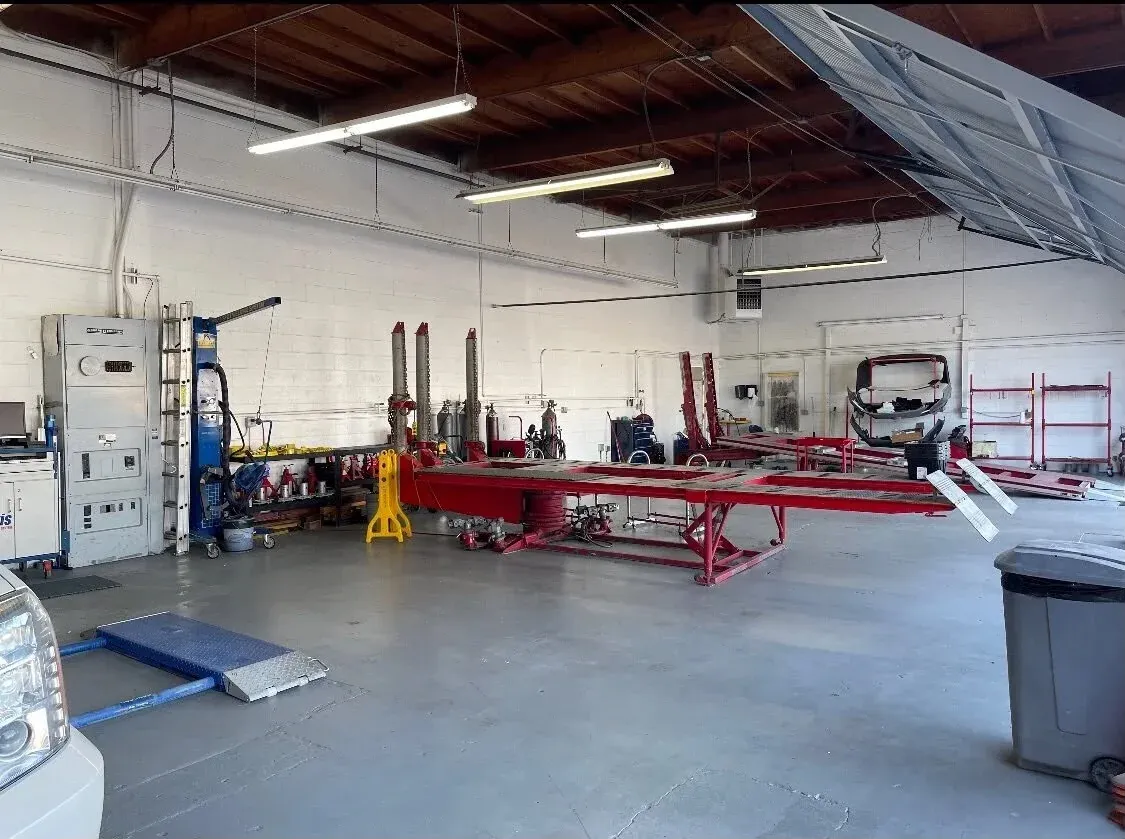
What the bench does is simple to say: the car is clamped at its pinch welds, dozens of factory reference points are read against the manufacturer’s specifications, and hydraulic towers pull in measured stages until the numbers agree. Where a rail has folded past pulling, that length is cut out at the manufacturer’s joint and new steel welded in with the corrosion protection restored — never heated back into shape, because the high-strength grades in modern rails and pillars do not tolerate it.
Many of the cars in Oakville’s driveways add aluminum panels and some aluminum subframes to the picture. Those pieces are handled with dedicated tools on their own terms — aluminum does not spring back, and a section bent twice cracks — so the call is more often replace than pull. When the structure is true, the mechanical parts and panels go back on, the alignment is set, and any ADAS recalibration the car may require comes last.
Getting a bent car from Oakville to North York
A car with structural damage usually cannot be driven, which makes the 50 kilometres a logistics job rather than a drive. You choose where the tow goes under Ontario’s rules; ask for Sheppard and Don Mills, beside Fairview Mall, and we give the operator a drop-off window. The expensive detour is the Halton storage yard: a car released to the nearest yard after a QEW crash is billed storage by the day while the paperwork catches up, and a week of phone tag can quietly cost more than the second tow. That second leg is worth arranging on the first call, and on a not-at-fault claim the towing and storage normally form part of the claim.
Our estimator writes the estimate from photos and the first measurement, opens the file with your insurance company, and gives you the position early: a bent unibody on a car of modest value can reach the point where repair cost plus salvage exceeds its actual cash value, and the insurance company declares a total loss. There is no fixed percentage in Ontario; it is a calculation, and we walk you through it in English or Mandarin so you can decide whether to press for a repair. If the repair goes ahead, the rental your coverage allows runs through the job, and the car is measured again before you see it.
Questions people ask
The alignment shop in Oakville says the rear is out of spec after the crash. Is that frame damage?
Often, yes. Rear toe or thrust angle that cannot be adjusted back usually means a rail or a suspension mounting point has moved. Send the alignment printout with your photos; it tells our estimator roughly what moved and whether a structural measurement is warranted before any body work is written.
Will the car be safe after straightening, or should I push for a total loss?
A structure measured back to specification, with damaged high-strength sections replaced rather than heated, is as sound as the factory intended. The total-loss decision is financial, not a safety verdict: it turns on the car’s cash value against repair cost and salvage. Our estimator gives you both numbers so you can decide with the insurance company.
Does the lease company need to know the car had structural repair?
Read the lease. Most require repairs to be done to manufacturer standard and disclosed at return, and a proper measured repair with documentation satisfies that. What causes trouble is an undocumented straightening that leaves panel gaps off; the return inspector will find those, and the chargeback is worse than the disclosure.