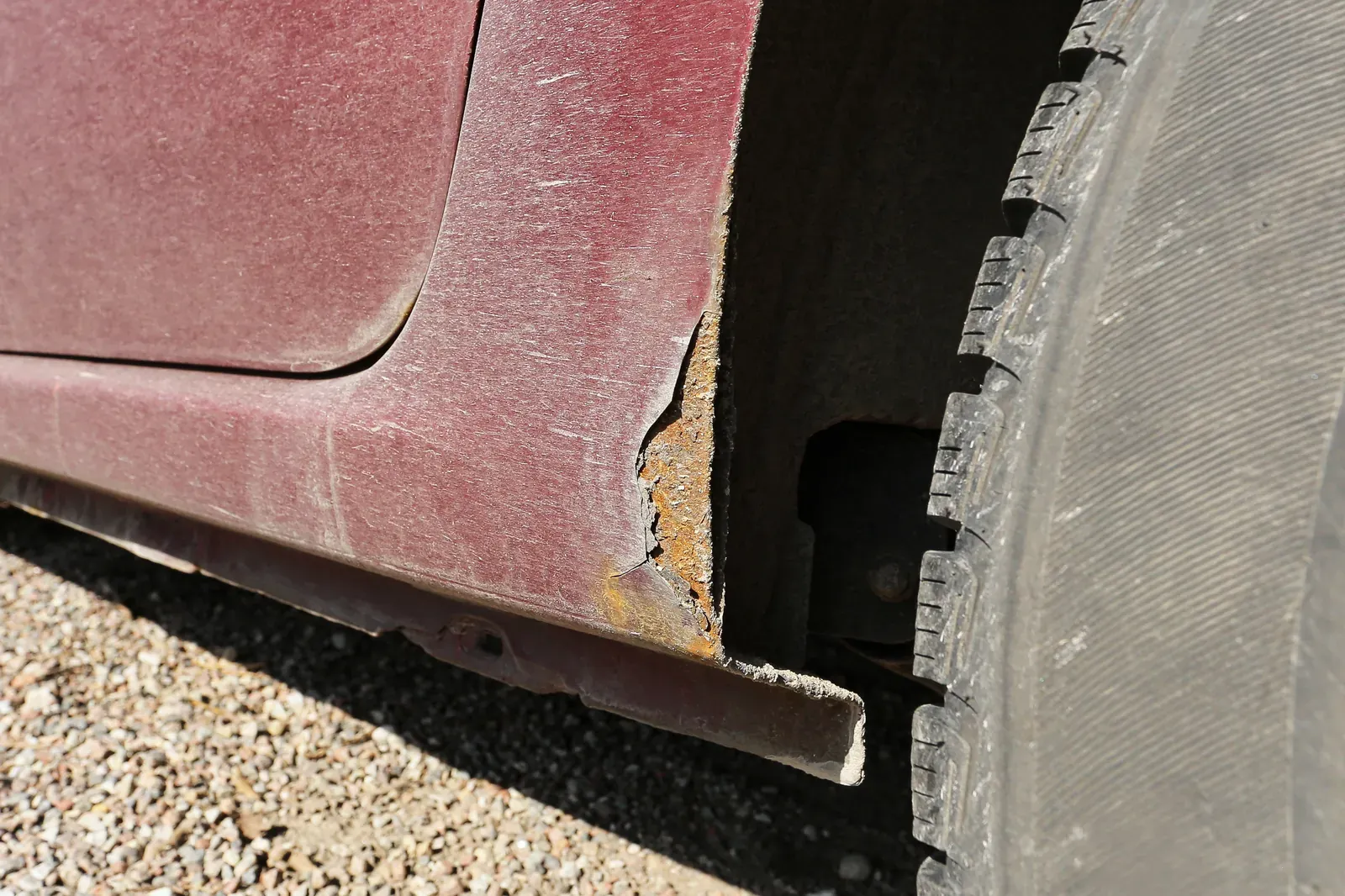
Salt from the airport lands down to Lakeshore
Mississauga’s highways are salted as hard as any in the province. The 401 through the airport lands, the 403 across the middle of the city and the QEW along the bottom get brine before a storm and rock salt during it, and a car commuting daily between Meadowvale and the 427 spends four months with that mixture packed into the rockers, the rear wheel arches and the doglegs ahead of the rear wheels. It sits in the seams, holds moisture through the freeze-and-thaw of February and March, and works from the inside out, so the first bubble appears on the paint long after the steel behind it has gone.
Street parking makes the south end worse. Port Credit, Lakeview and Clarkson keep a lot of cars outdoors on narrow streets off Lakeshore, where the windrow from every plough pass holds slush against the rockers instead of letting it drip off in a garage. At the north end, vehicles left in the open lots around Pearson — long-term parking, the rideshare fleet — sit outdoors, wet and salted, for days at a time.
Rockers, arches and the dogleg
Rust follows the water. The rocker panel under each door is the first casualty — it is a closed box that fills from the drains behind the wheel and rots from the bottom edge. The rear wheel arch comes next, because the inner and outer panels meet in a seam that traps grit, and the bubbles show along the lip where the fender folds inward. The dogleg — the curve of the quarter panel just ahead of the rear wheel — collects everything the tire throws at it. On trucks and older SUVs the cab corners and the bottom of the tailgate join the list.
A repair is a repair, not a cover-up. Surface rust that has not perforated is ground to clean steel, treated, primed and refinished. Where the steel is gone, the panel is cut back to solid metal, a new section is welded in — a rocker patch or a full replacement rocker, an arch repair section — the welds are ground, the seams are sealed inside and out, and the panel is primed, painted and blended. Sanding over a hole and filling it is not on the menu, because it comes back by the next spring, and a lifetime warranty on paint means the metal underneath has to be right.
- Bubbles with no hole: ground to clean steel, treated, primed, refinished
- Perforated rockers and arches: cut back, new steel welded in, seams sealed
- Inside of the repair coated so the salt has nowhere to sit next winter
- Panel refinished and blended, with the lifetime paint warranty behind it
A non-claim job, planned for one trip
Rust is almost never an insurance claim — it is wear, and it comes out of your pocket — so the decision is a plain one about the car. Our estimator will tell you from the photos whether the repair makes sense: a well-kept car with one rotten rocker and years of life ahead, yes; a car whose floor pans and subframe mounts are going at the same time, probably not. Where it does make sense, the estimate names the repair type — surface, patch, or full section — so you know what the drive is buying.
A rust job is best done once the salt is off the roads, when the car can leave the shop into dry weather. It usually takes longer than a paint repair because of the welding and sealing, so a Mississauga owner should plan the drop-off around a week when the car is not needed, and there is no rental coverage to lean on for a non-claim repair. The pickup on the 401 is the one trip you make, and a good time to ask about coating the underside before next winter.
Questions people ask
The car sits in Pearson long-term parking for two weeks at a stretch every winter. Does that speed the rust up?
It does, more than the driving. A car that goes into the lot salted and wet never gets the dry-out a garage gives it — the slush packed behind the arch liners and along the rocker seams just sits there working for the whole trip. The cheapest fix is a rinse of the arches and underside before you fly, and photos of the rockers when you get back tell us whether anything has started that is worth catching early.
The underseal on my ten-year-old van is peeling off in sheets. Repair it or leave it?
Deal with it — peeling underseal is worse than none, because moisture gets behind the loose sections and sits against the steel where you cannot see it. The loose coating is stripped back to sound material, any rust that started underneath is treated or cut out, and the area is re-coated. If the steel under the peel is still clean, it is a small job; the photos from underneath usually show which you have.
Is it worth fixing rust on a ten-year-old commuter?
If the rest of the car is sound, often yes — a rocker and an arch on a car you plan to keep for several more winters is cheaper than replacing the car. If the rust is also in the floor, the strut towers or the subframe mounts, we will say the car is past it. Photos of the rockers from underneath and the arches from behind the wheel are enough to answer that properly.