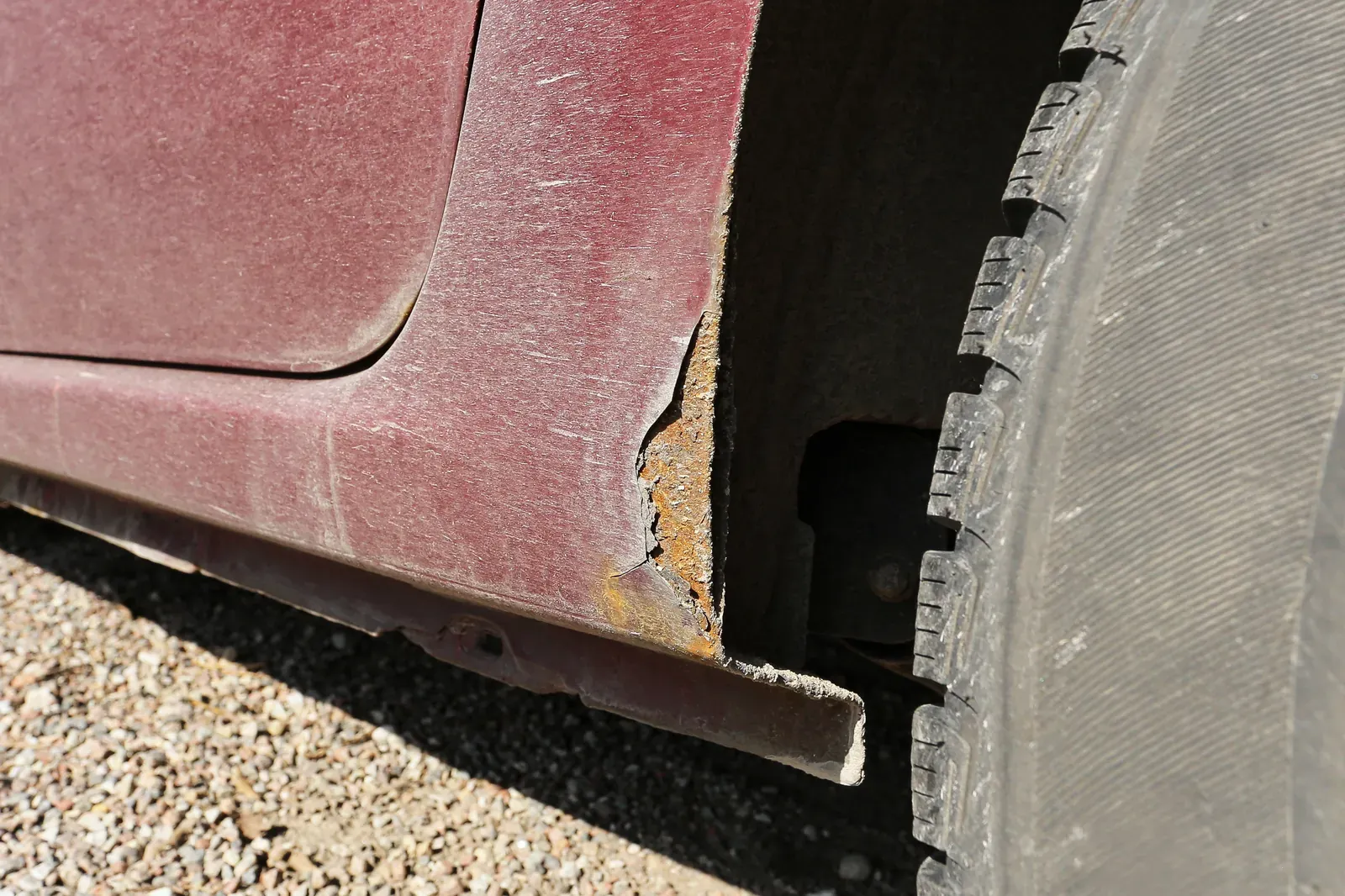
Brine on the concession roads and a truck that never gets washed
Concord’s rust problem is two problems stacked. The first is the salt: Highway 7, Dufferin, Centre and the concession roads out to the 400 are brined before every storm from November to March, and the freeze–thaw weeks of February and March push that brine into every seam it can find. The second is the vehicle. A pickup or a cargo van that works six days a week is washed when someone has time, which is rarely, and it parks outside in a yard where the slush on its rockers stays frozen until April, then melts into the seams. A family car in a townhouse garage off Centre has the opposite trouble: a warm garage keeps salt working all winter.
The gravel trucks make it worse. Stone off a loaded tandem chips the lower doors, the rockers and the front of the rear arches, and each chip is a spot where paint no longer stands between salt and steel. Two winters on, the chip has a rust ring; four winters on, the rocker is soft.
Cab corners, rockers, doglegs and the van door bottom
What rusts in Concord is the working fleet. Pickups go at the cab corners, along the rockers, at the lower rear arches and on the tailgate seam. Cargo vans go at the rockers, the dogleg ahead of the rear wheel, the bottom edge of the sliding door and the seams of the rear doors where the drain holes clog. Older cube vans rust where the box meets the cab and along the step. Mechanically these trucks have years in them; it is the body that is giving up first.
Then there are the cars on the townhouse streets — the ten-year-old sedan that has done the Highway 7 commute since new and is now handed down, with bubbles on both rear arches and a rocker that flexes when pressed. Location decides the outcome. Panels and rockers are repaired routinely with a predictable result. Once rust reaches a spring perch, a frame rail, a subframe mount or the floor under a seat, the question stops being paint and becomes safety — and on a vehicle that needs a Safety Standards Certificate before it can be sold, structural rust is a common reason it fails. We tell you which side of that line you are on before quoting.
A repair holds only when the rot leaves with a margin of clean steel
Doing it properly means the rust leaves the vehicle. We cut the rotten section out to bright steel with a margin, fit a patch or a full rocker or cab-corner section, weld it, dress the weld and seal every seam on both faces of the panel. Epoxy primer seals the bare metal before any shaping, and cavity wax or underbody coating goes inside the rocker and the arch, where the next rust would start. Then colour, blended into the panel, under the same lifetime paint warranty as everything else we refinish.
The short version — grind, skim filler, spray — is why rust comes back through a repaired panel in one winter, and we do not sell it. Rust is wear rather than a loss, so no policy pays for it; the estimate is a cash figure written against the vehicle’s value and the working years it has left. A fleet can rotate trucks through one at a time so the yard stays whole, and when a panel is beyond saving or a truck is not worth the hours, our estimator says so from the photos and saves you the trip east.
- Rotten steel cut out with a margin, new section welded in
- Bare metal sealed with epoxy before any shaping
- Cavity wax and underbody coating inside the rocker and arch
- A straight no from the photos when the panel is past it
Questions people ask
The rocker on our work van is soft when I press it. Is it still repairable?
Usually yes, if the softness is in the rocker itself and has not spread into the floor or the pillar behind it. A soft rocker means the inner structure has gone as well as the skin, so the repair is a section replacement rather than a patch, and the inside is coated afterward. Send a photo of the outside and one from underneath with a light, and our estimator tells you which it is.
Our cube van is rusting where the box meets the cab. Why there first?
That seam catches everything the front wheels throw — salt spray, stone, water — and it flexes constantly as the box and cab move on their separate mounts, so coatings crack there before anywhere else on the vehicle. The repair is the same cut-and-weld as a rocker, plus proper seam sealing and coating on the inside faces. If the rust has moved from the sheet metal into the box floor’s framing, that is a bigger conversation, and the photos usually show which one you are having.
Can we get the underside of the fleet coated so this stops happening?
Yes, and it is the right question. The rocker and arch we repair are coated inside and underneath as part of the job. For the rest of the fleet, an underbody treatment every autumn is the cheapest thing you can do to slow salt down, and rinsing the undersides after a storm is the second cheapest. Neither is a guarantee; both are the difference between one rocker repair and one every few years.