Kia’s own words: scanning is “an essential task”, so the estimate should show it
If you drive a Sportage or a Seltos and someone tells you a scan is an optional extra, Kia disagrees in writing. Its scanning position statement says pre-repair and post-repair scanning “should not be considered an option, but rather as an essential task”, at the estimate and again when the repair is done. Kia’s reasoning is that a stored trouble code does not always switch on a warning lamp, so a car that looks fine after a minor bump can still be carrying a fault.
In practice, the first scan shapes the estimate. It tells the person writing it whether a parking-sensor module, a radar unit or an airbag circuit logged anything during the hit. The final scan is the check that the car leaves with a clean report, which matters most after jobs where connectors were unplugged and harnesses moved to get panels off.
Kia’s statements are written by Kia America and are reproduced for Canadian repairers on oemrepairinfo.ca. They do not have the force of Ontario law, yet they are persuasive when a scan charge on a scuff-sized estimate gets queried.
Why Kia warns against salvaged panels, and why that warning lands harder in the GTA
Kia America’s body-parts statement takes a firm line for its own cars: it says Kia cannot recommend aftermarket body or structural parts, or parts taken from salvage vehicles. Ontario sets no matching rule, and an insurance company here may still price an estimate with non-Kia or used parts it treats as equivalent. The two positions sit side by side: the insurance company sets what it pays, and Kia’s statement is the evidence a shop brings to that discussion.
The reasons Kia gives for distrusting salvage parts are very familiar to anyone who has looked under a car in a Scarborough dismantler’s yard. A used panel may carry earlier accident damage, a previous poor repair, aftermarket pieces fitted by someone else, or corrosion, including corrosion from road salt. A recycled Telluride door that spent five winters on salted 401 lanes can look tidy on the outer skin and be blistering along the bottom hem and inner seam.
Warranty is the other piece. Kia America’s genuine-parts material says its factory and parts warranties apply to Genuine Kia parts only, not to aftermarket or remanufactured ones; for a Canadian car, your Kia Canada warranty booklet is the document to check. On a newer Kia still inside its coverage, that is often the strongest reason to ask for Kia parts on the lines that matter.
- Ask which lines on the estimate are written as aftermarket, recycled or Kia.
- For anything structural or sensor-bearing, ask for a Kia part and the reason in writing.
- If a recycled panel is used, ask whether its inner seams and lower edge were inspected for salt corrosion.
- Keep the final invoice that lists part types; it matters if a warranty question comes up later.
Drive Wise sensors sit behind the bumper, so a refinish is never just a refinish
Drive Wise is the label Kia puts on its driver-assistance suite: forward collision-avoidance, lane-keeping, smart cruise, blind-spot monitoring and parking sensors, depending on the trim. Many of the parts that make them work live behind the very bumper cover that takes the hit in a parking-lot reversal or a slow rear-end on Don Mills Road.
Whether a calibration is needed after the repair depends on what was disturbed, and I-CAR keeps a Kia ADAS reference that lists the calibration triggers for each Kia system. A removed and refitted bumper cover, a replaced radar bracket, a new windshield or a changed alignment can each appear on that list. A cover that is repaired and repainted in the radar zone also needs care, because heavy filler or extra paint film in front of a radar can affect its reading. None of that means a calibration is certain; it means the repair plan checks Kia’s triggers instead of assuming.
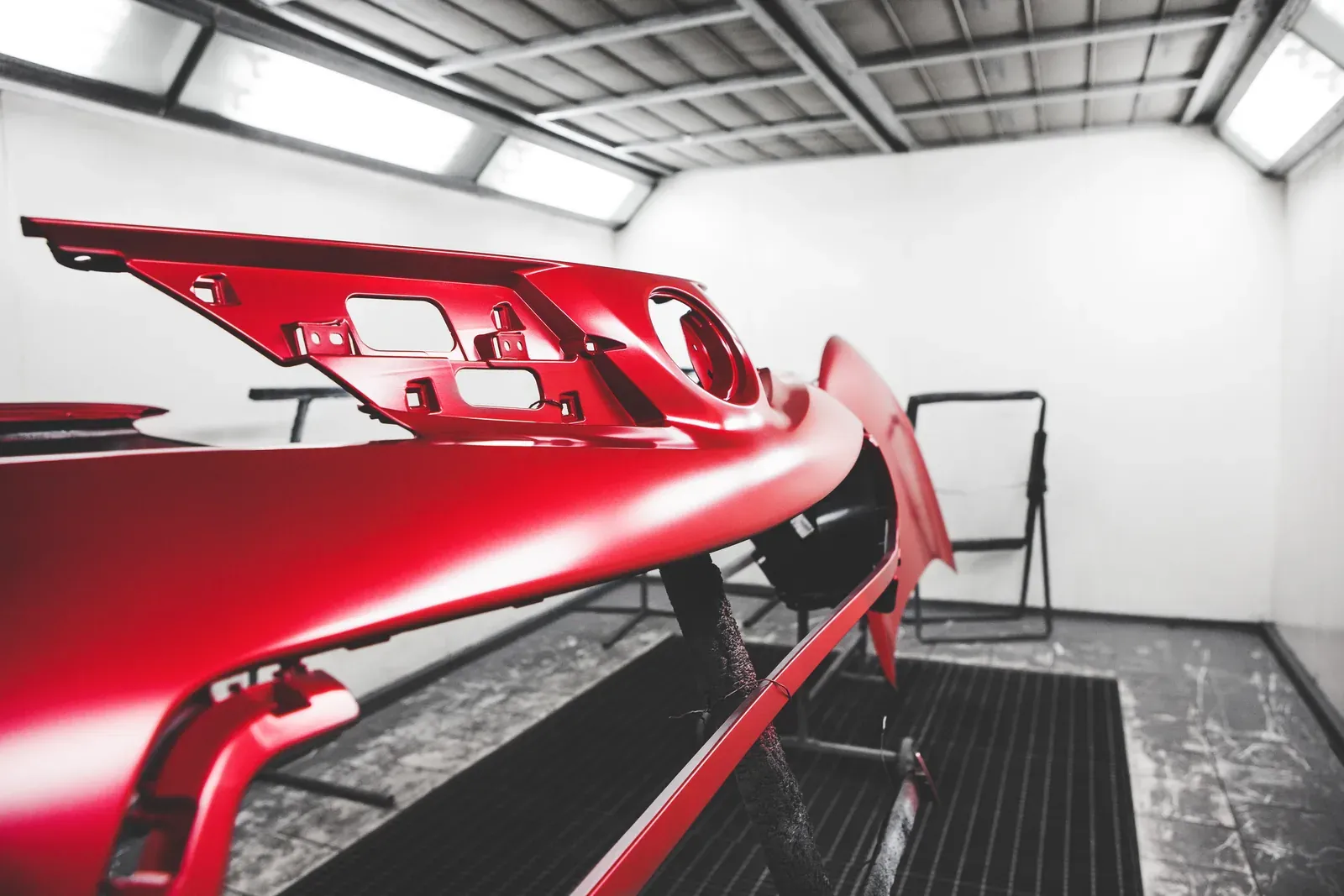
Colour adds its own step. A Kia bumper cover is usually painted complete as a part, and on metallic and pearl colours the neighbouring fender or quarter is often blended so the plastic’s slightly different texture does not show as a colour step under the parkade lights.
The EV6 follows its own repair information, not a borrowed rule from another car
An EV6 gets its panels removed much like a gas Sportage; what changes is everything around high voltage. Before cutting, grinding or welding, the battery circuit is isolated and checked as Kia’s EV6 procedure directs, and a hit low on the sill or underbody leads to a battery-area inspection before anyone signs off on the estimate.
Paint curing is where we are careful about what we do not know. We have seen published heat limits for some electric models, but we do not assume those figures carry over to the EV6. The booth setting for an EV6 comes from the EV6’s own repair information on the day of the job, and if that information calls for a lower cure or for painting parts off the car, that is how it is done.
We hold no Kia certification or factory approval and do not suggest otherwise. What we do is read Kia’s published procedures and position statements and build the estimate around them, and we can go through that estimate with you in English or Mandarin.
Questions people ask
The estimate for my Sportage lists a used door from a salvage yard. What are my options?
You can ask for a new Kia door and cover the price gap, and the shop can reject a salvage door that turns out to be rusted along the hem, previously damaged or badly repaired. Kia’s body-parts statement, which warns about salt corrosion and prior damage on salvage parts, is useful support in that conversation.
Does an aftermarket bumper cover affect my Kia warranty?
Kia America says its factory and parts warranties cover Genuine Kia parts only, so an aftermarket or remanufactured part is outside that coverage. For the exact terms on a Canadian car, check your Kia Canada warranty booklet or ask a Kia dealer.
Is a scan really needed on a Seltos with only a scuffed bumper?
Kia’s position is that it is. Its statement says scanning is an essential task even after repairs that look minor, because a code can be stored without a warning light.
Where can I read Kia’s position statements myself?
Kia America’s statements on scanning and body parts are published for repairers, and copies are posted for Canadian shops on oemrepairinfo.ca. Bring a copy to the counter if you want to go through it together.