The price follows how long the metal takes to move back, and size is only the start
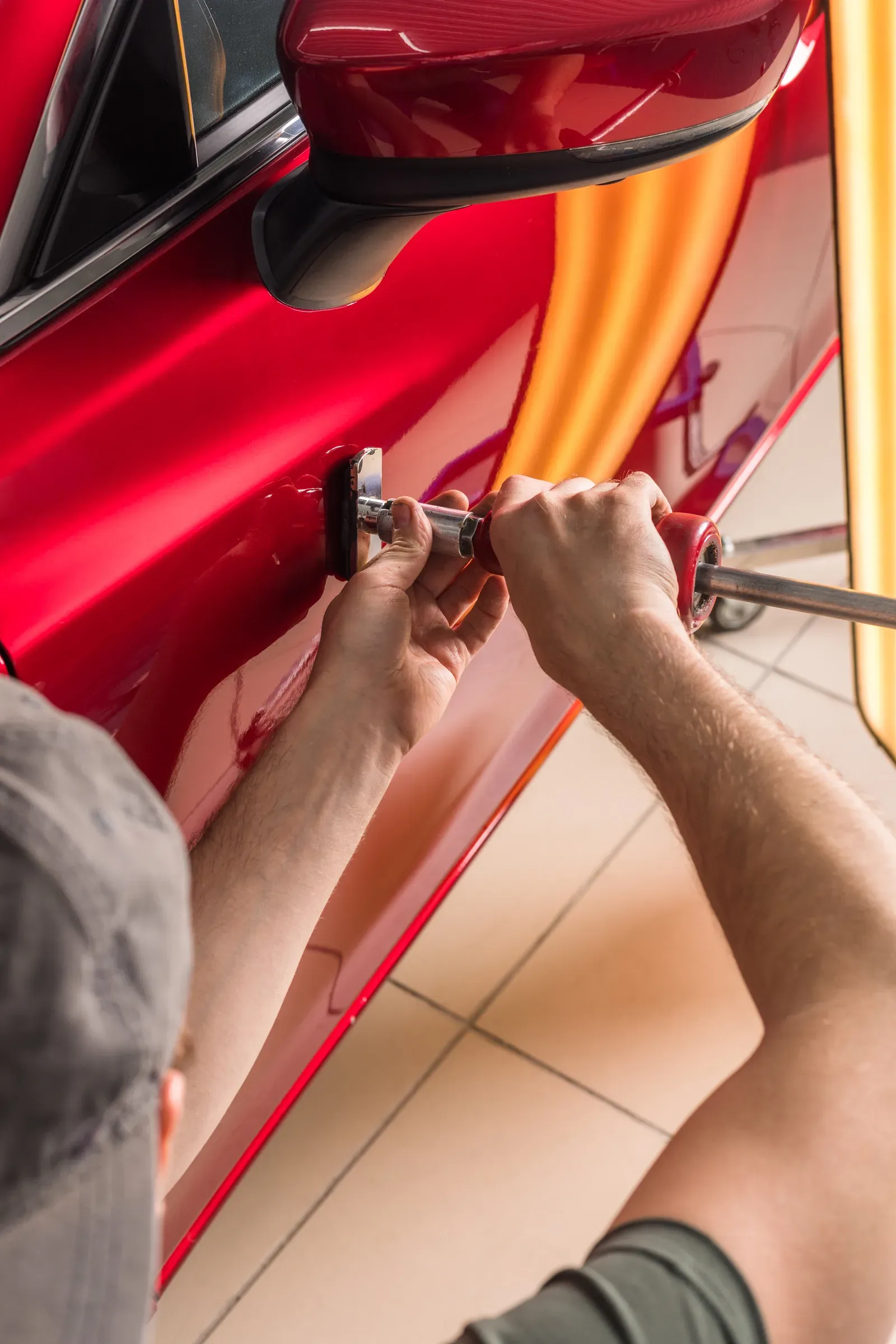
A paintless dent technician works the dent out from behind with long rods, or pulls it from the front with glue tabs, in many small, controlled pushes while reading the panel under a light board. The cost of the job is mostly that time. A shallow, round dent the size of a coin in the middle of a door can come out quickly. A dent the same width but deeper, or with a sharp centre, takes much longer because the metal has been stretched more and has to be coaxed back without leaving a high spot.
Depth and sharpness often matter more than diameter. A wide, soft dent from a leaning shopping cart is usually easier than a small, sharp one from a door edge in a tight parking space. If the paint is cracked or the metal has a crease too sharp to recover, paintless repair is no longer the right method and the job is priced as conventional dent repair with paint.
Body lines, panel edges and braces make the same dent harder
Where the dent sits changes the price as much as its size. Dents on a styling line, the sharp crease running along many doors and fenders, are among the hardest to repair because the line has to come back crisp and straight. Dents near the edge of a panel, where the metal is folded over or doubled, are stiffer and harder to move. Dents on roof rails or close to the edge of a hood or trunk lid can sit over a structural brace that blocks the tools.
Access is the hidden factor. To reach behind a dent, the technician may need to lower a headliner, remove an interior door panel, take out a taillight or pull back a wheel-well liner. That removal and refitting is part of the price. Where the back of the dent cannot be reached at all, the technician switches to glue tabs on the outside, which usually needs more pulls to reach the same finish.
- Flat area in the middle of a door or fender: usually the simplest to price
- On a body line or crease: more time, and some lines cannot be fully restored
- Near a hemmed edge or over a brace: stiffer metal and blocked access
- Roof and roof rails: access often means lowering the headliner
Aluminum panels cost more to work than steel
Many hoods, fenders and some full bodies are now aluminum, including recent Ford F-150 trucks and a number of SUVs and electric vehicles. Aluminum is softer than steel, yet it has little elastic memory, so a push that goes too far stays there; it also work-hardens under the tool and may split if the same spot is worked repeatedly. That means slower work in smaller steps and more care around the edges of the dent.
Technicians usually price aluminum higher for the same size of dent, and some dents that could be fixed on steel may not be a good candidate on aluminum. In cold weather, the panel is often warmed before it is worked, which applies to both metals but matters more on aluminum.
Several dents, or a hail storm, are priced by panel
A single door ding is priced as a single repair. Several dents on one panel are usually priced together for that panel, and each additional dent adds less than the first, because the setup and access have already been done. Hail damage is the extreme case: dozens of dents across a hood, roof and trunk are counted and sized per panel, and the estimate is built from those counts.
Summer thunderstorms across the GTA occasionally bring hail, and that damage falls under comprehensive coverage with your deductible. Single dents from mall parking lots, carts and doors are usually small enough that drivers pay for them themselves rather than claim, because the cost is often close to or below a typical deductible. A dent caused by another driver you can identify is a different situation and worth a conversation with your insurance company.
Why paintless repair usually costs less than repainting the panel
A conventional dent repair has more steps: straightening, filler, sanding, primer, colour, clear coat and often blending onto the next panel to hide where the new paint ends. Each of those adds labour and materials, and the car needs booth time and cure time. Paintless repair skips all of that, which is where the saving comes from.
It also keeps the factory finish on the car, which matters for lease returns and for resale. If an earlier repair left the panel with filler or a heavy layer of refinish, paintless methods may not suit it, since that thicker coating tends to fracture as the metal underneath is pushed. Our estimator looks at the panel’s paint history and the dent together before quoting, so you know whether paintless repair is realistic and what it will involve before any work begins.
Questions people ask
Why does a small sharp dent cost close to what a bigger round one costs?
A sharp dent stretches the metal into a tight point, and bringing that point back without a high spot takes many careful pushes. A larger round dent spreads the stretch over more metal and often comes out faster.
Is paintless dent repair priced per dent or per panel?
A single dent is priced on its own. When there are several on the same door or fender, the panel is usually priced as one job, because the access work is done once.
Will my insurance company pay for paintless repair after a hail storm?
Hail falls under comprehensive coverage, and paintless repair is a common method on hail claims when the paint is intact. You pay your comprehensive deductible, and the adjuster approves the dent count and method.