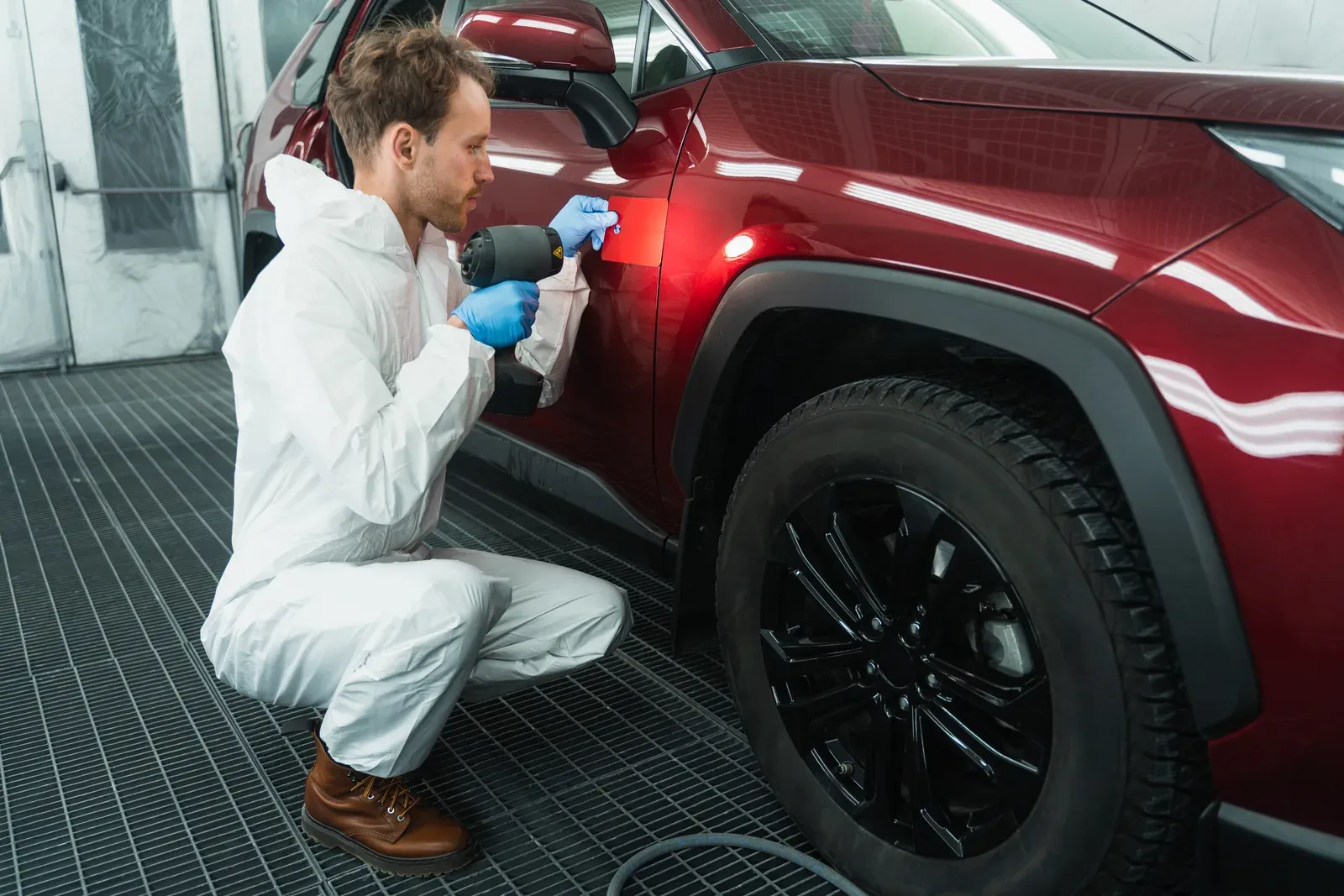
A tri-coat colour carries an extra layer, and every layer is booth time
Most cars wear a two-stage finish: one basecoat holding the colour and a clear on top. A tri-coat adds a third coat in the middle. First comes a ground coat, usually an opaque white or a solid colour. Over it goes a mid-coat that is mostly transparent and loaded with pearl or mica particles, which give the colour its glow and its shift from warm to cool as you walk around the car. Then the clear seals everything.
The extra layer is not just one more pass of the gun. Each coat has to flash before the next goes on, the mid-coat has to be applied with a very even hand, and the whole stack is thicker than a two-stage finish. That means more material, more time in the booth and more chances for the painter to have to stop and correct. Well-known examples on GTA roads include Toyota’s Wind Chill Pearl and Honda’s Platinum White Pearl, but tri-coat reds and some deep blues are built the same way.
The let-down panel is extra work done before the car is touched
With a normal colour, the painter mixes to the paint code, checks one spray-out card against the car and moves on. With a tri-coat, the colour changes with every pass of mid-coat, so a single test card cannot tell the painter enough. The answer is a let-down panel: a long test card sprayed with the ground coat, then stepped in strips with one, two, three and four passes of pearl, and cleared.
The painter holds that panel against the car in daylight-corrected light and finds the strip that matches the panel beside the repair. That number of passes becomes the recipe for the job. Making the let-down panel takes material and a full spray-and-dry cycle of its own, and on a car whose pearl has aged in the sun for years it sometimes takes two attempts with an adjusted ground coat. None of that time is visible on the finished car, but it is the reason the match works.
Pearl white is translucent, so the blend has to travel further
Because the mid-coat is see-through, its depth is part of the colour. A shade thinner and the white looks flatter and cooler; a shade heavier and it looks creamier. Even with a perfect let-down, the painter cannot stop at a hard edge without the difference showing. The fix is a wider blend: colour and pearl are faded across more of the neighbouring panel than they would be on a two-stage silver or black, and sometimes into a second panel along the side.
Bumper covers on these colours are painted complete as a part, and the fender or quarter beside them often has the colour faded into it, so the plastic’s slightly different surface does not show up as a step in shade at the seam. That is one more panel prepared, masked and cleared, and it is the main reason a small corner repair on a pearl white car costs noticeably more than the same repair on a solid colour.
- Ground coat sprayed and flashed across the repair.
- Mid-coat applied in the pass count the let-down panel called for.
- Pearl blended out across a wider area of the next panel.
- Clear applied over the full repaired and blended area.
Where the extra cost appears on your estimate
On a written estimate you will usually see a three-stage refinish allowance on top of the normal refinish hours for each panel, extra material for the additional layer, and blend lines on panels that were not damaged. The estimating systems used by shops and insurance companies in Ontario recognise three-stage paint as its own operation, which is why these lines exist. They are a known part of the job, and an adjuster expects them on a tri-coat car.
If the repair is going through a claim, the insurance company pays to restore the colour the car left the factory with; a pearl white owner is not upgrading anything by asking for a proper tri-coat repair. If you are paying yourself, ask any shop quoting the job whether its number includes the let-down panel and a three-stage refinish. A quote that seems light on a pearl colour often treated it as two-stage, and the shortcut shows as soon as the car is parked next to an unrepaired one in the same white.
Small chips on pearl colours are harder to hide than people expect
Owners of these colours notice it first with stone chips from the 404. A touch-up pen holds a single colour, and on a tri-coat it cannot reproduce the ground coat, the pearl and the clear in the right depth, so the dab often looks greyer or yellower than the paint around it. That is not a sign the pen is the wrong code. It is the limit of putting a three-layer colour on in one stroke.
For a cluster of chips on a pearl hood, the choices are living with them, careful chip filling in layers, or refinishing the panel. If the car is new and spends its winters on the highway, a clear protective film on the leading edges is worth considering early, because it is far cheaper to protect a tri-coat nose than to repaint one.
Questions people ask
How can I tell whether my white is a tri-coat?
Check the paint code on the label in the driver’s door jamb and the colour name. Names with pearl or crystal in them are often tri-coat. A dealer or a body shop can confirm it from the code or the vehicle identification number.
Will my insurance company cover the extra cost of a three-stage refinish?
On an approved claim, yes: the estimate is written for the colour the car has, and three-stage refinish is a standard operation adjusters see regularly. Your deductible stays the same whatever the colour.
Why did my pearl white touch-up pen dry darker than the car?
The pen puts the colour on as one layer, while the factory built it from a ground coat, a translucent pearl coat and clear. Without that layering the chip reads as a slightly different white from most angles.
Are tri-coat reds as expensive to repair as pearl whites?
They follow the same three-layer process, so they carry the same kinds of extra steps. Deep reds can be just as sensitive to the number of mid-coat passes, which makes the let-down panel equally important.