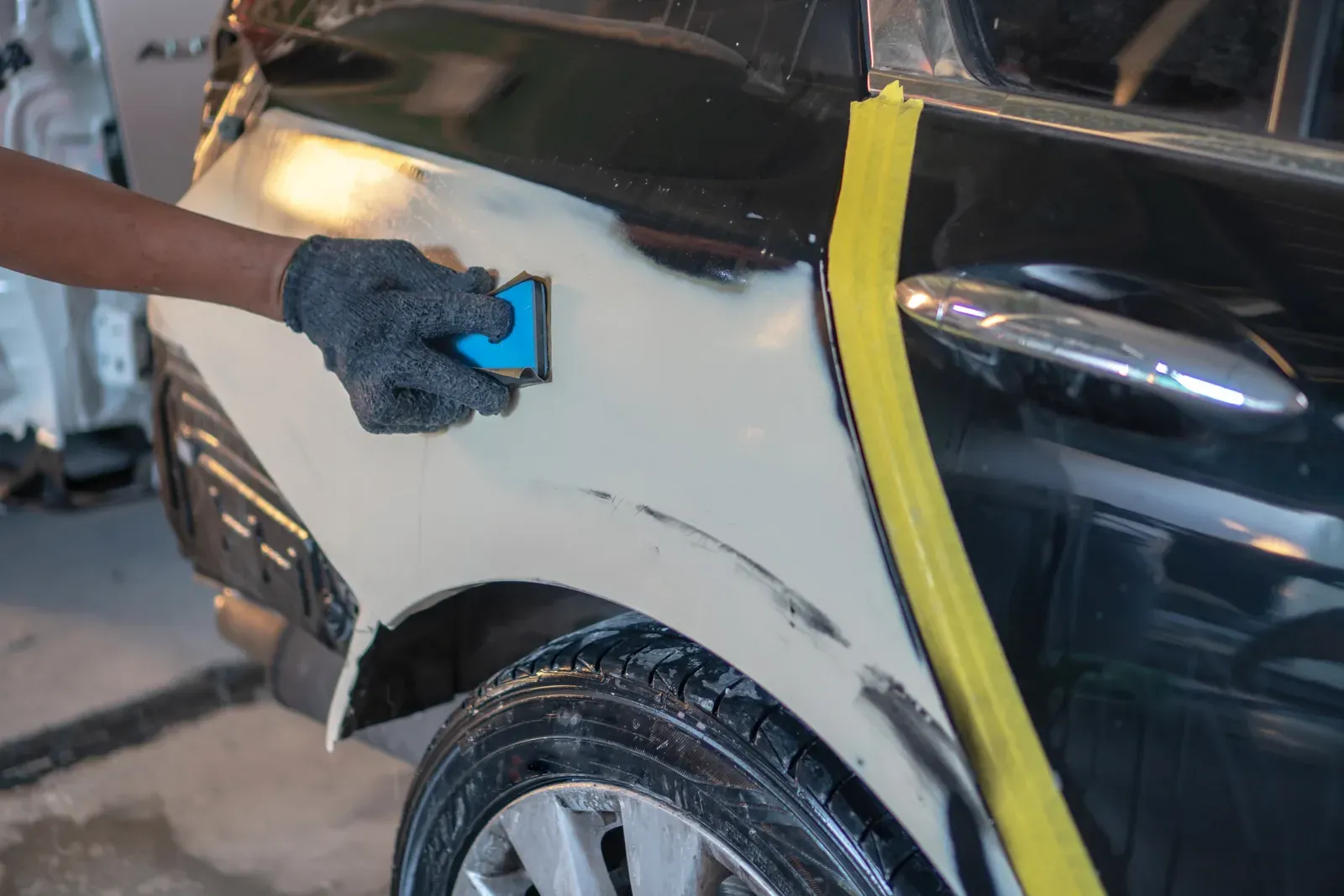
Most bad repairs announce themselves within a season or two
Plenty of disappointing repairs look fine on pickup day and then show their hand later. The first Toronto winter is often what exposes them. Freeze–thaw cycles flex a panel that was filled too thickly, and a hairline crack or a ring of tiny blisters appears where the filler meets the metal. Salt gets into a seam that was never sealed and rust bubbles up along the edge by March. A bumper cover that was glued instead of clipped starts to sag after a few car washes.
Other signs are there from the start if you know where to look. A colour step at the edge of a door that is obvious in afternoon sun. A texture on one panel that looks like orange peel beside a smooth neighbour. Fine lines in the clear coat that follow the direction of sanding, which means the primer was not finished before paint went on. Overspray on rubber seals, on the tire sidewall or on the chrome. Gaps that are wide at one end of a door and tight at the other.
- Hairline cracking or a raised ring around a repaired dent
- Sanding scratches visible through the clear coat in sunlight
- Paint mist on weatherstrips, trim or glass
- A panel that is a shade lighter or darker at a hard seam
- Warning lights or a driver-aid system that has behaved oddly since the repair
What a second shop can measure that you cannot see
A careful second look starts with readings, not opinions. A paint-thickness gauge run across the panel shows where the film suddenly goes from factory depth to many times thicker, which is how a shop finds heavy filler without grinding anything. A scan of the car’s modules shows stored fault codes from sensors that were unplugged or never recalibrated. If the first repair involved the structure, the car can go on a measuring bench and its control points can be compared with the manufacturer’s numbers, which settles whether a rail or apron was pulled back to where it belongs.
Our estimator then writes up what was found and what it would take to put right, in the same line-item format as any other estimate. That document matters more than any verbal impression. It is what an adjuster, the first shop, or, if it comes to it, a court will look at. Photos of the panel before anything is touched go into the same file.
Not every complaint ends in a full redo. A colour that is slightly off on a metallic can sometimes be corrected by blending the neighbouring panel. A dust-heavy clear coat can sometimes be wet-sanded and polished. A bumper that sits low may only need the correct brackets. The point of the assessment is to separate those from the jobs where the panel has to be stripped back to metal, and to tell you which one you have.
Who pays depends on how the first repair was paid for
When the original repair was part of an insurance claim, call the adjuster before anything is redone. The insurance company paid for a proper repair and generally wants to know when it did not get one. It may send its own appraiser to inspect, ask the original shop to correct the work, or approve another shop to do it. Redoing the repair first and asking for the money later makes that conversation much harder, because the evidence has been sanded away.
When you paid cash, start with the original shop. Most shops stand behind their refinish with some kind of written warranty, and giving them the chance to correct it is usually the fastest route. Put the request in writing and attach the photos and the second shop’s findings. If they decline or the relationship has broken down, you may end up paying the second shop yourself and then deciding whether the amount is worth pursuing. Under Ontario’s Limitations Act, most civil claims have to be started within two years of the day you knew, or reasonably ought to have known, about the defect, so keep the dates of every email and photo.
There is a third case that comes up more often than people expect: the car was bought used, and the poor repair belonged to a previous owner. There is usually nobody to send the bill to. A second shop can still tell you what is wrong and what it would cost, which is worth knowing before you decide whether to fix it, live with it, or factor it into a trade-in.
Taking over someone else’s work takes a little longer
A redo is slower than a fresh repair because the shop has to undo before it can do. Old filler is ground out, mismatched paint is stripped to a sound layer, and any wrong brackets or fasteners are replaced. Parts that were reused when they should not have been, such as one-time clips or bolts, are ordered new. Expect the estimate to say plainly which steps are removal of the previous work and which are the repair itself.
If the first job was structural and the measurements show it is still out, the redo is a safety repair before it is a cosmetic one. That is where the paperwork from the bench matters most, both for the claim and for your own peace of mind when the car is back on the 401.
Questions people ask
Will a second shop tell me the first shop did a bad job just to win the work?
A good one shows you readings and photos instead of adjectives. Ask to see the paint-thickness numbers, any scan codes and the measuring printout, and judge from those.
Can thick filler be left alone if it looks fine?
Sometimes it holds for years, but filler laid on too thick tends to crack with temperature swings. If the readings show a heavy layer on a panel you plan to keep, budget for it eventually.
Does the original shop have to be told before another shop works on the car?
Nothing obliges you to, but if you want them to pay or redo it, they need a chance to see the car first. Once the panel is stripped, their warranty argument usually ends.